Melena de León, Erizo y Langosta Silvestres
10 consejos en Recolección e Identificación Silvestre
Por Andrew Langevin · Fundador, Nature Lion Inc · Autor colaborador, Mushroomology (Brill, 2026)
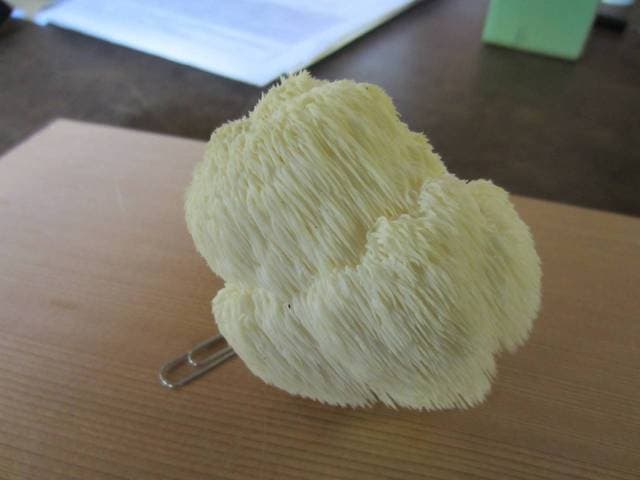
Norteamérica hosts four distinct wild Hericium species, each occupying a specific ecological niche and geographic range. Based on verified Mushroom Observer data, the combined observations total 52 across all four species, revealing clear regional patterns.\n\nNorteamérican Hericium species:\n\n- H. americanum (18 obs) — The diente de cabeza de oso fungus. Dominant in Eastern forests at Bald Mountain Recreation Area, Brown County State Park, Cayuga Nature Center, Cook Forest State Park, and Rochester\n- H. erinaceus (16 obs) — True melena de león. Verified at Bald Mountain RA, Baton Rouge, Brown County, Gainesville, Hampton, and Hawn State Park. The single-clump species cultivated commercially\n- H. coralloides (10 obs) — The diente de coral fungus. Found at Big Basin Redwoods, Bohemia Ecological Preserve, and Highway 24 areas. Branching coral-like structure\n- H. abietis (8 obs) — The PNW conífera specialist. Restricted to Breitenbush, Cascades Highway 12, and Gifford Pinchot National Forest. Grows exclusively on dead coníferas\n\nAll four species are choice edibles with no dangerous look-alikes, making Hericium one of the safest genera for beginning foragers. Look for them on dead or dying frondosas (or coníferas for abietis) from late summer through fall.
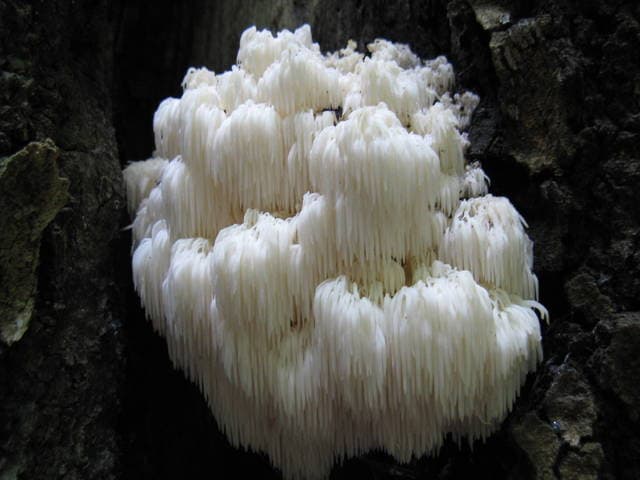
The four Norteamérican Hericium species differ in growth form, spine structure, and habitat — learning these differences will help you identify them instantly in the field. Based on verified Mushroom Observer data, each species has a characteristic appearance.\n\nSpecies comparison:\n\n- H. erinaceus (16 obs) — A single compact clump of long, dangling spines (1-5 cm). No branching. Looks like a white waterfall or beard hanging from the tree. This is the species sold commercially as \"melena de león\"\n- H. americanum (18 obs) — Branching structure with long spines (1-3 cm) hanging from the branch tips. Resembles a bear's paw with icicles. More open and branching than erinaceus\n- H. coralloides (10 obs) — Highly branched, coral-like structure with short spines (under 1 cm). The most delicately branched species, resembling white coral\n- H. abietis (8 obs) — Similar branching to americanum but found exclusively on coníferas in the Pacific Northwest. Spines are intermediate in length\n\nThe key field distinctions: If it is a single unbranched clump with long teeth, it is erinaceus. If it branches with long teeth on frondosa, it is americanum. If it branches with short teeth, it is coralloides. If it is on a conífera in the PNW, it is abietis. All are excellent eating — sauté in butter until golden brown.
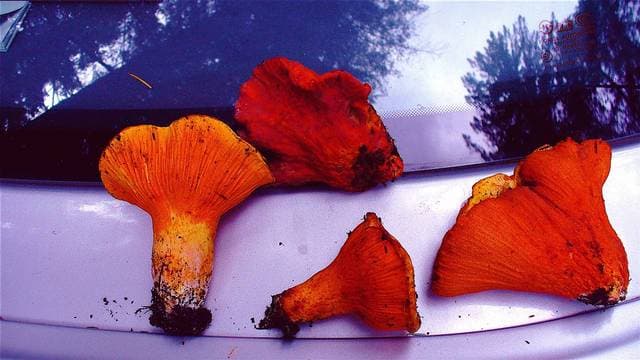
setas langosta are among the most commonly observed choice edibles in Norteamérica, with a wide distribution across both Eastern and Western forests. Based on verified Mushroom Observer data, Hypomyces lactifluorum has 47 confirmed observations — one of the highest counts for any edible species in the database.\n\nVerified seta langosta locations:\n\n- Northeast/Midwest: Brown County State Park, Algonquin Provincial Park, and multiple locations across the Great Lakes region\n- Pacific Northwest: Cascades region, with observations from Washington through Oregon\n- Northeast Canada: Emerald Lake State Park (Vermont), extending into Quebec and Ontario\n\nThe seta langosta is actually not a species of mushroom at all — it is a parasitic fungus (Hypomyces lactifluorum) that attacks and completely transforms Russula and Lactarius species into a firm, bright orange-red, seafood-flavored edible. The parasite covers the host mushroom so completely that the original gills are obliterated.\n\nFinding setas langosta requires finding their hosts. Look in forests with abundant Russula and Lactarius — typically under tsuga, picea, fir, and frondosas. Lobsters often fruit partially buried in duff, with just the orange-red cap visible at the soil surface. Brush away leaves to reveal the full specimen.
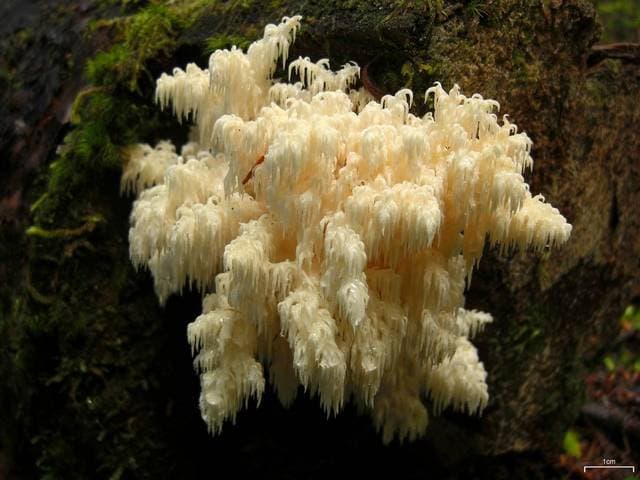
*Hericium abietis* is the Pacific Northwest's endemic melena de león relative, found exclusively on dead coníferas in the region's old-growth and mature second-growth forests. Based on verified Mushroom Observer data, it has 8 confirmed observations at Breitenbush, Cascades Highway 12, and Gifford Pinchot National Forest — all classic PNW conífera forest locations.\n\nKey characteristics of H. abietis:\n\n- Host trees: Dead or dying abeto de Douglas, western tsuga, picea de Sitka, and true firs. Never on frondosas\n- Range: Pacific Northwest from northern California through British Columbia. Centered in Oregon and Washington\n- Growth form: Branching structure similar to H. americanum, with intermediate-length spines\n- Season: septiembre through noviembre, coinciding with fall rains and rebozuelo season\n- Elevation: Sea level to approximately 1,500 meters, following the range of its conífera hosts\n\nThis species is often found high on standing dead trees (snags), sometimes 5-10 meters above the ground, making harvesting challenging. When accessible, it is an excellent edible with the same rich, slightly sweet flavor as cultivated melena de león. For PNW foragers, finding abietis is a reliable indicator of healthy old-growth forest ecosystems — the dead snags it requires are removed in managed forests.
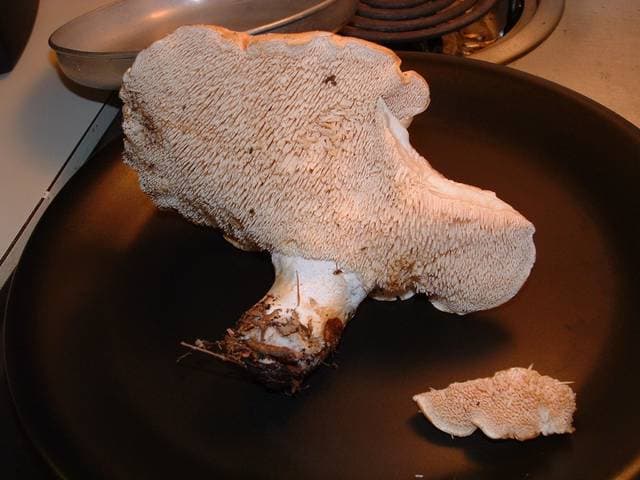
setas erizo are found across Norteamérica in two main species, both recognized by their distinctive tooth-like spines instead of gills. Based on verified Mushroom Observer data, Hydnum repandum has 7 confirmed observations and H. umbilicatum has 8 observations, with Cook Forest State Park emerging as a hotspot.\n\nHedgehog mushroom species and locations:\n\n- H. repandum (7 obs) — The large hedgehog. Verified at Cook Forest State Park (PA), Humboldt County (CA), Point Reyes National Seashore (CA), and Salt Point State Park (CA). Cap 5-15 cm, cream to pale orange\n- H. umbilicatum (8 obs) — The depressed hedgehog. Confirmed at Camp Sequanota (PA), Cook Forest State Park (PA), and Hickory Run State Park (PA). Smaller (2-6 cm), with a distinctive navel-like depression in the cap center\n\nCook Forest State Park in Pennsylvania is the standout location, hosting both species among its old-growth tsuga and frondosa stands. On the West Coast, the California coastal forests — Point Reyes and Salt Point — produce repandum under live roble and tanoak.\n\nHedgehog mushrooms are among the safest wild edibles because the toothed underside is unmistakable. No poisonous mushroom has the same combination of fleshy cap with hanging teeth underneath. Their flavor is mild, nutty, and slightly peppery when raw, mellowing with cooking.
seta langosta season spans julio through octubre across most of Norteamérica, with regional variation driven by rainfall and the fruiting schedule of their host species. Based on verified Mushroom Observer data compiled from 47 observations, clear seasonal patterns emerge by region.\n\nLobster mushroom peak seasons:\n\n- Northeast and Great Lakes: Late julio through septiembre. Peaks in agosto when Russula and Lactarius hosts are most abundant under tsuga and frondosas\n- Pacific Northwest: agosto through octubre. Later than the East, triggered by early fall moisture. Cascades locations peak in septiembre\n- Southeast: julio through agosto. Earlier start due to warmer temperatures and summer rain patterns\n- Northern Ontario/Quebec (Algonquin PP area): agosto through early septiembre, compressed by the shorter northern growing season\n\nThe seta langosta's timing is entirely dependent on its hosts. Since Hypomyces lactifluorum parasitizes Russula and Lactarius, lobsters only appear when and where these host fungi are fruiting. In practice, this means the conditions that produce good Russula flushes — warm soil temperatures plus adequate rainfall — predict seta langosta success.\n\nLook for them 5-10 days after soaking rains when temperatures are between 18-25°C. Productive sites often produce year after year in the same spots.
Yes — the Eastern US is the richest region in Norteamérica for wild Hericium species, with two species commonly found in deciduous forests. Based on verified Mushroom Observer data, H. americanum has 18 observations and H. erinaceus has 16 observations, both heavily concentrated in the East.\n\nEastern US Hericium hotspots:\n\n- H. americanum: Bald Mountain Recreation Area (MI), Brown County State Park (IN), Cayuga Nature Center (NY), Cook Forest State Park (PA), Rochester (NY). The most commonly encountered species in the East\n- H. erinaceus: Bald Mountain RA (MI), Baton Rouge (LA), Brown County SP (IN), Gainesville (FL), Hampton (VA), Hawn State Park (MO). Found across a wider latitude range\n\nThe best strategy for finding Eastern Hericium is to scout mature frondosa forests with standing dead or dying trees. Both species prefer haya, arce, and roble — especially trees with visible wounds or dead branches. Look 1-5 meters up on standing trunks, and check fallen logs as well.\n\nPeak season is septiembre through noviembre in most Eastern states, with southern locations (Baton Rouge, Gainesville) extending into diciembre. After the first fall rains, check your favorite haya groves weekly — Hericium micelio often produces from the same wound site across multiple years.
Each Hericium species has strong host tree preferences that make tree identification your best search strategy. Based on verified Mushroom Observer data, the tree associations across 52 total observations are remarkably consistent.\n\nHericium host tree preferences:\n\n- H. erinaceus (16 obs) — Primarily American haya (Fagus grandifolia) and roble (Quercus spp.). Also documented on arce, walnut, and sycamore. Prefers large wounds on living or recently dead trees\n- H. americanum (18 obs) — haya and arce are the dominant hosts. Also found on abedul, roble, and other frondosas. Often on fallen logs as well as standing trees\n- H. coralloides (10 obs) — haya is the strongly preferred host, though it occurs on other frondosas. In California, found on tanoak and other western frondosas at Big Basin Redwoods\n- H. abietis (8 obs) — Exclusively coníferas: abeto de Douglas, western tsuga, picea de Sitka, true firs. The only Hericium species that grows on softwoods\n\nPractical search strategy: Find a mature forest with large haya trees — especially trees with broken branches, old wounds, or standing dead trunks. Check these trees from base to crown in septiembre and octubre. Hericium micelio is saprotrófico (feeding on dead wood), so it colonizes wound sites and produces cuerpos fructíferos from the same location for several consecutive years.
Sustainable Hericium harvesting focuses on protecting the micelio network inside the host tree, which can produce cuerpos fructíferos for many years if the wood substrate remains intact. Since all Hericium species are saprotrófico rather than micorrícico, the micelio lives within the dead wood itself.\n\nSustainable harvesting guidelines:\n\n- Take only the cuerpo fructífero — Cut the mushroom at its base with a clean knife. Do not pull or twist, which can damage the micelio at the attachment point\n- Leave a small stub — Cut 1-2 cm from the tree surface rather than flush. This protects the micelial interface\n- Never damage the host tree — Do not strip bark, hammer nails, or break branches to access specimens. The wood structure protects the micelio\n- Leave some specimens for spore dispersal — If you find multiple fruitings on one tree, harvest no more than half. Spores from remaining specimens will colonize new wood\n- Avoid overharvesting productive trees — One harvest per tree per season is a reasonable limit for personal foraging\n- Mark productive trees — Record GPS coordinates and return next year rather than searching new areas\n\nThe greatest threat to wild Hericium populations is not overharvesting — it is habitat loss. Old-growth and mature forests with standing dead trees are the critical habitat. Supporting forest conservation and opposing the removal of dead standing trees (snags) does far more for Hericium populations than individual harvest restraint.
No — Hericium is one of the safest genera in the mushroom kingdom, with zero dangerous look-alikes. All four Norteamérican species are edible and choice, and no toxic mushroom shares their distinctive toothed or spined appearance on wood.\n\nWhy Hericium is so safe to forage:\n\n- Unique morphology: The combination of white, fleshy fruitbodies with hanging teeth or spines, growing on wood, is shared by no toxic species\n- All species edible: Even if you misidentify which Hericium species you have, every species in the genus is safe and delicious\n- No toxic toothed fungi on wood: While some toothed fungi exist on the ground (like Sarcodon and Hydnellum), none are dangerous and none resemble Hericium\n\nThe only possible confusion points:\n\n- Young coral fungi (Clavulina, Ramaria) — Some branching coral fungi on wood might superficially resemble young H. coralloides, but they lack the distinct hanging teeth. Most Ramaria species are edible or at worst mildly laxative\n- Between Hericium species — You might call your H. americanum an H. coralloides, but since both are excellent edibles, the stakes are zero\n\nThis is why Hericium is one of the top recommended genera for beginning foragers alongside rebozuelos, colmenillas, and bejines. The identification is straightforward, the look-alike risk is nonexistent, and the culinary reward is outstanding.
¿Necesitas más ayuda? Dr. Myco puede responder preguntas adicionales sobre melena de león, erizo y langosta silvestres basándose en miles de experiencias reales de cultivo.
Pregunta al Dr. MycoMás en Recolección e Identificación Silvestre
Fundamentos y Seguridad en la Recolección
10 consejos
Especies Comestibles Selectas
12 consejos
Especies Mortales y Tóxicas
14 consejos
Guías Regionales de Recolección
9 consejos
Guía de Identificación Visual
17 consejos
Identificación y Recolección de Chaga
10 consejos
Guía de Recolección de Colmenillas
10 consejos
Variedades de Colmenillas y Rebozuelos
10 consejos
Recolección en Norteamérica por Región
14 consejos
Guía de Recolección en Europa
12 consejos
Recolección en el Hemisferio Sur y Trópicos
10 consejos
Especies de Recolección por Temporada
12 consejos
Dónde Encontrar Setas Silvestres
15 consejos
Hábitats de Setas y Asociaciones con Árboles
12 consejos
Especies de Rebozuelo por Región
12 consejos
Especies de Colmenilla por Región
12 consejos
Pollo del Bosque y Cola de Pavo por Región
10 consejos
Setas Mortales — Dónde Crecen Realmente
10 consejos
Boletus Edulis, Trompeta Negra y Otras Selectas
10 consejos