Setas Mortales — Dónde Crecen Realmente
10 consejos en Recolección e Identificación Silvestre
Por Andrew Langevin · Fundador, Nature Lion Inc · Autor colaborador, Mushroomology (Brill, 2026)
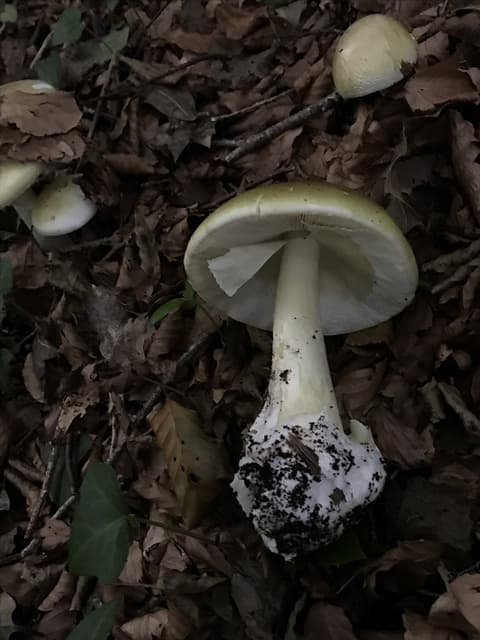
Amanita phalloides is concentrated in California, with a secondary range along the East Coast — it is not evenly distributed across the continent. Based on verified Mushroom Observer data, there are 31 confirmed observations, with a striking concentration in the San Francisco Bay Area: Canyon alone accounts for 10 observations.\n\nVerified A. phalloides locations:\n\n- California (dominant): Canyon (10 obs!), El Corte de Madera, El Dorado County, Albion, and multiple Bay Area locations\n- Oregon: Ashland and scattered Willamette Valley locations\n- East Coast: Scattered observations in the Mid-Atlantic and Northeast, often in urban parks and estates with imported European trees\n\nThe oronja mortal is not native to Norteamérica. It was introduced from Europe, almost certainly on the roots of imported alcornoque (Quercus suber) and possibly other European robles and hornbeams. This is why it clusters so heavily in the Bay Area — the region's historic importation of European ornamental trees created ideal habitat. Every forager in coastal California should learn to identify this species on sight. It is responsible for over 90% of mushroom fatality cases worldwide.
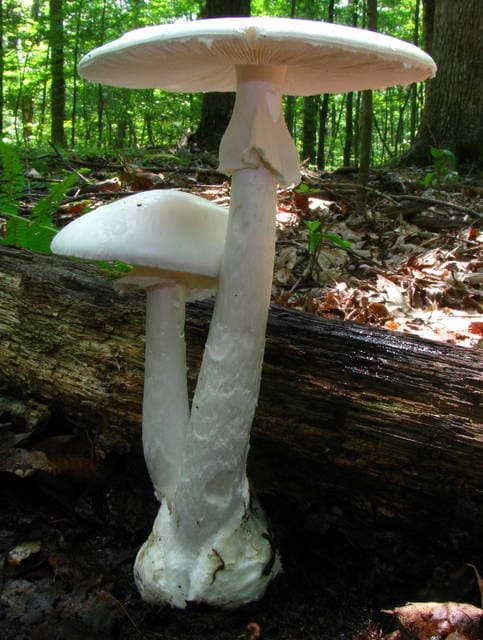
Amanita bisporigera, the Eastern ángel destructor, is concentrated in the deciduous forests of Eastern Norteamérica. Based on verified Mushroom Observer data, there are 23 confirmed observations, all in the eastern half of the continent — this species does not occur on the West Coast.\n\nVerified A. bisporigera locations:\n\n- Michigan: Addison robles County Park, Bald Mountain Recreation Area, Midland\n- Indiana: Brown County State Park\n- West Virginia: Babcock State Park\n- New Hampshire: College Woods\n- Virginia and Mid-Atlantic: Multiple scattered locations\n\nIdentifying features of the ángel destructor:\n\n- Pure white throughout — cap, gills, stem, and ring\n- Sack-like volva at the stem base (often buried — you must dig to see it)\n- Free gills (not attached to the stem)\n- esporada: White\n- Season: junio through octubre, peaking in mid-summer\n\nThis species is commonly confused with edible *Agaricus* species and *Leucoagaricus* species. The critical difference is the volva — always dig up the base of any white mushroom before eating it. A single ángel destructor can contain enough amatoxina to kill an adult. There is no antidote that reliably reverses amatoxina poisoning once symptoms appear.

Norteamérica has two distinct subspecies of matamoscas that most field guides still lump together, but they differ in color, range, and tree associations. Based on verified Mushroom Observer data, Amanita muscaria var. guessowii has 44 confirmed observations in the East and A. muscaria subsp. flavivolvata has 35 observations in the West.\n\nEastern vs. western matamoscas:\n\n- A. muscaria var. guessowii (44 obs, Eastern NA) — Yellow to orange-yellow cap with white warts. Found under abedul, pino, and picea in the Northeast, Midwest, and Appalachians. The classic \"yellow matamoscas\" of Eastern forests\n- A. muscaria subsp. flavivolvata (35 obs, Western NA) — Bright red cap with white to yellowish warts. Found under picea, pino, and fir in the Rocky Mountains, Pacific Northwest, and Southwest. This is the iconic red-and-white toadstool\n\nNeither subspecies is as deadly as the oronja mortal or ángel destructor, but both contain ácido iboténico and muscimol, which cause a deliriant-type poisoning distinct from the organ-destroying amatoxinas of A. phalloides. Symptoms include nausea, confusion, visual disturbances, and drowsiness, typically resolving within 12-24 hours. Deaths are extremely rare but documented in children and elderly individuals.

*Galerina marginata* is the most geographically widespread deadly mushroom in Norteamérica, found on dead wood in virtually every forested region. Based on verified Mushroom Observer data, it has 44 confirmed observations across an enormous range — from the Pacific Northwest to the Southeast, from urban parks to remote wilderness.\n\nWhat makes G. marginata so dangerous:\n\n- Ubiquitous habitat: Any rotting wood — logs, stumps, buried wood, mulch, even wood chips in landscaping\n- Year-round fruiting: Can appear in any month depending on region and moisture\n- Small and unassuming: Brown cap 1-5 cm, thin stem with a fragile ring that often disappears\n- Contains amatoxinas: The same deadly compounds found in oronjas mortales and ángeles destructores\n- Commonly misidentified: Confused with edible wood-growing species like Kuehneromyces mutabilis (sheathed woodtuft) and even Psilocybe species\n\nUnlike the oronja mortal, which has a limited introduced range, *G. marginata* is native and found everywhere trees grow and die. It fruits in clusters on decaying wood, and a single log may produce dozens of fruitbodies. This species is responsible for the critical foraging rule: never eat small brown mushrooms from wood unless you are an expert. Even experienced foragers use microscopy or esporadas to confirm identification.
The Bay Area has more documented oronja mortal observations than any other region in Norteamérica, largely due to historic tree importation. Based on verified Mushroom Observer data, the town of Canyon alone has 10 verified Amanita phalloides observations — nearly one-third of all Norteamérican records in the database.\n\nWhy the concentration exists:\n\n- Imported trees: European alcornoques (Quercus suber) and other ornamental trees were extensively planted in the Bay Area during the late 1800s and early 1900s. A. phalloides hitchhiked on their roots as a micorrícico partner\n- Climate match: The Bay Area's Mediterranean climate with cool, wet winters closely mirrors the oronja mortal's native European habitat\n- Native tree colonization: The fungus has jumped from imported robles to native robles vivos costeros (Quercus agrifolia), dramatically expanding its range\n- Urban-wildland interface: Many observations occur where residential areas meet roble woodlands — exactly where people forage\n\nAdditional verified hotspot locations include El Corte de Madera Creek Preserve, El Dorado County, and Albion in Mendocino County. The oronja mortal is actively spreading in California, having been documented progressively further from its original introduction points. Oregon's Willamette Valley and Rogue Valley are emerging secondary hotspots as the species continues its northward expansion.
Deadly Amanita species fruit in two distinct seasonal windows depending on whether you are on the West Coast or East Coast. Based on verified Mushroom Observer data, the peak observation months for each species reveal patterns directly tied to regional rainfall.\n\nDeadly Amanita seasonality by region:\n\n- West Coast — A. phalloides (31 obs): Peaks octubre through enero, triggered by the first fall rains. The Bay Area's rainy season creates ideal fruiting conditions under robles. This winter timing is unusual for Amanitas and catches many foragers off guard\n- East Coast — A. bisporigera (23 obs): Peaks junio through septiembre, fruiting during warm, humid summer weather in deciduous forests. Most observations cluster in julio and agosto\n- matamoscas — guessowii (44 obs): Eastern, peaks agosto through octubre\n- matamoscas — flavivolvata (35 obs): Western, peaks agosto through noviembre\n\nThe critical takeaway for foragers: There is no safe season. West Coast oronjas mortales fruit in fall and winter when many edible species are also active. East Coast ángeles destructores fruit in summer alongside desirable Agaricus species. Extra vigilance is required during these peak windows, especially when collecting white-capped or green-capped mushrooms near roble trees.
Yes — deadly mushrooms are regularly documented in residential neighborhoods, urban parks, and landscaped areas. Based on verified Mushroom Observer data, Amanita phalloides has been confirmed at Evergreen Washelli Memorial Park and multiple Bay Area residential neighborhoods. Galerina marginata appears on wood mulch in gardens and playgrounds.\n\nUrban settings where deadly species grow:\n\n- Under planted robles: oronjas mortales associate with both European and native robles planted as street trees and in parks\n- Wood chip mulch: Galerina marginata fruits readily on landscaping mulch, wood chip paths, and garden beds\n- Cemetery grounds: Many cemeteries planted European trees decades ago, creating ideal oronja mortal habitat\n- College campuses: Older campuses with mature imported trees are documented hotspots\n- Residential yards: Any yard with mature roble trees in California or the Pacific Northwest\n\nThe danger is amplified in urban settings because people are less cautious about mushrooms growing in familiar environments. Children and dogs are particularly at risk — young children may eat mushrooms found in yards, and dogs are attracted to the sweet smell of mature oronjas mortales. If you live in coastal California under roble trees, inspect your yard regularly during the rainy season and remove any Amanita-like mushrooms wearing gloves.
Amanita phalloides and A. bisporigera top the list of deadly misidentifications, each resembling popular edible species closely enough to fool even moderately experienced foragers. Most fatal mushroom poisonings worldwide involve one of these two species being confused with a familiar edible.\n\nThe most dangerous look-alike pairs:\n\n- A. phalloides confused with seta de arroz (Volvariella volvacea) — This is the #1 cause of fatal mushroom poisoning among Southeast Asian immigrants in California. Both have a volva and similar cap shape. setas de arroz are widely cultivated in Asia\n- A. phalloides confused with Agaricus species — Young oronjas mortales with closed caps can resemble champiñones silvestres. The key difference: Agaricus has pink-to-brown gills, oronjas mortales have white gills\n- A. bisporigera confused with Agaricus and Leucoagaricus — White ángeles destructores look like white champiñones de botón to casual observers. The buried volva is the critical distinguishing feature\n- Galerina marginata confused with Kuehneromyces mutabilis — Both are small brown mushrooms growing in clusters on wood. Even experts use spore color to distinguish them\n\nThe universal safety rule: always check for a volva. Dig up the base of every mushroom you intend to eat. If there is a sack-like cup at the base, do not eat it under any circumstances.
Yes — at minimum, *Galerina marginata* occurs in every US state with significant forest cover, making it impossible to forage anywhere in America without encountering deadly species. Based on verified Mushroom Observer data, G. marginata alone has 44 observations across enormously diverse locations, and the deadly Amanitas add region-specific risks.\n\nDeadly species coverage by region:\n\n- Pacific Coast: A. phalloides (31 obs concentrated in CA/OR) + G. marginata (on any dead wood)\n- Eastern US: A. bisporigera (23 obs from NH to FL) + G. marginata\n- Midwest: A. bisporigera (verified in IN, MI, OH) + G. marginata\n- Rocky Mountains: G. marginata + A. muscaria subsp. flavivolvata (35 obs, toxic but rarely fatal)\n- Southeast: A. bisporigera + G. marginata + emerging A. phalloides reports\n- Alaska/Hawaii: G. marginata in Alaska; Hawaii has fewer documented deadly Amanitas but G. marginata is present\n\nNo region is risk-free. Even states with low Amanita diversity still have Galerina on every rotting log. This is why the foundational foraging rule — never eat a mushroom you cannot identify with 100% certainty — applies everywhere. A esporada, a field guide, and ideally confirmation from an experienced micólogo should precede any wild mushroom meal.
Do not panic, but take the find seriously — especially if the mushroom is in a populated area where children or pets could encounter it. A suspected oronja mortal near homes, schools, or parks warrants immediate action to protect your community.\n\nStep-by-step response:\n\n- Photograph it in place — Take photos of the cap (top and underside), stem, ring, and especially the base (gently clear soil to reveal the volva). Include a ruler or coin for scale. Natural lighting is best\n- Do not eat or taste it — Even handling is fine with bare hands (amatoxinas require ingestion to cause harm), but wash your hands afterward as a precaution\n- Report to Mushroom Observer — Upload your photos with GPS coordinates at mushroomobserver.org. Expert identifiers will confirm or reject your ID, adding valuable distribution data\n- Warn neighbors — If the mushroom is in a shared area, alert neighbors with young children and dog owners. Post in neighborhood groups if appropriate\n- Remove if necessary — In high-risk areas (playgrounds, dog parks), remove the fruitbodies wearing gloves and dispose of them in sealed trash. This does not eliminate the micelio but removes the immediate hazard\n- Contact local sociedad micológica — They may want to document the find and can provide expert confirmation\n\nIf someone has already eaten a suspected oronja mortal, call Control de Envenenamientos (1-800-222-1222) immediately. Do not wait for symptoms — amatoxina poisoning has a 6-12 hour delay before the first symptoms appear.
¿Necesitas más ayuda? Dr. Myco puede responder preguntas adicionales sobre setas mortales — dónde crecen realmente basándose en miles de experiencias reales de cultivo.
Pregunta al Dr. MycoMás en Recolección e Identificación Silvestre
Fundamentos y Seguridad en la Recolección
10 consejos
Especies Comestibles Selectas
12 consejos
Especies Mortales y Tóxicas
14 consejos
Guías Regionales de Recolección
9 consejos
Guía de Identificación Visual
17 consejos
Identificación y Recolección de Chaga
10 consejos
Guía de Recolección de Colmenillas
10 consejos
Variedades de Colmenillas y Rebozuelos
10 consejos
Recolección en Norteamérica por Región
14 consejos
Guía de Recolección en Europa
12 consejos
Recolección en el Hemisferio Sur y Trópicos
10 consejos
Especies de Recolección por Temporada
12 consejos
Dónde Encontrar Setas Silvestres
15 consejos
Hábitats de Setas y Asociaciones con Árboles
12 consejos
Especies de Rebozuelo por Región
12 consejos
Especies de Colmenilla por Región
12 consejos
Pollo del Bosque y Cola de Pavo por Región
10 consejos
Melena de León, Erizo y Langosta Silvestres
10 consejos
Boletus Edulis, Trompeta Negra y Otras Selectas
10 consejos