Pollo del Bosque y Cola de Pavo por Región
10 consejos en Recolección e Identificación Silvestre
Por Andrew Langevin · Fundador, Nature Lion Inc · Autor colaborador, Mushroomology (Brill, 2026)
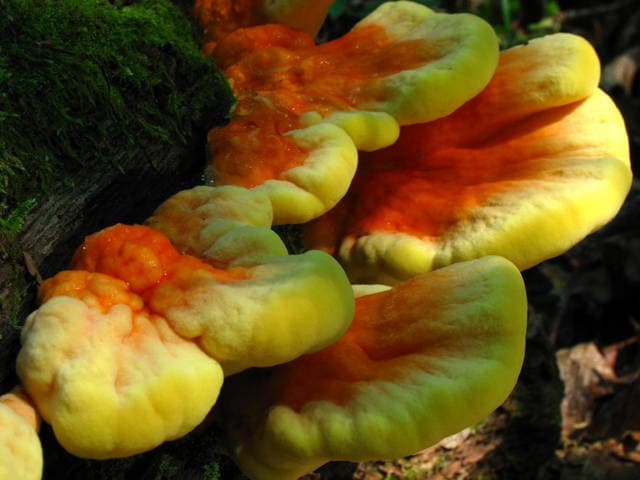
Norteamérica hosts five confirmed species of pollo del bosque (Laetiporus), each adapted to different regions and tree hosts. Based on verified Mushroom Observer data, the total verified observations across all five species exceed 80, revealing clear geographic patterns.\n\nNorteamérican Laetiporus species:\n\n- L. sulphureus (39 obs) — The classic eastern pollo del bosque. Bright orange-yellow shelves on frondosa trunks, especially roble\n- L. cincinnatus (22 obs) — The white-pored chicken. Grows at the base of trees rather than on trunks, primarily in the East and Midwest\n- L. gilbertsonii (10 obs) — The West Coast species. Found on eucalipto, roble, and other frondosas in California and Oregon\n- L. conifericola (9 obs) — The conífera specialist. Restricted to the Pacific Northwest on dead coníferas\n- L. persicinus (4 obs) — The tropical species. Found in Florida and the Southeast on frondosas\n\nKnowing which species occurs in your region is critical for safe foraging. The conífera-growing species (L. conifericola) is more likely to cause gastrointestinal upset than the frondosa species. Always confirm your host tree before eating any pollo del bosque.
Laetiporus sulphureus is the most commonly observed pollo del bosque, dominating Eastern and Midwestern forests. Based on verified Mushroom Observer data, it has 39 confirmed observations at locations spanning from the Northeast through the Southeast and into the Midwest.\n\nVerified L. sulphureus locations include:\n\n- Midwest: Brown County State Park (Indiana), Bald Mountain Recreation Area (Michigan)\n- Northeast: Cook Forest State Park (Pennsylvania), Portland (Maine)\n- Mid-Atlantic: Edmund Babler State Park (Missouri)\n- Southeast: Gainesville (Florida)\n\nThis species fruits on standing or fallen frondosas, with a strong preference for roble (Quercus spp.). It produces bright orange shelves with a yellow superficie porosa — the yellow underside is the key feature separating it from L. cincinnatus. Fruitings typically appear mayo through octubre, with peak abundance in late summer and early fall after warm rains. Young specimens with firm, moist edges are the best for cooking — once the edges become dry and brittle, the mushroom is past prime.
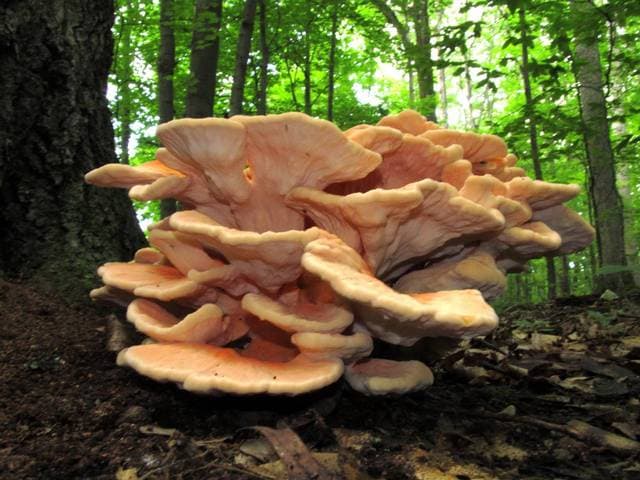
Laetiporus cincinnatus is the white-pored pollo del bosque, often considered the best-tasting species in the genus. Based on verified Mushroom Observer data, it has 22 confirmed observations at locations including Bald Mountain Recreation Area, Brown County State Park, Culpeper County, Edmund Babler State Park, Hampton, and Hawn State Park.\n\nKey differences from L. sulphureus:\n\n- superficie porosa: White to pale salmon instead of bright yellow — this is the most reliable field distinction\n- Growth habit: Fruits at the base of trees or from buried roots, rather than high on trunks\n- Cap color: Paler peach-orange on top, less vivid than sulphureus\n- Texture: Generally more tender with a finer grain, making it preferred for cooking\n- Host trees: Almost exclusively roble, especially at the base of large mature robles\n\nMany foragers consider cincinnatus the superior eating species. Its texture is more succulent and less fibrous than sulphureus, with a milder flavor. Look for it growing in rosette-like clusters at the base of roble trees rather than the shelf-like brackets higher up on trunks. The two species can occasionally fruit on the same tree.
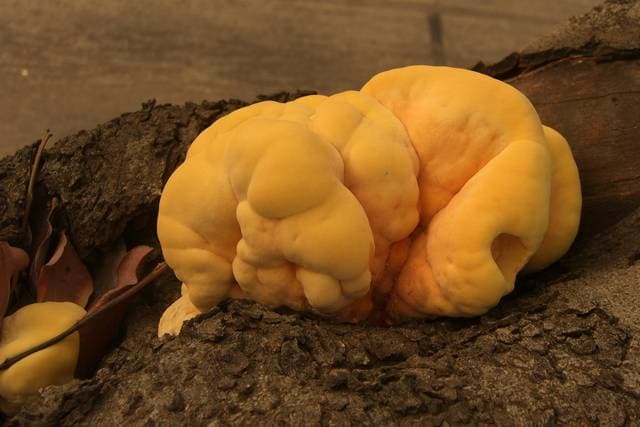
The West Coast has two distinct pollo del bosque species not found in the East, each occupying different ecological niches. Based on verified Mushroom Observer data, Laetiporus gilbertsonii has 10 confirmed observations and L. conifericola has 9 observations in the western states.\n\nWest Coast Laetiporus species:\n\n- L. gilbertsonii (10 obs) — Found on frondosas in California and Oregon. Verified locations include Canyon, Howarth Park, Mogollon Rim, Olympia, Pioneer Cemetery, and Santa Cruz. Commonly fruits on eucalipto and live roble\n- L. conifericola (9 obs) — The conífera specialist. Verified at Breitenbush, Cascades Highway 12, Glacier National Park, and Humboldt County. Grows exclusively on dead or dying coníferas including fir, tsuga, and picea\n\nThe host tree distinction matters for edibility. L. gilbertsonii on frondosas is generally safe to eat, but L. conifericola growing on coníferas has a higher incidence of causing gastrointestinal distress — possibly due to absorbed tree compounds. Some foragers eat conifericola without issues, but beginners should stick to frondosa-growing specimens. Always confirm the host tree species before harvesting any West Coast pollo del bosque.
Yes — the Southeast hosts a unique tropical species, *Laetiporus persicinus, that most field guides fail to mention. Based on verified Mushroom Observer data, this species has 4 confirmed observations at Box Hill South, Cantonment, Fort Myers, and Hawthorne, all in subtropical or tropical environments.\n\nWhat makes L. persicinus distinctive:\n\n- Color: Peach to salmon-pink caps, paler than northern species, with a white superficie porosa\n- Range: Restricted to the Southeast US, Caribbean, and tropical regions\n- Host trees: frondosas in subtropical forests, including live roble and other southern species\n- Season: Can fruit year-round in South Florida due to warm temperatures, with peaks after heavy rain periods\n\nSoutheastern foragers may also encounter L. sulphureus in the northern portions of the region — its range extends into the upper Southeast. The key identification challenge in Florida is separating persicinus from cincinnatus*, as both have pale pore surfaces. Geographic location is your best clue: if you are in South Florida on a tropical frondosa, you almost certainly have persicinus. North of the subtropical zone, cincinnatus becomes more likely.
pollo del bosque season spans from mayo through noviembre across most of Norteamérica, with tropical regions offering year-round opportunities. Based on verified Mushroom Observer data, peak observation months reveal distinct regional patterns.\n\nChicken of the woods peak seasons:\n\n- Northeast and Midwest (L. sulphureus, L. cincinnatus): junio through septiembre. Peak in agosto and septiembre after warm, humid periods. Triggered by summer rains on roble-dominated forests\n- Pacific Northwest (L. conifericola): septiembre through noviembre. Follows fall rains similar to rebozuelo season. Found on dead coníferas in mature forests\n- California and Oregon coast (L. gilbertsonii): mayo through noviembre, a broader season than other regions. eucalipto hosts can fruit multiple times per year\n- Southeast and Florida (L. persicinus): Year-round in South Florida, with peaks after heavy summer and fall rains. Further north, junio through octubre\n\nThe best strategy is to scout your roble and frondosa stands in early summer, then check them weekly once temperatures are consistently above 18°C. pollo del bosque can appear suddenly and grow to full size in just 1-2 weeks. Mark productive trees — they often produce year after year from the same internal decay column.
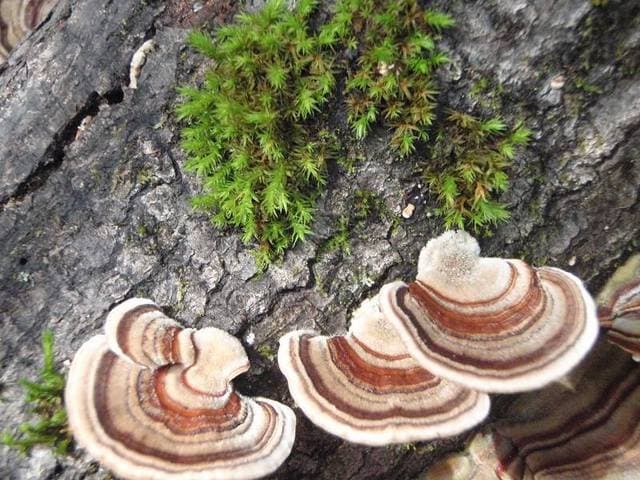
cola de pavo is the most documented polypore in Norteamérica, found in virtually every forested region on the continent. Based on verified Mushroom Observer data, Trametes versicolor has an extraordinary 101 confirmed observations spread across Estados Unidos and Canada — more than any other bracket fungus in the database.\n\nTurkey tail distribution highlights:\n\n- Habitat: Dead frondosa logs, stumps, and fallen branches. Occasionally on coníferas\n- Range: Every US state with forest cover. Verified from Maine to Florida, California to Michigan, and throughout Canada\n- Season: Year-round. Persistent fruitbodies can be found in every season, with new growth primarily in fall and spring\n- Abundance: Often grows in dense, overlapping clusters covering entire logs\n\nThe reason cola de pavo is so widespread is its extremely aggressive wood-decomposition strategy. It colonizes dead wood rapidly, produces millions of spores from long-lived fruitbodies, and tolerates a wide range of temperatures and moisture levels. For foragers interested in cola de pavo for tea or tinctures, the good news is that you will never need to travel far to find it. Check any pile of dead frondosa branches in a shaded, moist area.
True cola de pavo (Trametes versicolor) has three diagnostic features that separate it from every look-alike — if any one fails, you do not have cola de pavo. This is critical because several common polypores closely resemble it.\n\nThe three-test verification method:\n\n- Test 1 — superficie porosa: Flip it over. True cola de pavo has a white superficie porosa with tiny, barely visible pores (3-5 per mm). If the underside is smooth, gill-like, or has large visible pores, it is not cola de pavo\n- Test 2 — Flexibility: Fresh cola de pavo is thin and flexible, bending without snapping. If the bracket is thick, woody, or rigid, suspect Trametes ochracea or Stereum ostrea\n- Test 3 — Zonation: The cap should display distinct concentric color zones — alternating bands of brown, tan, gray, blue, and sometimes green (from algae). Stereum ostrea (false cola de pavo) has similar zones but fails the pore test\n\nCommon look-alikes:\n\n- Stereum ostrea — Smooth underside, no pores at all. The most frequent misidentification\n- Trametes ochracea — Thicker, less flexible, browner overall, fewer distinct zones\n- Trametes hirsuta — Hairier surface, less colorful zonation\n\nRun all three tests on every specimen. With 101 verified Mushroom Observer records, true cola de pavo is common — but so are its mimics.
Each Laetiporus species has evolved to decompose specific types of wood, making tree identification one of the most reliable ways to determine which species you have found. Based on verified Mushroom Observer data, the tree-species associations are remarkably consistent.\n\nTree preferences by species:\n\n- L. sulphureus (39 obs) — roble is the primary host, especially roble rojo and roble blanco. Also found on cherry, locust, and other eastern frondosas. Fruits on standing trunks, often 1-3 meters high\n- L. cincinnatus (22 obs) — Almost exclusively roble, fruiting at the base of the tree or from buried roots. The basal fruiting habit distinguishes it from sulphureus on the same tree species\n- L. gilbertsonii (10 obs) — eucalipto is a major host in California, plus live roble and other western frondosas. The eucalipto association is unique to this species\n- L. conifericola (9 obs) — Strictly coníferas: abeto de Douglas, western tsuga, picea de Sitka, and true firs. Never on frondosas\n- L. persicinus (4 obs) — Tropical and subtropical frondosas, including live roble and other southern species\n\nAlways identify the host tree before eating any pollo del bosque. Specimens from coníferas (conifericola) carry higher gastrointestinal risk. Specimens from eucalipto (gilbertsonii) are generally safe but may have a slightly different flavor.
Laetiporus sulphureus and L. cincinnatus are the safest and most widely consumed species, with decades of culinary tradition and no significant reports of adverse reactions when properly cooked. However, safety varies by species and even by individual sensitivity.\n\nSafety ranking from most to least reliable:\n\n- L. sulphureus (39 obs) — Excellent edibility on frondosas. The most commonly eaten species. Cook thoroughly — raw pollo del bosque can cause nausea\n- L. cincinnatus (22 obs) — Considered the best-tasting species by many foragers. Tender texture, excellent flavor, very few adverse reports\n- L. gilbertsonii (10 obs) — Generally safe on frondosas. Specimens from eucalipto are eaten by many Californian foragers without issue, but some people report mild reactions\n- L. persicinus (4 obs) — Limited data. Eaten in the Southeast, but fewer documented experiences than northern species\n- L. conifericola (9 obs) — Most likely to cause malestar GI. Growing on coníferas, this species may absorb resinous compounds from the host wood. Some foragers eat it without problems, but the incidence of nausea and cramping is notably higher\n\nRegardless of species, always cook pollo del bosque thoroughly, eat only young tender edges, and try a small portion the first time you eat any new species. About 10% of people appear sensitive to all Laetiporus species.
¿Necesitas más ayuda? Dr. Myco puede responder preguntas adicionales sobre pollo del bosque y cola de pavo por región basándose en miles de experiencias reales de cultivo.
Pregunta al Dr. MycoMás en Recolección e Identificación Silvestre
Fundamentos y Seguridad en la Recolección
10 consejos
Especies Comestibles Selectas
12 consejos
Especies Mortales y Tóxicas
14 consejos
Guías Regionales de Recolección
9 consejos
Guía de Identificación Visual
17 consejos
Identificación y Recolección de Chaga
10 consejos
Guía de Recolección de Colmenillas
10 consejos
Variedades de Colmenillas y Rebozuelos
10 consejos
Recolección en Norteamérica por Región
14 consejos
Guía de Recolección en Europa
12 consejos
Recolección en el Hemisferio Sur y Trópicos
10 consejos
Especies de Recolección por Temporada
12 consejos
Dónde Encontrar Setas Silvestres
15 consejos
Hábitats de Setas y Asociaciones con Árboles
12 consejos
Especies de Rebozuelo por Región
12 consejos
Especies de Colmenilla por Región
12 consejos
Setas Mortales — Dónde Crecen Realmente
10 consejos
Melena de León, Erizo y Langosta Silvestres
10 consejos
Boletus Edulis, Trompeta Negra y Otras Selectas
10 consejos