How to Start a Mushroom Farm: Business Plan, Costs & Profit
By Andrew Langevin · Founder, Nature Lion Inc · Contributing author, Mushroomology (Brill, 2026) · Updated August 10, 2026
Start a mushroom farm by proving a repeatable weekly market before investing in a large facility. Choose one or two species, calculate the blocks and room capacity required for your sales target, run at least three complete production cycles, and budget for contamination, labor, utilities and unsold product. A profitable farm is a production-and-sales system—not simply a room full of mushrooms.
Batch, yield, loss, labor and sales templates.
Calculate weekly blocksWork backward from harvest into room capacity.
Plan oyster yieldYield per block, BE, flushes and weekly starts.
Model crop lossMeasure contamination cost and break-even risk.
Compare species profitRank crops by block and fruiting shelf-week.
Estimate startup costBuild a budget, runway and break-even scenario.
Build a production planCalculate weekly batches, capacity, costs and margin.
Plan room capacityEstimate harvests, revenue and operating profit.
Model crop yieldCalculate BE, losses and saleable harvest.
Calculate spawnScale substrate batches accurately.
1. Choose a market before choosing equipment
Interview chefs, grocers, distributors and direct-market customers. Record the species, weekly quantity, packaging, delivery day and price they will actually accept. Restaurants may pay a premium but order inconsistently; distributors accept larger volumes at lower margins; farmers markets offer retail pricing but require selling time and create unsold-inventory risk.
A sensible first target is one dependable weekly route. Obtain expressions of interest before sizing the fruiting room, then plan production at 10–20% above committed demand to cover variability without making waste the business model.
2. Select species with production economics in mind
| Species | Commercial advantage | Typical cycle | BE benchmark |
|---|---|---|---|
| Oyster | Fast, forgiving, broad market | 2–4 weeks | 100–150% |
| Lion's mane | Premium price, strong specialty demand | 3–5 weeks | 50–75% |
| Shiitake | Long shelf life and established demand | 8–16 weeks | 75–125% |
| King oyster | Premium culinary product | 4–6 weeks | 50–75% |
Biological efficiency (BE) is fresh harvest divided by dry substrate weight. Benchmarks are planning ranges, not guarantees; genetics, substrate, environment and measurement method matter.
3. Set a realistic startup budget
| Stage | Planning range | Output target | Operating model |
|---|---|---|---|
| Market test | $1,000–$5,000 | 25–75 lb/week | Purchased blocks; small fruiting tent or room |
| Side business | $10,000–$40,000 | 100–300 lb/week | In-house substrate and incubation |
| Small commercial farm | $50,000–$200,000+ | 500–2,000+ lb/week | Dedicated clean lab, incubation and fruiting rooms |
Budget separately for buildout, clean-air equipment, incubation, fruiting controls, refrigeration, packaging, delivery, insurance, licensing and three to six months of working capital. Local construction and energy costs can move these ranges dramatically.
4. Design the production flow
Separate dirty substrate handling from clean inoculation work. A practical flow is raw-material storage → hydration and mixing → sterilization or pasteurization → cooling → clean inoculation → incubation → fruiting → harvest → cold storage → packing. People, carts and air should not carry contamination backward from fruiting into the lab.
- Clean lab: washable surfaces, controlled air, cultures and inoculation.
- Incubation: stable species-appropriate temperature, shelving and batch labels.
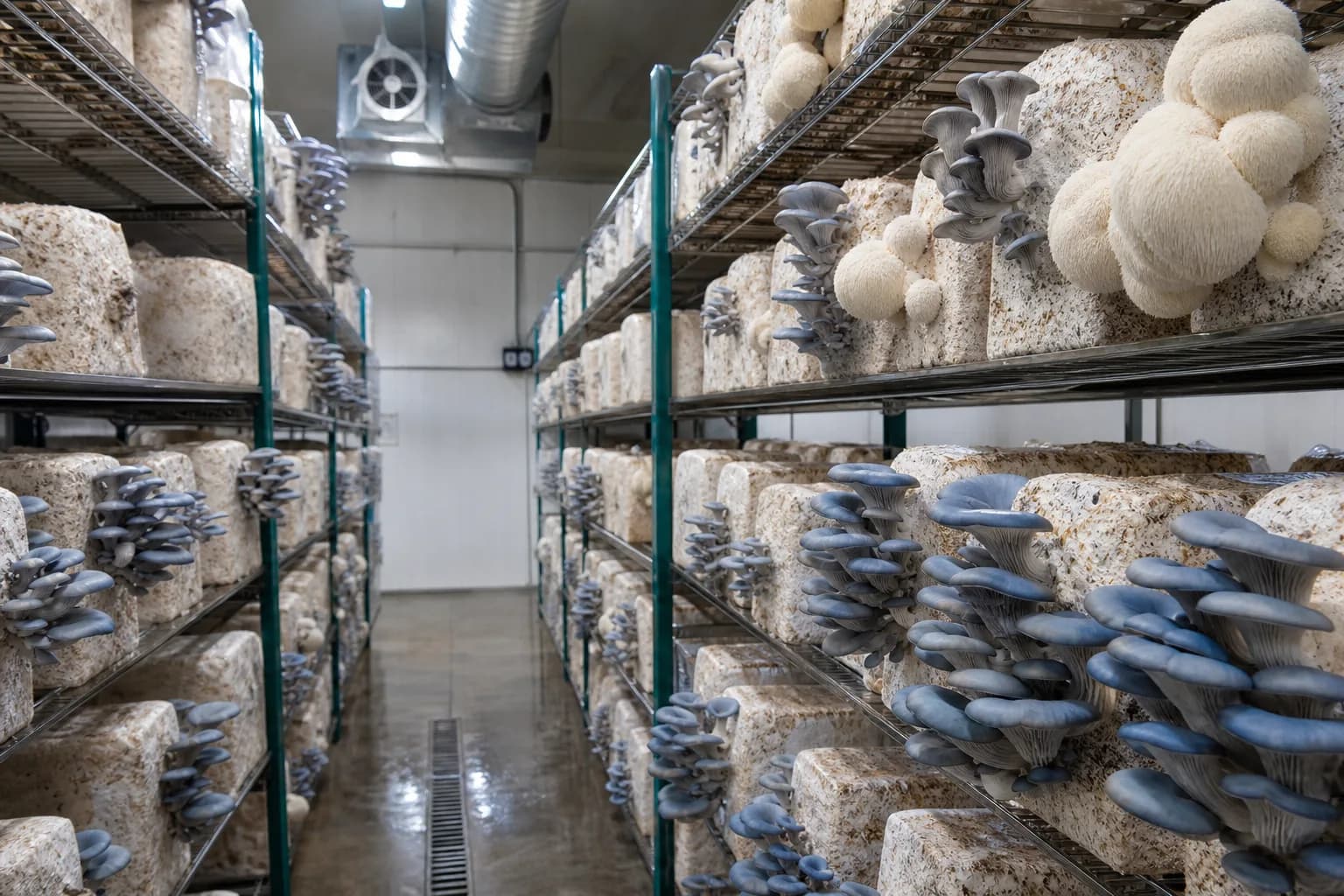
- Fruiting: humidity, fresh-air exchange, temperature, light and drainage.
- Cold chain: rapid cooling, food-safe packaging and documented inventory rotation.
5. Work backward from weekly harvest
If one block produces 1.5 lb and expected crop loss is 10%, a 150 lb weekly target requires roughly 112 blocks reaching harvest each week: 150 ÷ 1.5 ÷ 0.90. Multiply weekly starts by incubation and fruiting duration to find the shelving capacity the whole pipeline requires—not just the number of blocks visible in the fruiting room.
Track every batch: culture, substrate recipe, inoculation date, colonization time, contamination, each flush weight, labor and selling price. Use the yield calculator for BE and crop revenue, and the grow-room calculator for capacity and operating-profit scenarios.
6. Build the mushroom farm business plan
- Executive summary: species, market, weekly output and competitive advantage.
- Customer evidence: interviews, trial orders, pricing and route density.
- Production plan: blocks started weekly, cycle time, BE and crop-loss assumptions.
- Facility plan: room capacities, workflow, environmental controls and expansion triggers.
- Sales plan: wholesale, restaurant, retail and recurring delivery mix.
- Financial model: startup capital, unit cost, gross margin, labor, overhead and cash runway.
- Risk plan: contamination, equipment failure, market concentration, recalls and business interruption.
Scale only after the numbers repeat
Expand when several consecutive cycles meet your yield, contamination, labor and sell-through targets. If a crop looks wrong, diagnose it before multiplying the problem across a larger batch.
Commercial mushroom farm planning library
Use these focused guides to move from market validation through facility design, production economics, crop controls and post-harvest delivery. Each guide links to the relevant planning tools and operating records.
Commercial equipment planning
Mushroom Farm Equipment List: Market Test to Commercial Scale
Choose mushroom farm equipment by production stage, from a low-risk market test through an integrated commercial facility.
Facility design
Commercial Mushroom Farm Layout and Workflow
Plan a commercial mushroom farm layout with clean-to-dirty product flow, separated lab, incubation, fruiting, packing, cold storage and waste routes.
Facility economics
Mushroom Farm Profit per Square Foot and Shelf Position
Calculate mushroom farm profit per square foot using vertical racks, saleable yield, crop cycle, occupancy, utilization and contribution per shelf-week.
Sales and unit economics
Mushroom Farm Pricing Guide: Wholesale, Restaurant and Retail
Set mushroom prices from true unit cost, channel margin, packaging, delivery, unsold inventory and target contribution—not competitor guesses.
Commercial launch roadmap
Mushroom Farm Startup Checklist: From Market Test to First Sale
Follow a staged mushroom farm startup checklist covering market proof, crop trials, facility, records, food safety, production and launch readiness.
Premium crop planning
Lion’s Mane Yield per Block and Commercial Economics
Plan lion's mane mushroom yield per 5 lb block using dry substrate, biological efficiency, saleable grade, crop loss and shelf-week economics.
Worked business-plan example
Oyster Mushroom Farm Example: A 100 kg/Week Operating Plan
Study a worked 100 kg/week oyster mushroom farm example covering customers, blocks, rooms, labor, pricing, risks and financial assumptions.
Environmental engineering
Mushroom Fruiting Room Design: Airflow, Humidity and CO₂
Design a mushroom fruiting room around crop-level airflow, humidity, CO2 removal, condensate, sensors, racks and failure response.
Crop-loss management
Mushroom Farm Contamination Rate: Measurement and Action Thresholds
Measure mushroom farm contamination by stage, calculate its financial effect and set evidence-based internal action thresholds without relying on a universal rate.
Post-harvest operations
Mushroom Harvest, Cooling and Shelf-Life SOP
Build a mushroom harvest and cold-chain SOP covering maturity, grading, lot identification, rapid cooling, packaging, storage and delivery records.