Especies Mortales y Tóxicas
14 consejos en Recolección e Identificación Silvestre
Por Andrew Langevin · Fundador, Nature Lion Inc · Autor colaborador, Mushroomology (Brill, 2026)
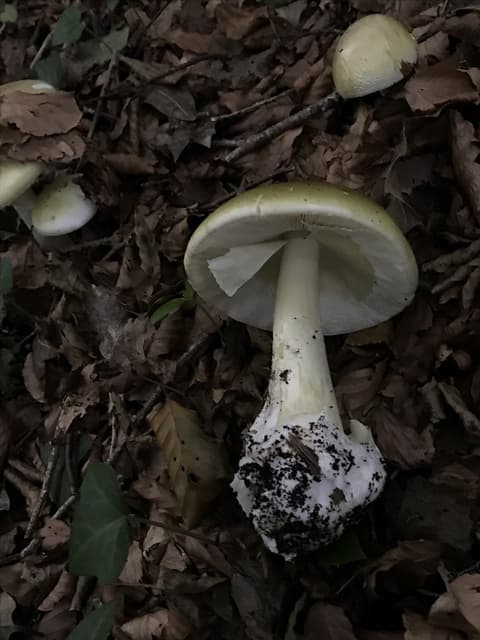
The oronja mortal (Amanita phalloides) is the single deadliest mushroom in the world, responsible for over 90% of fatal mushroom poisonings globally. Originally native to Europe, it has spread to Norteamérica, Australia, and other continents via imported trees. A single cap can contain enough toxin to kill an adult.\n\nKey identification features:\n\n- Greenish-yellow to olive-brown cap, sometimes pale or nearly white\n- White free gills (not attached to stem)\n- White stem with a membranous skirt-like ring\n- Cup-shaped volva (sack) at the base — often buried, you must dig carefully\n- White esporada\n- Grows near imported robles, chestnuts, and other frondosas\n- Faint honey-sweet smell when fresh\n\nThe toxin (amatoxina) causes no symptoms for 6-12 hours, then severe malestar GI, followed by an apparent recovery period, then liver and insuficiencia renal on days 3-5. By the time symptoms appear, organ damage has already begun. There is no antidote — treatment is supportive, and trasplante de hígado may be the only option.
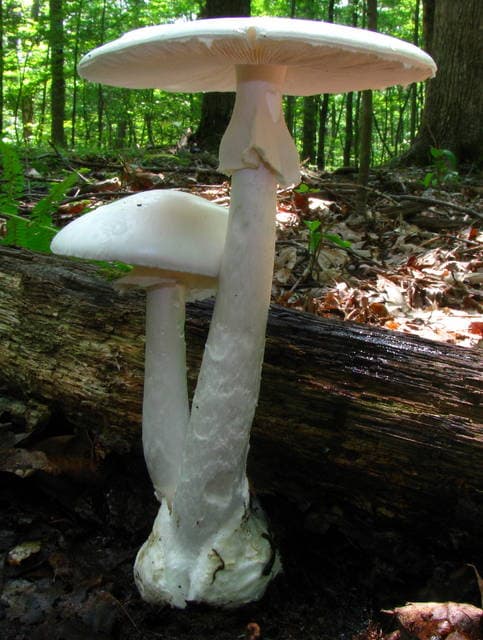
The ángel destructor refers to several all-white Amanita species (A. bisporigera, A. virosa, A. ocreata) that are equally as deadly as the oronja mortal and contain the same amatoxinas. They're particularly dangerous because they closely resemble edible white mushrooms like champiñones de botón, bejines (in the button stage), and meadow mushrooms.\n\nKey identification features:\n\n- Entirely white — cap, gills, stem, and ring\n- Free white gills\n- Prominent white membranous ring on the upper stem\n- Bulbous base enclosed in a cup-like volva (sack) — often underground\n- White esporada\n- Grows in frondosa and mixed forests, woodland edges, and sometimes lawns near trees\n- Fruits in summer and fall\n\nThe most common fatal confusion is with young bejines. Always slice any round white mushroom in half — a bejín will show uniform white flesh inside, while a young Amanita will show the outline of a developing cap and gills. This simple check saves lives.
galerina mortal (Galerina marginata) is a small, brown, nondescript mushroom that contains the same amatoxinas as the oronja mortal and ángel destructor. It's particularly dangerous because it grows on wood in mixed clusters and can be confused with edible setas de miel (Armillaria) or, fatally, with hallucinogenic Psilocybe species.\n\nKey identification features:\n\n- Small to medium brown cap, 1.5-5 cm, smooth and slightly tacky when wet\n- Brown gills\n- Thin brown stem with a fragile ring that may disappear with age\n- Rusty brown esporada (critical distinguishing feature)\n- Grows on decaying wood, often in clusters\n- Found year-round in moist conditions\n\nThe confusion with Psilocybe species has caused deaths. Psilocybe mushrooms bruise blue, while Galerina does not. However, they can grow side by side on the same log, so mixed collections are dangerous. The rusty brown esporada (vs. purple-brown for Psilocybe) is the definitive separation. Always esporada small brown mushrooms found on wood.
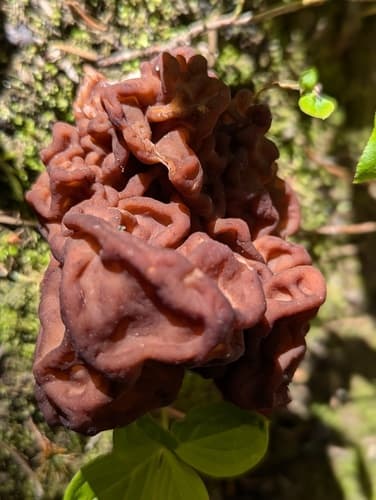
falsas colmenillas (Gyromitra esculenta and related species) superficially resemble colmenillas verdaderas but contain giromitrína, a toxin that metabolizes into monometilhidrazina (rocket fuel) in the body. Poisoning can cause insuficiencia hepática and death, though toxicity varies by specimen, region, and preparation.\n\nKey differences from colmenillas verdaderas:\n\n- Cap is wrinkled or brain-like, not honeycombed with defined pits and ridges\n- Cap is irregularly lobed and folded, not symmetrically pitted\n- Interior is chambered or cottony, not cleanly hollow — slice lengthwise to check\n- Stem may be irregular and partially hollow with internal chambers\n- Cap attaches to stem at the top in some species (colmenillas verdaderas attach at the bottom of the cap)\n\nIn some European countries and parts of Norteamérica, falsas colmenillas are eaten after extensive preparation (parboiling and discarding water multiple times), but this practice is risky and not recommended. Toxin content varies unpredictably, and inhalation of cooking vapors can also cause poisoning.
The cortinario mortal (Cortinarius rubellus, formerly C. speciosissimus) and the cortinario del loco (C. orellanus) contain orellanina, a toxin with an unusually long delay — symptoms may not appear for 2-14 days after ingestion, by which time irreversible kidney damage has occurred.\n\nKey identification features:\n\n- Tawny orange-brown to reddish-brown cap with a conical to convex shape\n- Brown gills with a cortina (cobweb-like veil) in young specimens\n- Brown fibrous stem, sometimes with yellowish bands\n- Rusty brown esporada\n- Grows in conífera forests, particularly with picea and pino\n- Fruits in fall\n\nThe extremely long latency period makes webcap poisoning especially insidious — by the time you connect the symptoms to the mushroom, you may not even remember eating it. There is no antidote. Treatment is dialysis and, in severe cases, kidney transplant. The Cortinarius genus is large and difficult to identify, which is why experienced foragers generally avoid eating any brown Cortinarius species.
The seta de olivo (Omphalotus olearius in eastern Norteamérica, O. olivascens in the west) is a bright orange mushroom commonly confused with rebozuelos. While not deadly, it causes severe gastrointestinal distress — violent vomiting, diarrhea, and cramps that can last for hours and may require hospitalization.\n\nKey identification features that separate it from rebozuelos:\n\n- True sharp-edged gills (rebozuelos have blunt, forking ridges)\n- Grows in clusters on wood or from buried roots (rebozuelos grow singly from soil)\n- Orange flesh throughout when cut (rebozuelos have white flesh)\n- Often larger than rebozuelos\n- Gills may glow faintly green in total darkness (bioluminescence)\n- Connected at the base in clusters\n\nThe three-point check is reliable: if it has láminas verdaderas, grows in clusters on wood, and is orange inside when cut, it's a seta de olivo, not a rebozuelo. rebozuelos have falsas láminas (ridges), grow individually from soil, and have white flesh inside.
The lepiota de esporas verdes (Chlorophyllum molybdites) is the most commonly consumed poisonous mushroom in Norteamérica. It causes severe gastrointestinal distress — violent vomiting and diarrhea lasting 6-12 hours — and sends hundreds of people to the emergency room each year. It's commonly found in lawns, parks, and grassy areas.\n\nKey identification features:\n\n- Large white cap with brown scales, 10-30 cm across\n- White gills that turn green as spores mature\n- Green esporada (the defining feature — no common edible has green spores)\n- Tall white stem with a movable ring\n- Grows in lawns, parks, and grassy areas, often in fairy rings\n- Common in warm, humid climates from late summer through fall\n\nThe green esporada is diagnostic — always take a esporada of any large white parasol-type mushroom before eating. Young specimens have white gills that haven't yet turned green, so the esporada is essential. Edible parasoles lanudos and parasoles have white to cream esporadas.
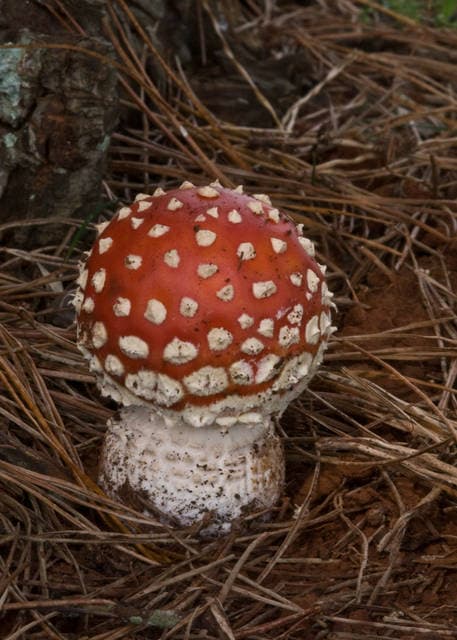
matamoscas (Amanita muscaria) is the iconic red-capped mushroom with white spots seen in fairy tales, video games, and folk art. It contains ácido iboténico and muscimol, which cause a distinctive poisoning syndrome including nausea, confusion, agitation, hallucinations, and sedation. Deaths are rare but have occurred, especially in children.\n\nKey identification features:\n\n- Bright red to orange cap with white to yellowish wart-like patches\n- White free gills\n- White stem with a ring and bulbous base with concentric rings of scales\n- White esporada\n- Grows under abedul, pino, picea, and fir trees (micorrícico)\n- Fruits in fall and early winter\n\nColor variations exist — yellow, orange, and peach forms occur across Norteamérica and can be confused with edible Amanita species like A. jacksonii (oronja de los Césares). The white warts on the cap are remnants of the universal veil and can be washed off by rain, making a rain-washed matamoscas look very different from the classic image.
The amanita pantera (Amanita pantherina) is a brown relative of the matamoscas that contains the same toxins (ácido iboténico and muscimol) but in higher concentrations, making it significantly more dangerous. Poisonings can cause severe disorientation, seizures, and in rare cases, death.\n\nKey identification features:\n\n- Brown to dark brown cap with white wart-like patches arranged in a pattern\n- White free gills\n- White stem with a ring and a distinctive bulbous base with a collar-like rim\n- The volva rim sits distinctly on top of the basal bulb like a gutter\n- White esporada\n- Grows under coníferas and frondosas\n- Fruits in summer and fall\n\nThe amanita pantera is commonly confused with the edible blusher (Amanita rubescens), which has a similar size, shape, and brown coloring. The key difference: the blusher turns pink-red when damaged or cut, while the amanita pantera does not change color. However, unless you are very experienced, avoid all brown Amanita species entirely.
The embudo del loco (Clitocybe rivulosa, also known as C. dealbata) is a small white mushroom that contains muscarine at potentially lethal concentrations. It grows in lawns, parks, and grassy areas — the same habitats where people forage for edible champiñones silvestres and setas de corro de hadas.\n\nKey identification features:\n\n- Small white to pale pinkish cap, 2-6 cm, often with a frosted or mealy appearance\n- White to cream decurrent gills (running down the stem)\n- Short white stem without a ring\n- White to pale pink esporada\n- Grows in grassy areas, lawns, and meadows, often in arcs or rings\n- Fruits in late summer and fall\n\nMuscarine poisoning causes the \"PSL\" syndrome — profuse sweating, salivation, and lacrimation (tearing), along with dangerous drops in heart rate and blood pressure. Unlike amatoxina poisoning, symptoms appear within 15-30 minutes. Atropine is the antidote and is generally effective. The embudo del loco is easily confused with the edible seta de corro de hadas (Marasmius oreades), which shares the same lawn habitat.
No. Every folk rule for identifying safe mushrooms has deadly exceptions. These myths have killed people and continue to circulate online and in outdated guides. You must learn species-specific identification — there are no shortcuts.\n\nDangerous myths that have caused fatalities:\n\n- \"If animals eat it, it's safe\" — squirrels and rabbits can eat oronjas mortales without harm\n- \"If it peels easily, it's safe\" — oronjas mortales peel easily\n- \"If you can cook it with a silver spoon and it doesn't tarnish, it's safe\" — completely false\n- \"Brightly colored mushrooms are dangerous; dull ones are safe\" — the cortinario mortal is dull brown; the bright red seta langosta is choice edible\n- \"If it smells pleasant, it's safe\" — oronjas mortales smell pleasant when fresh\n- \"If it grows on wood, it's safe\" — galerina mortal grows on wood\n\nThe only safe approach is positive species-level identification using multiple features: cap shape, gill/pore type, esporada color, stem features, habitat, season, smell, and sometimes chemical tests. There is no universal test that separates safe from toxic mushrooms.
Call Control de Envenenamientos (1-800-222-1222 in the US, or your local emergency number) immediately — do not wait for symptoms to appear. Time is critical with amatoxina poisoning (oronja mortal, ángel destructor, galerina mortal), where organ damage begins hours before symptoms.\n\nImmediate steps:\n\n- Call Control de Envenenamientos or go directly to the emergency room\n- Save the mushroom — bring any remaining specimens, cooked portions, or even scraps from the garbage. Take photos if you can\n- Note the time of ingestion, amount consumed, and any symptoms\n- Do not induce vomiting unless specifically instructed by Control de Envenenamientos\n- If multiple people ate the mushroom, all should seek medical evaluation even if asymptomatic\n\nCritical timeline for amatoxina poisoning:\n\n- 6-12 hours: GI symptoms begin (vomiting, diarrhea)\n- 24-48 hours: apparent improvement (the \"false recovery\")\n- 48-96 hours: liver and insuficiencia renal\n\nHospital identification resources include local sociedades micológicas (many have emergency ID hotlines) and regional poison center micólogos. Keep the NAMA poisoning hotline number in your phone if you forage regularly.
The oronja mortal (*Amanita phalloides*) is the world's deadliest mushroom, responsible for over 90% of all fatal mushroom poisonings worldwide. With an estimated 165,000 monthly searches globally, it is the most searched mushroom species on earth — and for good reason.\n\nWhy the oronja mortal is uniquely dangerous:\n\n- Tastes pleasant — victims report it tastes mild and unremarkable. There is no bitter or warning flavour\n- Delayed symptoms — amatoxina poisoning symptoms don't appear for 6-12 hours after ingestion, by which time the toxins have already begun destroying liver cells\n- False recovery — after initial GI symptoms (vomiting, diarrhoea), patients feel better for 24-48 hours. This \"false recovery\" delays treatment while insuficiencia hepática progresses\n- No antidote — treatment is supportive (IV fluids, carbón activado if caught early, trasplante de hígado in severe cases). There is no specific antidote for amatoxinas\n- Lethal dose is tiny — a single cap can contain enough amatoxina to kill an adult\n\nIdentification features:\n\n- Cap: 5-15cm, olive-green to yellow-green to pale greenish-white. Can be almost white in some specimens\n- Gills: White, free (not attached to stem)\n- Stem: White with a prominent ring (annulus) and a cup-like volva at the base (often hidden underground)\n- esporada: White\n\nOriginally from Europe, oronjas mortales have been introduced worldwide with imported trees. Major populations now exist in California (especially the San Francisco Bay Area — 31 verified Mushroom Observer observations), Oregon, the US East Coast, Australia (Melbourne, Canberra), and South Africa.
oronja mortal confusion kills people every year — understanding which edible species are mistaken for Amanita phalloides can save lives.\n\nMost dangerous confusions worldwide:\n\n- seta de arroz (Volvariella volvacea) — the #1 confusion. Southeast Asian foragers familiar with setas de arroz (which have a similar volva) have been fatally poisoned after finding oronjas mortales in Australia, California, and Europe. The button stage looks nearly identical\n- champiñón silvestre (Agaricus campestris) — common confusion in Europe and Australia. Both grow in grass near trees. Key difference: champiñones silvestres have pink-to-brown gills (never white) and no volva\n- oronja de los Césares (Amanita caesarea) — prized edible in Southern Europe. Looks similar to oronja mortal but has orange-yellow gills (not white) and an orange cap. Confusion occurs when caps are pale or faded\n- Green-cracked Russula (Russula virescens) — green cap colour matches oronja mortal. But Russula has no ring, no volva, and brittle gills that snap cleanly\n- bejín (button stage) — young oronjas mortales in the \"egg\" stage can resemble small bejines. Always slice bejines in half — a true bejín is uniform white inside with no internal structure. A oronja mortal egg shows the outline of cap and gills inside\n\nThe universal safety rule: If a white-gilled mushroom has BOTH a ring on the stem AND a cup (volva) at the base — do not eat it. This combination is the hallmark of deadly Amanita species.
¿Necesitas más ayuda? Dr. Myco puede responder preguntas adicionales sobre especies mortales y tóxicas basándose en miles de experiencias reales de cultivo.
Pregunta al Dr. MycoMás en Recolección e Identificación Silvestre
Fundamentos y Seguridad en la Recolección
10 consejos
Especies Comestibles Selectas
12 consejos
Guías Regionales de Recolección
9 consejos
Guía de Identificación Visual
17 consejos
Identificación y Recolección de Chaga
10 consejos
Guía de Recolección de Colmenillas
10 consejos
Variedades de Colmenillas y Rebozuelos
10 consejos
Recolección en Norteamérica por Región
14 consejos
Guía de Recolección en Europa
12 consejos
Recolección en el Hemisferio Sur y Trópicos
10 consejos
Especies de Recolección por Temporada
12 consejos
Dónde Encontrar Setas Silvestres
15 consejos
Hábitats de Setas y Asociaciones con Árboles
12 consejos
Especies de Rebozuelo por Región
12 consejos
Especies de Colmenilla por Región
12 consejos
Pollo del Bosque y Cola de Pavo por Región
10 consejos
Setas Mortales — Dónde Crecen Realmente
10 consejos
Melena de León, Erizo y Langosta Silvestres
10 consejos
Boletus Edulis, Trompeta Negra y Otras Selectas
10 consejos