Sales and unit economics
Mushroom Farm Pricing Guide: Wholesale, Restaurant and Retail
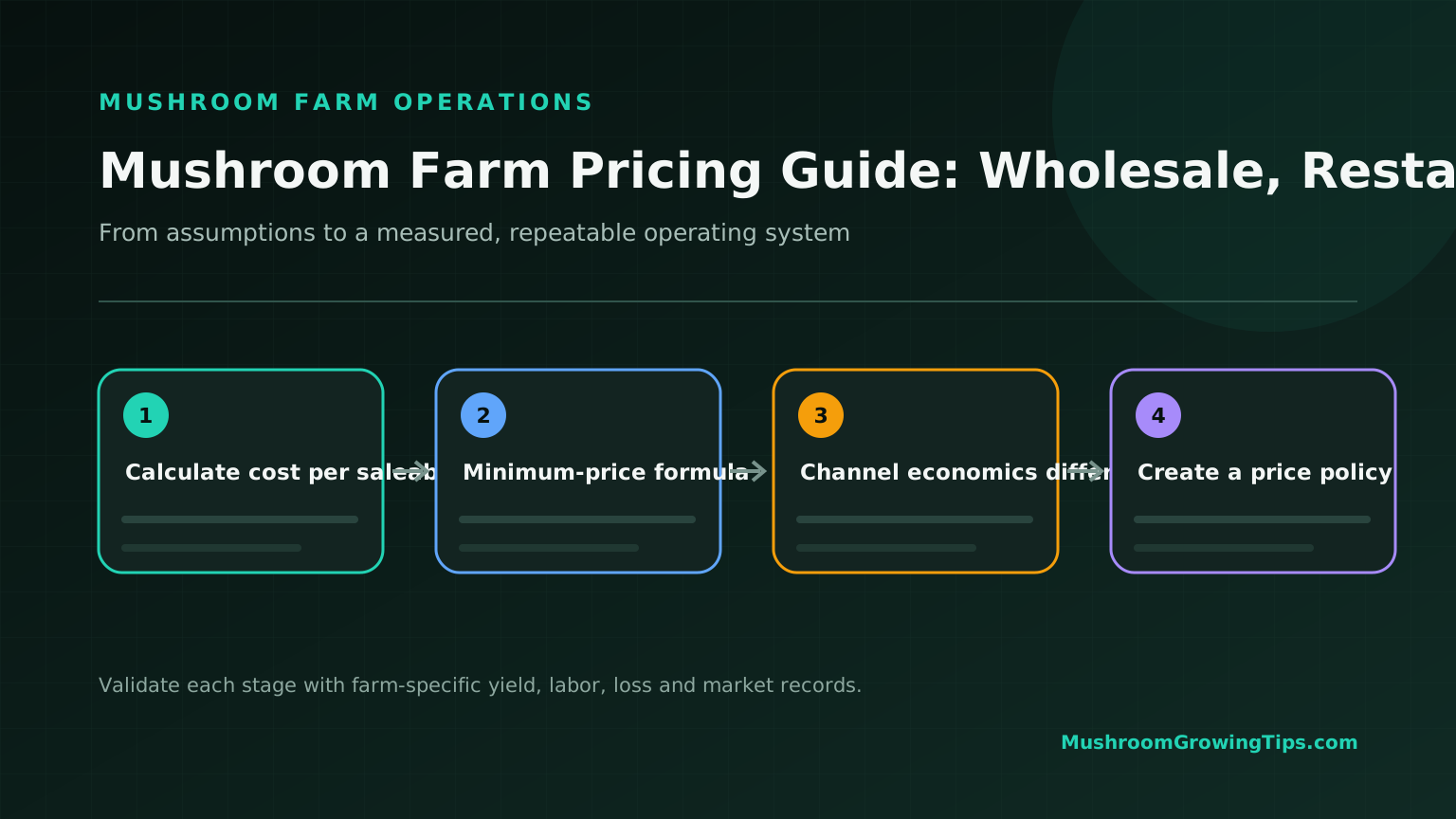
Price mushrooms from the fully loaded cost of saleable product, then test each channel's packaging, delivery, payment and waste burden. The minimum sustainable price is unit cost divided by one minus the required contribution-margin rate.
By Andrew Langevin · Founder, Nature Lion Inc · Contributing author, Mushroomology (Brill, 2026) · Updated August 11, 2026
Calculate cost per saleable kilogram
- Block materials and spawn
- Direct production, harvest and packing labor
- Packaging and labels
- Crop loss and downgraded product
- Allocated fruiting-room and refrigeration costs
- Delivery time, distance and vehicle cost
- Sales fees, discounts and bad debt
- Unsold and returned product
Minimum-price formula
If fully loaded cost is $10/kg and the farm requires a 35% contribution margin, minimum price is $10 ÷ (1 − 0.35), or $15.38/kg. This is not a market forecast; it is the price below which the entered margin cannot be achieved.
| Fully loaded cost | Target margin | Minimum price |
|---|---|---|
| $8/kg | 30% | $11.43/kg |
| $10/kg | 35% | $15.38/kg |
| $12/kg | 40% | $20.00/kg |
| $15/kg | 45% | $27.27/kg |
Channel economics differ
| Channel | Advantage | Hidden cost to measure |
|---|---|---|
| Distributor | Volume and consolidated delivery | Lower price, terms, rejected product |
| Restaurant direct | Premium relationship and product feedback | Small orders, sales time, multiple stops |
| Grocery wholesale | Recurring visibility and larger accounts | Packaging, barcodes, compliance, returns |
| Farmers market | Retail pricing and customer education | Market fees, staffing, unsold inventory |
| Subscription / CSA | Precommitted recurring demand | Packing complexity and customer service |
Create a price policy
- Define grades, pack sizes and minimum orders
- Set delivery zones, days and order cutoffs
- Document volume discounts and who may approve them
- Review realized price after credits and waste
- Increase prices when costs or service scope change—not only when competitors do
Frequently asked questions
How should a mushroom farm set wholesale prices?
Start with fully loaded cost per saleable unit, include channel-specific service and waste, then divide by one minus the required contribution margin. Validate the result against customer demand.
Why is retail mushroom pricing higher than wholesale?
Retail pricing must cover selling labor, market or transaction fees, small packaging, unsold inventory and customer service that wholesale channels may not require.
Continue building the farm plan
Commercial launch roadmap
Mushroom Farm Startup Checklist: From Market Test to First Sale
Follow a staged mushroom farm startup checklist covering market proof, crop trials, facility, records, food safety, production and launch readiness.
Premium crop planning
Lion’s Mane Yield per Block and Commercial Economics
Plan lion's mane mushroom yield per 5 lb block using dry substrate, biological efficiency, saleable grade, crop loss and shelf-week economics.
Worked business-plan example
Oyster Mushroom Farm Example: A 100 kg/Week Operating Plan
Study a worked 100 kg/week oyster mushroom farm example covering customers, blocks, rooms, labor, pricing, risks and financial assumptions.
Build this into a measured production plan
Use your own yields, labor, loss rate, prices and room constraints before committing capital or customer volume. The planning tools below turn these operating assumptions into a weekly model.