Post-Harvest
12 tips in Fruiting & Harvest
By Andrew Langevin · Founder, Nature Lion Inc · Contributing author, Mushroomology (Brill, 2026)
The best way to store fresh mushrooms is in a paper bag or wrapped loosely in a paper towel inside the refrigerator at 34-38F (1-3C). Paper absorbs excess moisture that would otherwise cause the mushrooms to become slimy and decompose faster. Never store fresh mushrooms in a sealed plastic bag or airtight container: mushrooms continue to respire after harvest and will quickly accumulate moisture and CO2 in a sealed environment, leading to rapid spoilage.
Storage best practices:
- If you use a plastic container, leave the lid cracked or poke several holes in the plastic wrap
- Place mushrooms in a single layer if possible to avoid bruising and allow air circulation
- Do not wash mushrooms before storage — brush off any substrate material with a dry pastry brush or soft cloth and wash just before cooking
- Keep mushrooms away from strong-smelling foods as they readily absorb odors
For longer storage, some growers wrap individual lion's mane or large shiitake in dry paper towels and place them in a partially open container in the coldest part of the fridge (not the freezer). For commercial growers, immediate cooling after harvest (within 1-2 hours) significantly extends shelf life. Harvest in the morning and keep mushrooms in a cooler at 36-38F.
Fresh mushroom shelf life varies dramatically by species and storage conditions. All of these estimates assume optimal storage: 34-38F (1-3C), in a breathable paper bag or loosely wrapped paper towel, in the main body of the refrigerator rather than the door where temperatures fluctuate.
Shelf life by species:
- Pink oyster — only 1-2 days, extremely perishable; deteriorates within hours at room temperature with a distinctly fishy smell
- Yellow oyster — 3-5 days
- Blue and pearl oyster — 5-7 days, though quality is best in the first 3-4 days
- Lion's mane — 7-10 days if stored properly and undamaged; bruised areas turn brown quickly
- Shiitake — 7-10 days, sometimes up to 14 days if very fresh
- King oyster — the shelf-life champion at 10-14 days, thanks to its dense, low-moisture stem
- Maitake (hen of the woods) — 5-7 days
- Nameko — 3-5 days due to its natural mucilaginous coating
- Chestnut mushrooms — 5-7 days
- Button mushrooms from stores — 7-10 days but were already several days old at purchase
The general pattern is that denser, firmer mushrooms with lower moisture content last longer. At room temperature, most fresh mushrooms deteriorate noticeably within 24 hours.
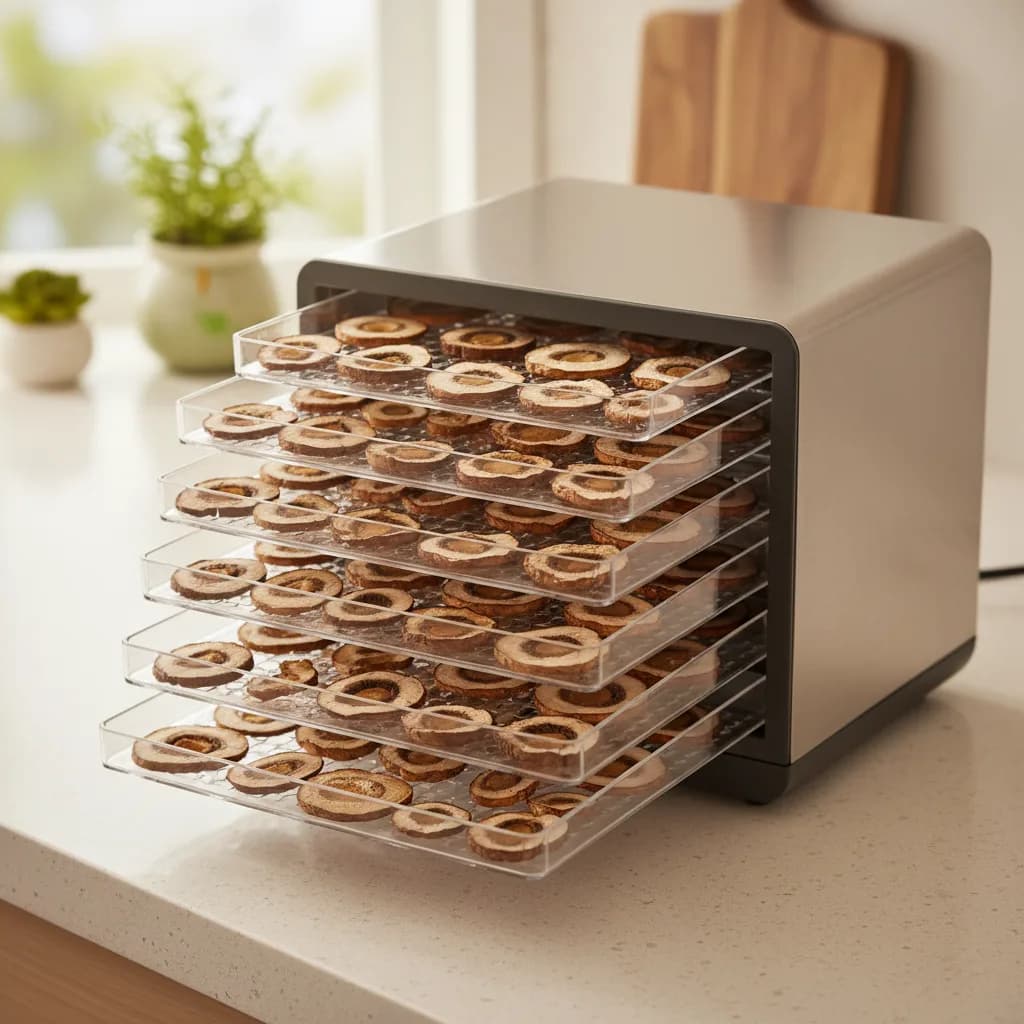
Dehydrating mushrooms is the most reliable method for long-term preservation and concentrates flavors significantly. Use a food dehydrator with adjustable temperature control for the best results. Set the temperature to 125-135F (52-57C) for most species — higher temperatures cook the mushrooms rather than drying them.
Preparation by species:
- Slice mushrooms into uniform pieces, 1/8 to 1/4 inch thick, for even drying
- Oyster mushrooms — can be torn into strips along their natural grain
- Shiitake caps — can be sliced or dried whole if small; remove tough stems and dry separately
- Lion's mane — tear or slice into 1/4-inch pieces
- King oyster — slices into beautiful even rounds
Arrange pieces in a single layer on dehydrator trays without overlapping, leaving space between pieces for airflow. Drying time depends on mushroom thickness, moisture content, and your dehydrator: expect 4-8 hours for thin slices and up to 12 hours for thicker pieces. Rotate trays every 2-3 hours if your dehydrator does not have a fan.
Alternative methods: use an oven set to its lowest temperature (usually 170F) with the door cracked open for airflow. Sun drying is possible in hot, dry, low-humidity climates by placing slices on a wire rack in direct sunlight for 1-2 days, covering with cheesecloth to keep insects off.
The ideal dehydration temperature for mushrooms is 125-135F (52-57C). This range removes moisture efficiently while preserving flavor compounds, nutritional value, and beneficial bioactive compounds like beta-glucans and ergothioneine. Below 120F (49C), drying is very slow and the extended time in a moist, warm environment can encourage bacterial growth. Above 150F (65C), you begin to cook the mushroom tissue rather than dehydrate it.
Special considerations:
- Medicinal mushrooms (reishi, turkey tail, chaga) — some growers use slightly higher temperatures of 140-150F (60-65C) because these will be powdered or brewed into tea rather than reconstituted whole
- Shiitake being dried for umami-rich cooking — 130F (54C) is ideal and develops the guanylate compounds that give dried shiitake their distinctive intense umami flavor, which is actually stronger than fresh shiitake
A recommended approach: start at 125F for the first 2 hours while moisture content is highest, then increase to 135F for the remaining time to finish drying efficiently.
If using an oven, most ovens do not go below 170F (77C), so keep the door cracked 2-3 inches to lower the effective temperature and provide airflow. An oven thermometer placed on the tray gives a more accurate reading than the oven dial.
The gold standard test for fully dehydrated mushrooms is cracker dry: when you bend or snap a dried piece, it should break cleanly with a crisp snap, just like a cracker or dry pasta. It should not bend, flex, or feel leathery. If it bends without breaking, there is still too much moisture inside and the mushrooms need more drying time.
This is critical because even a small amount of residual moisture (above 10%) creates conditions for mold growth during storage, which can ruin an entire batch weeks or months later.
Testing tips:
- Test several pieces from different trays since pieces vary in thickness and dry at different rates
- Check the thickest pieces, as thin edges may feel cracker-dry while the center is still moist
- Let pieces cool to room temperature before testing — warm mushrooms from the dehydrator may seem drier than they actually are
- The jar test: place a batch in a sealed glass jar and check the next day — if you see any condensation on the inside of the jar or the mushrooms have softened, they need more time in the dehydrator
A properly dried mushroom should weigh about 10% of its fresh weight. Mushrooms at 8% moisture or less will store safely for a year or more without mold or degradation.
Properly dried and stored mushrooms can last 1-2 years at full quality and remain safe to use for much longer. The enemies of dried mushrooms are moisture, oxygen, light, and heat.
Storage methods (from good to best):
- Glass mason jars with tight lids — add a food-grade silica gel desiccant packet to each container
- Vacuum-sealed bags — removes oxygen that causes oxidation and flavor loss; the sealed bag is impervious to ambient humidity
- Mylar bags with oxygen absorbers — best for very long-term storage (2+ years) in a cool basement
Store in a cool, dark location: a pantry, cupboard, or closet away from the stove and windows. Ideal storage temperature is 60-70F (16-21C). Avoid storing above the refrigerator where heat rises. Do not store in the refrigerator unless vacuum-sealed, as opening the cold container in a warm room causes condensation.
Maintenance:
- Label each container with the species, date dried, and batch number
- Check stored mushrooms every few months for signs of mold, off smells, or insect activity
- Pantry moths and grain beetles can occasionally find their way in; vacuum sealing or glass jars prevent this
You can freeze mushrooms, but raw freezing produces poor results for most species because the high water content (85-95%) forms ice crystals that rupture cell walls, resulting in a mushy, waterlogged texture when thawed. The best approach is to cook mushrooms before freezing.
Recommended freezing methods:
- Sauteed — cook sliced mushrooms in butter or oil over medium-high heat until they release their liquid and most of it evaporates (about 5-8 minutes); cool completely, flash freeze on a parchment-lined baking sheet for 1-2 hours, then transfer to freezer bags; keeps well for 6-12 months
- Blanched — boil mushroom slices for 1-2 minutes, ice bath, drain thoroughly, and freeze; best for soup, stew, or stock applications where texture is less important
- Duxelles — finely chopped mushrooms cooked down with shallots and herbs until nearly dry; freeze in ice cube trays for convenient portions
- Mushroom stock — simmer trimmings, stems, and imperfect pieces for 1-2 hours, strain, and freeze in portions; great way to use shiitake stems and oyster stem bases
Lion's mane freezes reasonably well raw because its texture is naturally stringy and fibrous, though it still benefits from cooking first.
Mushroom powder is made by grinding fully dehydrated mushrooms into a fine powder using a blender, spice grinder, or coffee grinder. The mushrooms must be cracker-dry first; grinding partially dried mushrooms produces a damp paste that clumps and molds. A coffee grinder produces the finest, most uniform powder.
How to make it:
- Break dried mushrooms into small pieces
- Pulse in short bursts until you achieve a fine powder
- Sift through a fine mesh strainer and re-grind any large pieces
- Store in airtight containers away from light and moisture
Mushroom powder is incredibly versatile:
- Shiitake powder — a potent umami booster; add 1-2 teaspoons to soups, sauces, rubs, gravies, and marinades
- Porcini powder — elevates risottos and cream sauces
- Lion's mane powder — popular as a supplement added to coffee, smoothies, and hot chocolate for potential nootropic and nerve-support properties
- Reishi powder — taken as a medicinal supplement, typically 1-3 grams daily in tea or capsules
- Turkey tail powder — used for immune support
- A blend of shiitake, maitake, and oyster mushroom powder makes an excellent all-purpose cooking seasoning
Mushroom powder also works as a thickener in soups and sauces since it absorbs liquid and adds body along with flavor.
Fresh mushroom shelf life depends on species density, moisture content, and how quickly you cool them after harvest. All estimates assume optimal storage at 34-38F (1-3C) in a breathable paper bag or loosely wrapped paper towel, in the main body of the refrigerator.
Shelf life by species:
- Pink oyster (Pleurotus djamor) — only 1-2 days, the most perishable cultivated mushroom; deteriorates within hours at room temperature with a distinctly fishy smell; rarely sold in grocery stores
- Yellow oyster — 2-4 days
- Blue and pearl oyster — 5-7 days
- Lion's mane — 7-10 days when undamaged, stored in a paper bag
- Shiitake — 7-10 days, sometimes 14 days due to relatively dry cap surface and dense flesh
- King oyster — 10-14 days, leads cultivated species thanks to its dense, thick stem with low moisture content
- Maitake — 5-7 days
- Nameko — 3-5 days due to natural mucilaginous coating
- Chestnut mushrooms — 5-7 days
- Pioppino — 7-10 days
- Button and cremini from stores — 7-10 days from purchase but may already be 3-7 days old
A spore print is a collection of spores deposited on a surface from a mature mushroom cap, used for microscopy, identification, or starting new cultures. Properly stored spore prints remain viable for 1-10+ years depending on species.
How to take a spore print:
- Select a mature mushroom with fully exposed gills, pores, or teeth that is at or just past the ideal harvest stage
- Cut the stem flush with the cap and place the cap gill-side-down on a clean piece of paper, aluminum foil, or glass
- Using both white and black paper (or foil) works well since some species have white spores invisible on white paper
- Cover the cap with a clean glass, bowl, or cup to prevent air currents from disturbing the deposit
- Leave undisturbed at room temperature for 6-24 hours
- Lift the cap carefully to reveal a radial pattern of spores matching the gill pattern
For shiitake, the print will be white to light tan. For oyster mushrooms, prints are white to pale lilac-gray. Allow the print to dry completely before handling. Store spore prints in a folded piece of foil inside a sealed zip-lock bag in the refrigerator.
Note that growing from spore prints produces genetically variable offspring, unlike cloning from tissue. For consistent results, tissue cloning onto agar is preferred by serious cultivators.
Raw morel mushrooms are toxic and must always be cooked thoroughly before eating. Uncooked morels contain hydrazine-related compounds that cause nausea, vomiting, and severe gastrointestinal distress. Proper preparation eliminates these toxins and unlocks the rich, nutty, earthy flavor that makes morels one of the most prized culinary mushrooms in the world.
Step-by-step safe preparation:
- Inspect and clean — slice each morel in half lengthwise to check that it is completely hollow inside (confirming it is a true morel, not a toxic false morel). Brush off visible dirt and debris
- Soak in salt water for 30 minutes — use 1 tablespoon of salt per liter of cold water. This drives out insects, larvae, and tiny forest debris hiding inside the honeycomb pits. Some foragers do two 15-minute soaks with fresh water each time
- Dry thoroughly — pat morels completely dry with paper towels or a clean kitchen cloth. Excess moisture prevents proper browning and causes splattering in hot fat
- Cook completely — sauté in butter over medium heat for 8-12 minutes, turning occasionally until they are golden brown on all sides and slightly crispy at the edges. The interior should be fully cooked through with no raw, spongy texture remaining
Cooking rules for morels:
- Never eat raw morels — even a small amount can cause illness
- Never serve morels with alcohol on the first try — some individuals experience an adverse reaction when combining morels and alcohol, though this is more commonly associated with certain other species
- Cook in small batches to avoid crowding the pan, which steams the mushrooms instead of searing them
- Store cooked morels in the refrigerator and consume within 2 days
When prepared correctly, morels develop an intensely savory, almost meaty flavor with a satisfying chewy texture that pairs beautifully with cream sauces, scrambled eggs, pasta, and wild game.
Store fresh mushrooms in a paper bag or breathable container in the main body of the refrigerator at 1-3°C (34-38°F). Paper absorbs excess moisture that would otherwise cause mushrooms to become slimy and rot. This single change — paper instead of plastic — can double or triple the usable life of most species.
Storage rules that matter most:
- Use a paper bag, not plastic — mushrooms continue respiring after harvest, releasing moisture and CO2. Sealed plastic traps both, creating a soggy environment that accelerates spoilage within 24-48 hours
- Never wash until ready to cook — water on stored mushrooms promotes bacterial growth and browning. Brush off substrate debris with a dry pastry brush or soft cloth instead
- Single layer if possible — stacking mushrooms causes bruising on delicate species like oyster and lion's mane. If space is limited, layer between paper towels
- Keep away from strong-smelling foods — mushrooms readily absorb odors from onions, garlic, and other aromatics through their porous flesh
- Use a breathable container — if using a plastic container, leave the lid cracked or poke several holes in plastic wrap to allow air exchange
Shelf life by species when stored properly:
- King oyster — 10-14 days (the shelf-life champion due to dense, low-moisture stems)
- Shiitake — 7-10 days
- Lion's mane — 7-10 days when undamaged
- Blue and pearl oyster — 5-7 days
- Maitake — 5-7 days
- Yellow oyster — 3-5 days
- Pink oyster — 1-2 days only (extremely perishable, develops a fishy smell quickly)
For commercial growers, rapid cooling within 1-2 hours of harvest is the single most impactful step for maximizing shelf life. Harvest in the morning and transfer immediately to a cooler at 1-3°C.
Need more help? Dr. Myco can answer follow-up questions about post-harvest based on thousands of real growing experiences.
Ask Dr. Myco