Mushrooms Not Pinning? Causes & Fixes
12 tips in Fruiting & Harvest
By Andrew Langevin · Founder, Nature Lion Inc · Contributing author, Mushroomology (Brill, 2026)
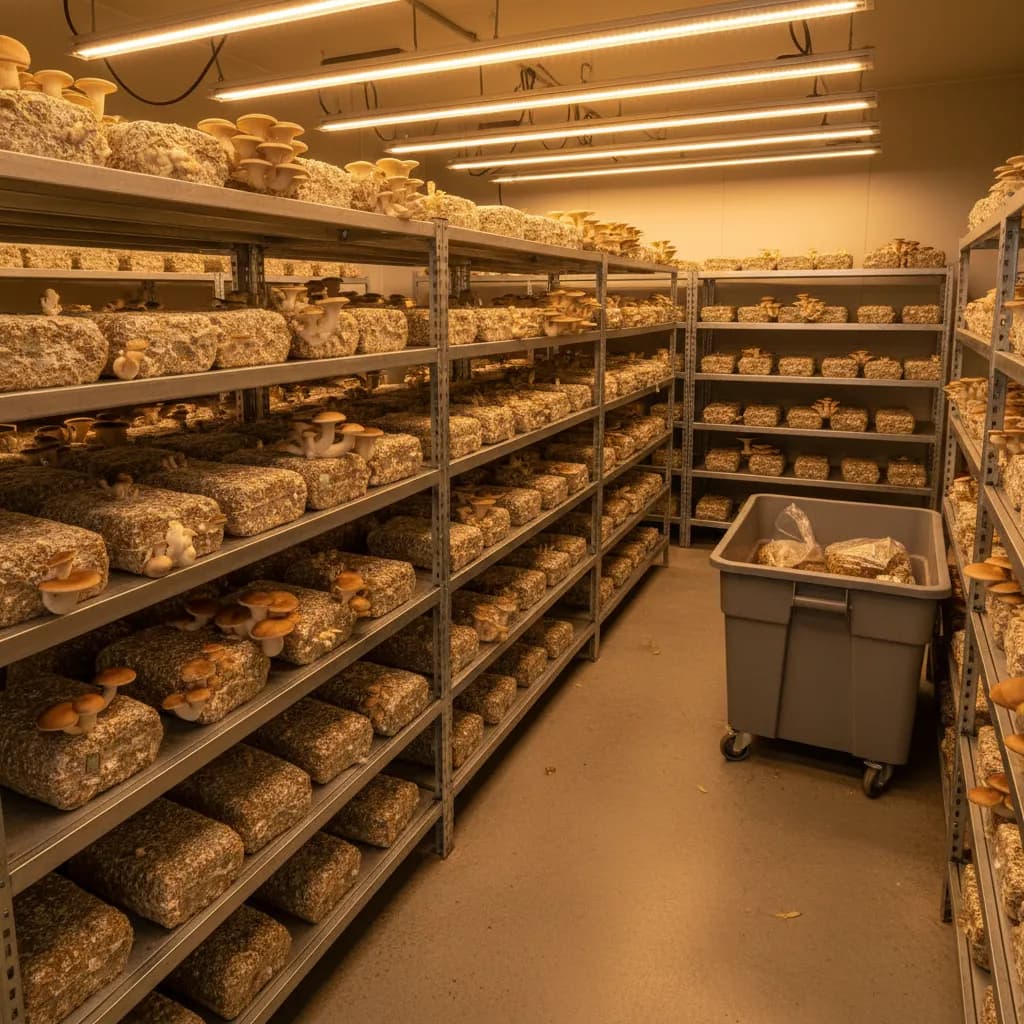
Quick diagnosis
Fully colonized substrate usually needs moisture at the surface, evaporation, fresh air, suitable temperature and a light cue
Change one measured condition at a time. Constant misting and repeated environmental swings can delay pinning or damage primordia.
| What you observe | What to do next |
|---|---|
| Substrate is not fully colonized | Wait; fruiting an unfinished block raises contamination risk |
| Surface looks dry or matte | Restore surface moisture gently; correct chamber humidity without soaking pins |
| Water pools or surface looks waterlogged | Stop misting the surface; increase evaporation and indirect air exchange |
| CO₂ remains high / air is stagnant | Increase measured fresh-air exchange without pointing a fan at the block |
| Temperature is outside the strain range | Move gradually into the supplier's fruiting range; do not cold-shock tropical species |
| No consistent light cue | Provide indirect daylight or a low-power 6000–6500 K light on a regular cycle |
| Block is colonized but immature | Allow species-specific consolidation; shiitake must brown before fruiting |
| Mycelium is thick and matted | Improve surface evaporation and avoid repeated heavy misting |
| Off odor, slime or unexpected color | Isolate and use the contamination diagnostic before changing fruiting conditions |
| Conditions look correct for 7–14 days | Verify sensor placement and strain requirements; then review genetics or block viability |
Pinning conditions by species
Use these as starting ranges. Strain instructions and conditions measured at block level take priority.
| Species | Initiation temperature | RH starting range | Important cue |
|---|---|---|---|
| Blue oyster | 13–18°C / 55–65°F | 85–95% | Fresh air, light and a cooler fruiting range |
| Pink oyster | 21–29°C / 70–85°F | 85–95% | Warm conditions; avoid refrigeration or cold shock |
| Lion's mane | 16–21°C / 60–70°F | 85–95% | Steady humidity and low CO₂ without direct drying air |
| King oyster | 13–18°C / 55–65°F | 85–95% | Cool initiation with fresh air; manage CO₂ after pins form |
| Shiitake | 10–21°C / 50–70°F | 85–95% | Fully browned block; strain-appropriate soak or temperature shift |
| Chestnut | 16–21°C / 60–70°F | 85–95% | Consolidation followed by fresh air, light and stable moisture |
Pins and primordia are the earliest visible stage of mushroom fruit body development. Primordia (singular: primordium) are tiny knots of hyphal tissue that form on the surface of colonized substrate when environmental conditions signal that it is time to fruit. They appear as small bumps, typically 1-3mm, that are denser and more organized than the surrounding mycelium. As primordia develop further, they differentiate into recognizable miniature mushrooms called pins, usually 3-10mm tall with a visible tiny cap and stem.
This is the most critical stage in the grow cycle because primordia are fragile: small changes in humidity, temperature, or airflow can cause them to abort (stop developing, darken, and shrivel). Once pins successfully develop past about 1cm, they are much more resilient and will generally grow to maturity.
The time from first visible primordia to pins varies by species:
- Oyster mushrooms — primordia to pins in 1-2 days
- Shiitake — may take 3-5 days
Recognizing primordia early lets you ensure conditions are dialed in before the critical growth phase. Look for a change in the surface texture: the smooth mycelium surface becomes bumpy and nodular as primordia form.
Triggering pinning requires shifting environmental conditions to mimic what a mushroom encounters when mycelium reaches the soil surface in nature. The four main triggers are fresh air exchange (FAE), light, humidity, and temperature change.
For most species, pinning is initiated by introducing FAE: the drop in CO2 and increase in oxygen signals that the mycelium has reached an open surface. Specific methods by setup:
- Monotub — crack or flip the lid after colonization is complete
- Martha tent — place fully colonized blocks on shelves and run the humidifier and exhaust fan
- Light — switch from darkness to a 12/12 light cycle with indirect light or a 6500K bulb
- Humidity — keep stable at 85-95% RH
- Temperature drop — a 5-15F (3-8C) drop from colonization temperature is a powerful trigger, especially for shiitake and oyster mushrooms
Some growers combine multiple triggers simultaneously for the strongest effect: move a block from a warm dark closet to a cooler room with light, humidity, and FAE all at once.
Patience is important: after introducing fruiting conditions, pins may take 3-10 days to appear depending on species. Do not keep adjusting conditions during this waiting period.
A pinset refers to the total number and distribution of pins that form across the substrate surface during a single fruiting event. An even, abundant pinset means many primordia formed simultaneously across the entire surface, which leads to a large flush of similarly-sized mushrooms that mature at roughly the same time. An uneven pinset, where pins form in isolated clusters or only on one side, typically produces fewer total mushrooms and makes harvesting less efficient.
The quality of your pinset is determined by how uniformly colonized the substrate is and how evenly fruiting conditions are distributed across the surface. If one side of a monotub gets more FAE than the other, pins will concentrate on that side. If the substrate surface has dry spots, those areas will not pin.
Key factors for good pinsets:
- Complete colonization before fruiting
- A level substrate surface
- Even misting
- Consistent FAE from multiple holes rather than a single opening
Commercial growers invest heavily in climate uniformity for this reason: even airflow, even humidity, even light. The first flush typically produces the best pinset; subsequent flushes tend to pin more unevenly as the substrate becomes depleted in some areas faster than others.
Cold shocking is a technique where fully colonized substrate is exposed to a brief period of cold temperature to trigger pinning. It works by mimicking the natural temperature drop that occurs in autumn or after a cold rain, which many mushroom species have evolved to use as a fruiting cue.
Cold shocking is well-documented and effective for certain species:
- Shiitake — almost essential for reliable fruiting of many strains
- Oyster mushrooms — helps but is often not necessary since oysters pin readily with just FAE and light
- Pioppino and nameko — respond well to cold shock
For these species, a drop of 10-20F (6-11C) below their colonization temperature for 12-24 hours can dramatically improve pinset density and speed of pin formation. The cold shock appears to trigger a stress response that shifts the mycelium from vegetative mode to reproductive mode.
For shiitake, place the fully colonized block in a refrigerator at 38-50F (3-10C) for 12-24 hours, then return it to fruiting conditions. Pins typically appear within 3-7 days. The cold period does not need to be exact: even moving blocks from a 75F room to a 60F garage overnight can provide enough of a trigger. Do not freeze the substrate as ice crystals will damage the mycelium.
Shiitake cold shocking is a well-established technique with specific parameters. Once your shiitake block is fully colonized and has turned brown and bumpy on the surface (a process called browning or popcorning that takes 2-4 weeks after full colonization), it is ready for cold shock.
The cold shock process:
- Place the block in a refrigerator set to 36-50F (2-10C), ideally 38-45F (3-7C)
- Leave it for 12-24 hours; most growers find 16-20 hours works best
- Some traditional Japanese log growers soak logs in cold water simultaneously, combining cold shock with a hydration soak
- For supplemented sawdust blocks, you can submerge the block in a clean bucket or cooler filled with cold water for 12-24 hours to achieve both effects at once
After the cold shock, return the block to your fruiting chamber at 60-70F (16-21C) with 85-90% RH, FAE, and 12/12 light. Pins should appear within 4-7 days. If no pins appear after 10 days, the block may need additional browning time or a second cold shock.
Some strains, particularly warm-weather shiitake isolates, require less dramatic cold shocks or no cold shock at all. Always check your spawn supplier's recommendations for your specific strain.
No, cold shocking does not work for tropical mushroom species and can actually harm or kill them. Tropical species like pink oyster (Pleurotus djamor), yellow oyster (Pleurotus citrinopileatus), paddy straw mushroom (Volvariella volvacea), and tropical reishi strains evolved in warm climates where natural cold events do not occur. These species do not have the genetic programming to interpret a temperature drop as a fruiting trigger.
Exposing pink oyster mycelium to refrigerator temperatures (36-45F) can shock and severely weaken the mycelium, potentially killing it outright. Pink oyster is particularly cold-sensitive and can start dying below 55F (13C).
Instead, tropical species pin in response to other cues:
- Fresh air exchange
- Light
- Simply reaching full colonization
- Pink oyster will often begin pinning on its own as soon as the substrate is colonized, sometimes even pinning through filter patches on grow bags
For species in the moderate range like king oyster and lion's mane, a mild temperature drop of 5-10F can help trigger pinning but a full cold shock to refrigerator temperatures is unnecessary and potentially counterproductive. Always research the natural habitat and temperature range of your specific species before applying cold-weather techniques.
Pin aborts occur when primordia or small pins stop developing, darken in color, and eventually shrivel. They are one of the most frustrating problems in mushroom cultivation. The most common cause is a sudden drop in humidity — primordia and young pins are mostly water and have no protective outer layer; even a brief dip below 80% RH can desiccate them irreversibly.
Other common causes:
- Opening the chamber too often, running the exhaust fan too long, or a humidifier running out of water overnight
- Insufficient moisture in the substrate itself — if the block was too dry going into fruiting, the mycelium cannot supply enough water to developing pins
- Temperature swings, especially rapid increases above the species' optimal range
- Contamination from bacteria or mold competing with the mycelium (causes localized aborts)
- A nutritionally depleted substrate (late flushes) that simply cannot support all the pins that formed
To prevent aborts, keep humidity consistently above 85%, avoid opening the chamber unnecessarily, ensure substrate is at field capacity before fruiting, and maintain stable temperature. If you get aborts, remove them by gently twisting them off, as decaying aborts attract fungus gnats and can harbor bacteria.
An even pinset starts with even colonization. If your substrate has uncolonized patches, those areas will not pin. Ensure your spawn is evenly distributed throughout the substrate and that colonization is thorough before introducing fruiting conditions. Use an appropriate spawn rate: 10-20% spawn to substrate by weight for most grain-to-bulk recipes. Higher spawn rates mean faster, more even colonization.
Surface conditions are critical. The substrate surface should be flat and smooth at the same height across the entire tub. After spawning, press the surface gently with a clean gloved hand or flat piece of cardboard to create a level plane. Do not compact it heavily, just level it.
Tips for even pinning:
- When cracking the lid, ensure even airflow across the entire surface — flip the lid or use a gap on both sides
- Position light centrally above the tub rather than from one side
- The bubble wrap tek (laying a sheet of bubble wrap, bubble-side down, on the substrate surface during primordia formation) helps create a consistent microclimate and is one of the most effective tricks for improving pinsets
- Remove the bubble wrap once pins are 3-5mm tall
The time from visible pins to harvest-ready mushrooms varies significantly by species. Temperature affects timing: cooler temperatures within the species' range slow growth but often produce denser, higher-quality fruit bodies, while warmer temperatures speed things up but may reduce quality.
Pin-to-harvest timelines:
- Blue and pearl oyster — 3-5 days, sometimes as little as 3 days at optimal temperature
- Pink oyster — even faster in warm conditions, sometimes 2-3 days from pins
- King oyster — much slower: 5-7 days for pin development plus 7-14 days for stem elongation and cap development, totaling 14-21 days
- Lion's mane — 7-14 days from visible primordia; teeth (spines) should be 1-2cm long at harvest
- Shiitake — pins develop over 5-7 days, caps expand over another 5-10 days, totaling 10-14 days
- Maitake (hen of the woods) — one of the slowest at 3-6 weeks from primordia to full maturity
- Chestnut mushrooms — 7-10 days
- Reishi — 2-4 weeks from primordia to the point where the white growing edge stops advancing
A casing layer is a thin layer of non-nutritious material applied on top of a colonized substrate to create a microclimate that promotes even pinning. The casing holds moisture at the surface, maintains consistent humidity, and provides a humid microenvironment that mycelium interprets as being at the soil surface, which triggers pinning.
Common casing materials:
- Peat moss mixed with vermiculite
- Pure vermiculite
- Coco coir
- pH-adjusted peat moss
The casing layer is typically applied 1/4 to 1/2 inch thick after the substrate surface is fully or nearly fully colonized. It is not necessary for all species: oyster mushrooms, lion's mane, and shiitake generally pin well without a casing layer.
However, casing layers are essential or very beneficial for certain species: Agaricus (button mushrooms, portobello) almost always require a casing layer to pin reliably. King oyster benefits from a thin casing layer in some setups. The casing should be moist but not dripping: squeeze a handful and you should get a drop or two of water at most. pH is important for Agaricus cultivation: the casing should be around pH 7-8, which is why peat (naturally acidic at pH 3-4) is mixed with lime or hydrated lime.
The 50/50 peat-vermiculite casing layer is one of the most commonly used casing recipes due to its simplicity, water-holding capacity, and balanced air porosity. Mix equal parts (by volume) of sphagnum peat moss and coarse vermiculite in a clean bucket or container. For a standard monotub, 2 quarts of each is typically sufficient.
Hydrate the mixture by slowly adding water and stirring until it reaches the right moisture level: squeeze a handful firmly and you should get only a few drops of water. If water streams out, the mix is too wet; add more dry material. If no water comes out at all, add more water. The peat holds moisture while the vermiculite provides air pockets and structural support.
Preparation steps:
- If growing Agaricus, add hydrated lime at a rate of 2 tablespoons per quart of dry mix to bring the pH to approximately 7.5-8.0 (for most other species, lime is optional)
- Pasteurize by microwaving in a microwave-safe container for 2-3 minutes until it steams, then let it cool completely (alternatively, pour boiling water over the dry mix and let it cool)
- Apply 1/4 to 1/2 inch thick evenly over the colonized surface
The mycelium will grow through the casing in 3-7 days, and pins will form on or just above the casing surface.
Bubble wrap tek is a simple technique where a sheet of bubble wrap is placed bubble-side down directly on the substrate surface during the pinning stage. The small air pockets between the bubbles and the substrate create hundreds of tiny humid microclimates that are ideal for primordia formation. The bubble wrap reduces moisture evaporation from the surface and maintains consistently high humidity at the substrate level even if the chamber humidity fluctuates.
How to use this technique:
- Cut a piece of standard small-bubble bubble wrap to fit inside your tub or tray, leaving a 1-inch gap around the edges for some air exchange
- Lay it directly on the substrate surface, bubble-side down
- Check under the wrap daily — you should see tiny primordia forming within 3-7 days
- Once pins reach about 3-5mm in height, remove the bubble wrap permanently and allow the mushrooms to grow normally
Leaving the bubble wrap on too long can trap too much moisture and encourage bacterial growth or cause pins to grow laterally. This technique is particularly effective for getting even pinsets in monotubs and trays, and is widely used as a remedy for tubs that struggle to pin due to low ambient humidity. It costs almost nothing and works remarkably well.
Put these tips into context
Review timing, moisture, temperature, light, fresh air, and kit format.
Troubleshoot a grow kit that is not pinningNeed more help? Dr. Myco can answer follow-up questions about mushrooms not pinning? causes & fixes based on thousands of real growing experiences.
Ask Dr. Myco