Common Problems & Fixes
20 tips in Contamination & Troubleshooting
By Andrew Langevin · Founder, Nature Lion Inc · Contributing author, Mushroomology (Brill, 2026)
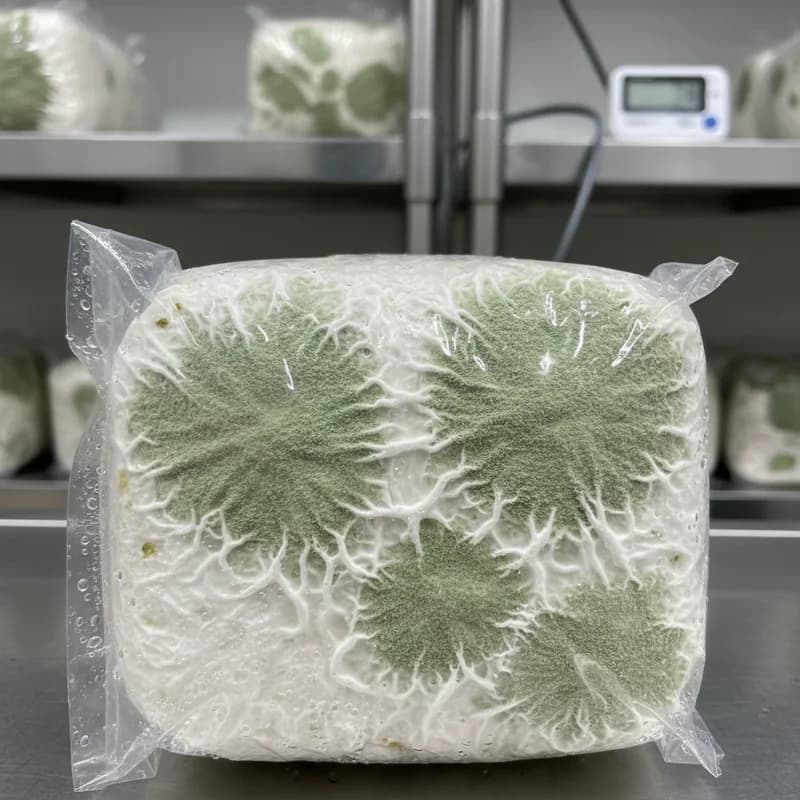
Fuzzy feet — thick white mycelial growth climbing up the base of your mushroom stems — is one of the most common issues in indoor cultivation and the solution is simple: increase your fresh air exchange. The fuzz is aerial mycelium that forms when carbon dioxide levels around the base of the mushrooms are too high. Mushroom mycelium naturally grows toward CO2-rich environments, so when CO2 accumulates in your fruiting chamber, the mycelium at the stem base starts reaching upward into the stagnant air. It is not contamination and it is not harmful.
To fix fuzzy feet:
- If fanning manually, increase from twice daily to four to six times daily
- If using a fan on a timer, increase the on-time or decrease the interval between cycles
- If you have passive air holes in your tub, make them larger or add more
- A small computer fan on a timer, blowing across your tub openings rather than directly at the mushrooms, often provides the right balance
The fuzzy feet should start reducing within 24 to 48 hours of improved air exchange. Be careful not to overcorrect — too much air exchange drops humidity and causes other problems. The goal is to increase air exchange just enough that the fuzz stops growing without drying out your mushrooms. You want CO2-heavy air replaced regularly while maintaining humidity above 85%.
Pin abortion — where small mushroom pins stop growing, darken, and shrivel up — is frustrating and usually caused by sudden environmental changes rather than contamination. Mushroom pins are extremely sensitive to their environment, and even a brief period of unfavorable conditions can kill actively growing pins. They cannot recover — those specific pins are done, but new pins should form once conditions stabilize.
The most common triggers:
- Humidity drops — If humidity fell below 80% for several hours (humidifier ran dry overnight or tub was left open too long)
- Temperature swings — A sudden 10-degree swing, especially a cold snap, can abort an entire pin set; keep fruiting temperatures within a 5-degree Fahrenheit range
- Insufficient FAE — CO2 accumulating to toxic levels causes pins to abort
- Erratic light schedules — Inconsistent lighting can stall pin development
If you see a mix of healthy pins and aborted ones, the healthy pins were likely in a slightly more favorable microclimate — closer to a FAE hole, or in a more humid pocket. The aborted pins were in the worst zone. Use this information to identify and fix the environmental inconsistency.
If your fully colonized substrate has been in fruiting conditions for three weeks without forming pins, something in your environmental parameters is off. The mycelium needs specific triggers to switch from colonization mode to fruiting mode, and at least one of those triggers is missing.
Check these parameters in order of likelihood:
- Fresh air exchange (most common cause) — Many species require a significant drop in CO2 to trigger pinning; if your tub is too sealed, crack your lid, add more holes, or increase fanning dramatically
- Temperature — Many species require a 5 to 15 degree Fahrenheit drop from colonization to fruiting temperature; research the specific range for your species
- Light — Most species require some ambient light as a pinning trigger; a 12-on-12-off cycle with normal room light is sufficient; complete darkness can prevent pinning
- Humidity — Must be consistently above 85%, ideally 90 to 95% during pinning; if your casing layer or substrate surface is drying out, it will not pin
Finally, consider your genetics. Some isolates are poor fruiters, especially if derived from a multispore syringe. If everything environmental checks out, try a different culture from a reputable supplier.
Stalled colonization — where mycelium grows partway through the substrate and then stops — usually comes down to moisture, temperature, gas exchange, or culture viability. Identifying which factor is responsible requires checking each one systematically.
Common causes of stalled colonization:
- Moisture (most common) — Substrate too dry does not provide enough water for expansion; substrate too wet creates anaerobic conditions where bacteria thrive; aim for field capacity where a firm squeeze produces a few drops but not a stream
- Temperature — If your colonization area dropped below the minimum for your species (most stall below 65 degrees Fahrenheit); check with a thermometer placed directly against the container
- Gas exchange — If your filter patch is wet, blocked, or the lid is sealed without gas exchange, CO2 builds up and stalls growth
- Culture viability — Old liquid culture, contaminated syringe, or senescent culture that has lost vigor
A useful diagnostic: if only some of your jars stalled and others from the same batch are fine, the stalled jars likely have a moisture or contamination issue. If all jars stalled, suspect temperature or culture viability. For grain jars specifically, check for wet, darkened grain at the bottom — that is bacterial contamination blocking further colonization.
Wet, soggy substrate is a recipe for bacterial contamination and poor mushroom yields. The fix depends on when you catch it. The target is field capacity: a firm squeeze of the substrate produces a few drops of water but not a stream.
Fixes by timing:
- Before inoculation — Spread substrate on a clean surface to dry down; for grain, spread on a clean baking sheet in front of a fan for 30 to 60 minutes, stirring occasionally; for bulk substrate, squeeze out excess water by hand or let it drain longer
- After inoculation, before colonization — You may be able to drain excess water by tilting sealed jars, though this risks contamination; for grain jars with visible pooling at the bottom, starting over is often safest
- In a tub after spawning — Increase air exchange by leaving the lid cracked or adding more holes; gently press paper towels onto standing water to wick it away
Prevention is key:
- Measure your water carefully during substrate preparation
- Always test a handful before committing to inoculation
- Slightly too dry is always better than slightly too wet — you can add humidity during fruiting, but you cannot remove moisture from a sealed, colonizing container
Cracked, dry mushroom caps are a direct result of insufficient humidity during the fruiting phase. Mushroom fruiting bodies are roughly 90% water, and they rely on ambient humidity to maintain that moisture content as they grow. When the relative humidity drops below about 80%, the caps lose water faster than the mycelium can deliver it from the substrate, and the surface tissue dries out and cracks.
This is especially visible on species with large, flat caps like shiitake, where the cracking pattern can resemble dried mud. Some growers actually desire mild cap cracking on shiitake — the donko or flower pattern — but severe cracking on most species means humidity is dangerously low.
To fix and prevent cap cracking:
- Check your humidifier output and reservoir level
- If relying on manual misting, mist more frequently — fruiting mushrooms in dry environments may need misting every few hours
- Seal unnecessary openings in your fruiting chamber
- Check that your perlite layer (if using a SGFC) is adequately moist
- Ensure FAE is not so aggressive that it strips humidity from the chamber
- Install a hygrometer inside your fruiting chamber — do not guess at humidity levels
Aim for 85 to 95% relative humidity during active fruiting. If you are in a dry climate or running forced-air heating, you may need an ultrasonic humidifier on a humidistat controller to maintain consistent levels automatically.
King oyster mushrooms (Pleurotus eryngii) are prized for their thick, meaty stems, but achieving that characteristic shape requires specific environmental manipulation that differs from most other mushroom species. Thin, spindly king oysters with large caps usually mean too much fresh air exchange and not enough CO2 during the stem elongation phase — the opposite of what most other species want.
King oysters develop thick stems in response to elevated CO2 levels. High CO2 encourages stem elongation while suppressing cap development. Most growers reduce FAE significantly during king oyster growth, allowing CO2 to build up.
Target conditions for thick king oyster stems:
- CO2 — Around 2000 to 3000 ppm, much higher than the 400 to 800 ppm for regular oyster mushrooms
- Light — Minimal overhead light; a dim, side-lit environment encourages the tall, thick stem morphology
- Temperature — 55 to 65 degrees Fahrenheit; warmer temperatures produce thinner stems and larger caps
- Late-stage FAE — After stems reach desired thickness and length, increase FAE for the final day or two to allow caps to flatten and mature
If you have been growing king oysters like regular oyster mushrooms, the fix is counterintuitive: seal up your fruiting chamber more, reduce fanning, and lower the temperature.
Small fruits and low yields come down to nutrition, hydration, genetics, or environmental conditions — and often a combination of all four. A standard fruiting block of supplemented hardwood sawdust should produce roughly 1 to 2 pounds of oyster mushrooms over multiple flushes. If you are getting a fraction of that, investigate each factor.
Key factors affecting yield:
- Nutrition — Supplemented substrates (sawdust with wheat bran, straw with soybean hull) produce dramatically larger yields than unsupplemented ones; if supplementation rate is too low or nutrients were depleted by contamination or excessive colonization time, yields suffer
- Hydration — Mushroom fruit bodies are mostly water; if your substrate is on the dry side, the mycelium cannot pump enough water into developing fruits; soak your blocks between flushes to rehydrate
- Genetics — A multispore syringe contains random genetic combinations, and some produce tiny fruits with poor yields; commercial operations use carefully selected isolates tested for productivity
- Environment — Low humidity stunts growth, wrong temperature reduces yields, and insufficient light can limit fruit body size for some species
If your technique is solid but yields are consistently low, try a culture from a reputable supplier. Genetics play a larger role than many new growers realize.
Side and bottom fruiting happens because mushroom primordia form wherever conditions are favorable — and the microclimate along the sides and bottom of your container is often more humid and protected than the top surface. When mycelium detects the right combination of fresh air, humidity, and light at the interface between substrate and container wall, it pins there.
To direct fruiting to the top surface:
- Use a black plastic liner inside your tub — as substrate shrinks during colonization and fruiting, the liner clings to the surface and moves with it, eliminating the gap between substrate and container wall where side pins form
- Block light from below — Make sure your tub is opaque on the bottom; place tubs on a dark, opaque surface or wrap the bottom and lower sides with black plastic; light penetrating from below triggers bottom pinning
- For bags — Fruiting occurs at the cut holes because those are the only fresh air access points
Mushrooms will always fruit where conditions are best, so engineer those conditions to be where you want them. If you want fruiting on specific surfaces, control where the fresh air access and light exposure occur. The liner technique is the single most effective method for preventing side and bottom pins in monotubs.
Overlay is a dense, thick, sometimes waxy-looking mat of mycelium that forms on the top surface of your substrate and prevents mushroom pins from forming through it. It looks like a solid white sheet covering the surface, often thicker and more compacted than normal surface mycelium. Overlay occurs when the mycelium colonizes the surface too aggressively before fruiting conditions are introduced.
Common causes of overlay:
- Waiting too long to introduce fruiting conditions after the surface has fully colonized
- Maintaining colonization temperatures too long
- High CO2 during late colonization encouraging thick mycelial growth without triggering fruiting
To fix existing overlay:
- Carefully score or fork the surface — using a sterile fork, gently scratch through the mycelial mat to break it up and create openings for pins
- Some growers lightly scrape the surface with a sterile knife
- After disrupting the mat, introduce proper fruiting conditions immediately: drop the temperature, increase FAE dramatically, provide light, and mist the surface
- Pins should begin forming in the scratched areas within a week
To prevent overlay in the future, introduce fruiting conditions as soon as the surface is colonized rather than waiting. The transition from colonization to fruiting should be prompt. A thin, healthy casing layer applied no thicker than half an inch also helps.
A failed second flush is one of the most common frustrations in mushroom growing, and the cause is almost always dehydration. During the first flush, your mushroom fruits pulled a tremendous amount of water out of the substrate — mushrooms are about 90% water by weight. A block that produced a pound of mushrooms lost roughly 14 ounces of water, leaving the substrate significantly drier than it started.
The standard fix is soaking — submerge your fruiting block or substrate in clean, cold water for 6 to 24 hours between flushes:
- For grain-based substrates in tubs, fill the tub with water, place a plate or lid on the surface to keep the substrate submerged, and drain after 12 to 24 hours
- For sawdust blocks, submerge in a clean bucket or cooler
- Cold water is better than warm — it discourages bacterial growth during the soak
After soaking, drain thoroughly and return to fruiting conditions. Pins should appear within 5 to 10 days.
If your block has been sitting dry for more than a week after the first flush, the surface mycelium may have died. In that case, soak longer and be patient — deeper mycelium may still be viable and can recolonize the surface. Also consider that your substrate may simply be spent — smaller blocks or poorly supplemented substrates may only have enough nutrition for one good flush.
If your liquid culture shows no visible mycelial growth after 7 to 14 days, several factors could be responsible. Check each one systematically to identify the issue.
Common causes of slow or absent LC growth:
- Temperature — LC grows best at the upper end of your species' colonization range, typically 75 to 80 degrees Fahrenheit; if sitting in a cool room at 65 degrees, growth may not be visible for weeks
- Inoculum viability — Spore syringes can have low spore counts or low viability, especially if old or improperly stored; LC-to-LC transfers with a known good culture are much more reliable; if using agar, ensure the piece was from an actively growing edge, not an old stagnant region
- Broth recipe — Too much sugar inhibits growth (most recipes call for 3 to 4% light malt extract or honey by weight); too concentrated becomes osmotically stressful; too dilute lacks nutrition; ensure broth was fully dissolved before sterilization
- Lack of agitation — Stagnant LC grows much slower than LC that is swirled regularly
Swirl or shake your LC jar every day or two — this breaks up the mycelial mass, creates more growing tips, and distributes nutrients. A magnetic stir plate is ideal but manual swirling works fine.
A monotub that refuses to fruit despite full colonization is one of the most common complaints in mushroom cultivation. The problem is almost always environmental — your mycelium needs specific triggers to switch from vegetative growth to fruiting, and at least one trigger is missing.
Systematically check each fruiting trigger:
- Fresh air exchange: This is the number one cause. Your tub needs significantly more FAE during fruiting than during colonization. Crack the lid, widen your holes, or fan more frequently — CO2 must drop for pinning to initiate
- Humidity: Surface moisture is essential. The substrate surface should have tiny water droplets visible — mist lightly if it looks dry, but avoid pooling water
- Temperature drop: Many species need a 5-10 degree Fahrenheit reduction from colonization temperature. Move the tub to a cooler location or lower your room thermostat
- Light: Provide 12 hours of ambient light daily. Mushrooms use light as a directional and timing cue — complete darkness can prevent pinning entirely
- Patience: Some genetics are slower than others. If all environmental parameters are correct, give it another week before making changes
If none of these work after two additional weeks, consider that your genetics may be poor fruiters, your substrate may be too dry, or overlay may have formed on the surface. Try forking the surface lightly with a sterile fork to break through any thick mycelial mat that could be blocking pin formation.
When grain jars sit with no visible growth for weeks after inoculation, the issue usually traces back to inoculum viability, temperature, or grain preparation. Work through each potential cause systematically before discarding.
Most likely causes in order:
- Dead or weak inoculum: Spore syringes lose viability over time, especially if stored improperly or exposed to heat. Liquid culture can die if contaminated or too old. Agar wedges from stagnant or senescent areas of a plate may fail to grow. Test your culture on agar first before committing to grain
- Temperature too low: Most species need 70-80 degrees Fahrenheit for colonization. A jar sitting at 60 degrees may show no growth for weeks. Place a thermometer directly against your jars to verify actual temperature
- Grain too wet: Waterlogged grain becomes anaerobic and bacterial, creating an environment hostile to mycelium. The grain should have no visible surface moisture and individual kernels should separate freely when shaken
- Grain too dry: Overly dry grain does not provide enough moisture for mycelial growth. Kernels should be hydrated through to the center but dry on the surface
- Contamination blocking growth: Bacteria can colonize grain invisibly, producing acids that inhibit mycelium. Smell the jar — any sour odor confirms this
A useful diagnostic: Inoculate a test plate of agar alongside your grain jars. If the agar shows growth but the grain does not, your grain preparation is the problem. If neither shows growth, your inoculum is the issue.
This is one of the most commonly asked questions in mushroom growing, and the answer depends on what type of contamination is present and where it is relative to your fruiting bodies. The general rule is to err on the side of caution, but not every contamination event means you must discard your harvest.
Generally safe to eat:
- Mushrooms that have already fully developed on a block where a small patch of Trichoderma appeared far from the fruiting bodies
- Fruits from a block with minor cobweb mold that was treated with hydrogen peroxide and did not contact the mushrooms directly
- Mushrooms growing from a block where the contamination appeared after the fruits were already maturing
Do not eat:
- Mushrooms growing directly from or adjacent to visible mold colonies
- Any fruits from a block contaminated with Aspergillus (black mold) — aspergillus produces mycotoxins that can be present even in areas that appear clean
- Mushrooms that have an off smell, unusual discoloration, or slimy texture
- Any fruits from blocks with bacterial contamination showing sour smells or wet rot
When in doubt, discard the mushrooms. The risk of consuming mycotoxins or bacterial metabolites is not worth saving a small harvest. Future flushes from a contaminated block should also be viewed with suspicion, as the contamination will typically worsen over time.
Oyster mushrooms are among the most forgiving and aggressive fruiters in cultivation, so if they refuse to pin, something is significantly off in your environment. The good news is that the fix is almost always straightforward because oysters have simple requirements.
Check these factors in order:
- Fresh air exchange (most common cause): Oyster mushrooms are extremely sensitive to CO2 levels. They need aggressive FAE — far more than most other species. If growing in bags, make sure your cuts or holes are large enough. If in a tub, leave the lid cracked wide. Oysters want CO2 below 800 ppm to pin properly
- Humidity: While oysters tolerate lower humidity than many species, the substrate surface still needs to stay moist. Mist regularly if you are not running a humidifier
- Temperature: Most oyster species fruit in a wide range (55-75 degrees Fahrenheit), but some strains need a cold shock. Try moving your block to a cooler location for 24-48 hours
- Light: Provide at least some ambient light — oysters use it as a directional cue
- Substrate exhaustion: If the block has already produced several flushes, it may be spent
If your oyster mushroom block has been in fruiting conditions for more than two weeks with no pins, dramatically increase FAE as your first intervention. Open the fruiting chamber, add a fan, or move the block to an area with natural air movement. Oysters will often pin within days once CO2 levels drop sufficiently. Also check that your substrate is not overly dry — soak spent blocks between flushes.
Mushrooms growing sideways, bending dramatically, or reaching toward one direction are responding to environmental cues — most commonly light and fresh air. Mushroom fruiting bodies use both light and CO2 gradients to determine which direction to grow, and if these cues are coming from the side rather than above, your mushrooms will grow toward them.
Common causes and fixes:
- Light coming from the side: If your only light source is a window or lamp to one side, mushrooms will grow toward it. Provide overhead ambient light or light from multiple directions to encourage upward growth
- Fresh air coming from the side: Mushrooms grow toward lower CO2 concentrations. If your FAE holes or openings are on one side of your tub, fruits will bend toward the fresh air source. Add FAE holes on multiple sides or provide airflow from above
- Growing from bag holes: Mushrooms fruiting from cut holes in bags naturally grow outward and sideways — this is normal for bag culture and not a problem
- Gravity: Some species naturally produce caps that tilt or grow at angles, especially when fruiting from vertical surfaces
The simplest fix is to provide even, overhead light and balanced fresh air exchange from multiple directions. A fluorescent or LED light mounted directly above the fruiting area combined with FAE holes on all sides of the container will produce mushrooms that grow predominantly upward. Rotate your containers 180 degrees daily if you cannot fix the light source.
Long stems with undersized caps — sometimes called leggy or stretched mushrooms — are a classic symptom of insufficient fresh air exchange and sometimes insufficient light. The mushroom is elongating its stem trying to reach better air quality while the cap remains stunted because conditions are not favorable for full development.
What is happening biologically:
- High CO2 drives stem elongation: Elevated carbon dioxide signals to the mushroom that it is in an enclosed space and needs to grow taller to reach open air for effective spore dispersal. The stem stretches upward while the cap stays small
- Low light reduces cap expansion: Many species use light as a cue for cap development. In dim conditions, caps stay small and pale while stems elongate toward any available light source
How to fix it:
- Increase FAE significantly: This is the primary fix. Add more holes to your tub, fan more frequently, or use a small fan on a timer to cycle air through your fruiting chamber
- Add overhead light: A simple 6500K LED or fluorescent light on a 12/12 timer provides the cue for proper cap development
- Check your CO2 levels: If you have a CO2 meter, aim for 400-800 ppm for most species (except king oysters, which prefer higher CO2 for thick stems)
Mushrooms already showing this morphology will not correct themselves — the stretched growth is permanent for those individual fruits. Harvest them anyway (they are still edible) and fix the environment for the next flush. New pins forming after environmental correction will develop normal proportions.
Stalled mycelium in grain jars — where colonization slows or stops before the jar is fully white — is most commonly caused by temperature problems, excess moisture, or a failing culture. Diagnosing the cause requires checking each factor systematically.
Common causes and fixes:
- Too cold — Mycelium growth slows dramatically below 18°C (65°F) and nearly stops below 15°C. Place a thermometer directly against your jars to verify actual temperature, not just room temperature. Move jars to a warmer location or use a seedling heat mat with a thermostat
- Too wet — Excess moisture creates anaerobic zones where bacteria thrive, producing acids that inhibit mycelial growth. Signs include water pooling at the jar bottom, slimy grain, and a sour smell. There is no reliable fix once grain is waterlogged — start over with better hydration
- Old or dead culture — Spore syringes lose viability over time, especially if stored above 25°C or exposed to direct light. Liquid culture older than 6 months may be exhausted. Test your inoculant on an agar plate to verify viability
- No gas exchange — Sealed lids without micropore tape or filter patches trap CO2 and deprive mycelium of oxygen. Check that your gas exchange ports are not blocked by condensation or debris
- Contamination fighting mycelium — Invisible bacterial contamination can create a stalemate where mycelium grows but cannot advance past the bacterial front. Smell the jar — any sour or sweet odor confirms contamination
A useful diagnostic rule: If all jars from the same batch stalled, suspect temperature or culture viability. If only some stalled, suspect individual jar moisture or contamination issues.
Low humidity is the most common environmental problem in mushroom fruiting chambers, causing cracked caps, aborted pins, and stunted growth. The target for most species is 85-95% relative humidity, and maintaining it requires both adding moisture and preventing its escape.
Immediate fixes for low humidity:
- Add a perlite layer — Spread 5-10 cm of coarse perlite in the bottom of your chamber and keep it soaked with water. Perlite provides massive surface area for passive evaporation and is the foundation of the shotgun fruiting chamber design
- Seal gaps and cracks — Check all joints, lid edges, and fan openings for air leaks that allow moist air to escape. Even small gaps cause significant humidity loss in dry environments
- Use an ultrasonic humidifier — A small cool-mist humidifier connected to a humidity controller is the most reliable solution for consistent humidity. Set it to activate at 87% RH and deactivate at 93% RH
- Mist walls more frequently — Increase from 2-3 times daily to 4-6 times daily, focusing on walls, lid, and any perlite layer rather than the mushrooms themselves
- Reduce FAE temporarily — If your exhaust fan is running too aggressively, shorten the on-cycle or widen the interval. Every air exchange event removes humid air and replaces it with drier ambient air
Long-term solutions:
- Use distilled or RO water in humidifiers to prevent mineral buildup and white dust on mushrooms
- Install a hygrometer at substrate level — sensors mounted high in the chamber read falsely high because warm moist air rises
- In dry climates below 30% ambient RH, you may need to double your humidification capacity or seal the chamber more aggressively
Need more help? Dr. Myco can answer follow-up questions about common problems & fixes based on thousands of real growing experiences.
Ask Dr. MycoMore in Contamination & Troubleshooting
Identifying Contamination
11 tips
Mushroom Contamination or Normal Mycelium?
10 tips
Contamination by Timing
10 tips
What Should Mushroom Mycelium Smell Like?
10 tips
Prevention & Sterile Technique
12 tips
Rescue & Recovery Techniques
8 tips
Mushroom Grow Room Cleaning & Hygiene SOP
20 tips
Advanced Contamination Diagnosis
17 tips