PF Tek
14 tips in Teks & Methods
By Andrew Langevin · Founder, Nature Lion Inc · Contributing author, Mushroomology (Brill, 2026)
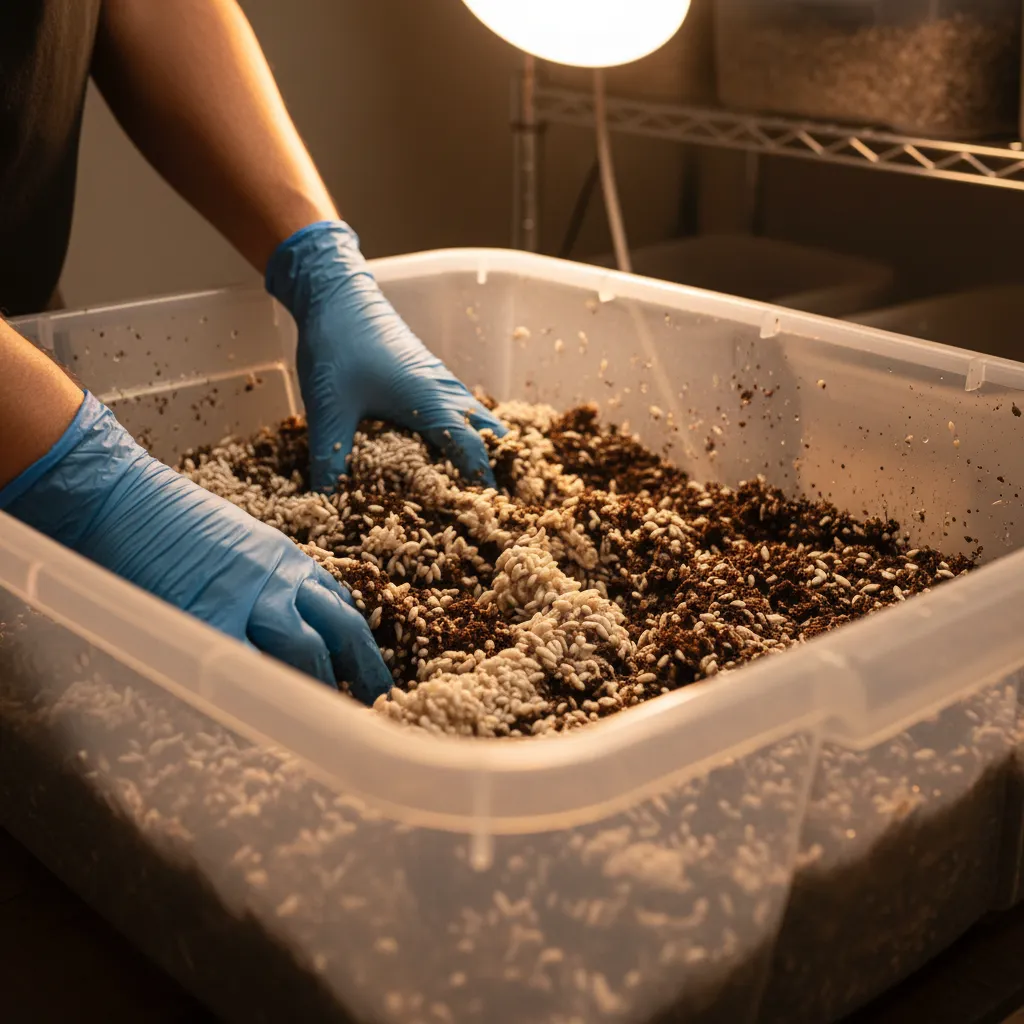
PF Tek (Psilocybe Fanaticus Technique) is the oldest and most widely taught mushroom cultivation method. It was developed by Robert McPherson, known online as Psilocybe Fanaticus, in the early 1990s. The technique was revolutionary because it allowed anyone with basic kitchen supplies to grow mushrooms at home without needing a laminar flow hood or advanced sterile technique.
The method uses brown rice flour (BRF) and vermiculite as a substrate, packed into half-pint mason jars, sterilized in a basic pot or pressure cooker, and inoculated with a spore syringe. After colonization, the consolidated cakes are removed from the jars and fruited in a simple shotgun fruiting chamber.
PF Tek remains the most recommended starting point for beginners because the small jar size limits contamination losses, the substrate is cheap and widely available, and the process teaches all the fundamental skills — sterile technique, inoculation, colonization monitoring, and fruiting chamber management. While yields are lower than bulk methods like monotubs, the simplicity and reliability make it an ideal first grow.
Here is the complete materials list for a standard PF Tek grow using 12 half-pint jars:
Substrate ingredients: - Brown rice flour (BRF) — about 2 cups total - Vermiculite (fine or medium grade) — about 2 cups total - Water — about 1 cup total
Equipment: - 12 half-pint wide-mouth mason jars with lids - Hammer and nail for lid modification - Pressure cooker or large pot with lid - Aluminum foil - Micropore tape (3M brand, available at any pharmacy) - Spore syringe or liquid culture syringe - Lighter or alcohol lamp - Rubbing alcohol (70% isopropyl) - Latex or nitrile gloves - Still air box (SAB) — a clear plastic tote with arm holes
Fruiting supplies: - Large plastic storage tote (50-66 quart) - Perlite (coarse grade) — enough for 4-5 inches depth - Spray bottle (misting) - Drill with 1/4-inch bit for shotgun fruiting chamber holes
Total cost for a first-time setup is typically $40-80 USD depending on what you already have at home.
The classic PF Tek substrate recipe uses a 2:2:1 ratio by volume — 2 parts vermiculite, 2 parts brown rice flour, and 1 part water. For a single half-pint jar, the measurements are:
- 1/4 cup vermiculite
- 1/4 cup brown rice flour (BRF)
- 1/8 cup water (2 tablespoons)
The preparation process is critical:
- Mix the vermiculite and water together first in a large mixing bowl. Stir until the vermiculite is evenly hydrated.
- Add the BRF and mix thoroughly until no dry clumps remain.
- Fill each jar loosely to about 1/2 inch below the rim — do not pack the substrate down. Loose packing allows mycelium to colonize faster and provides air exchange.
- Wipe the top 1/2 inch of the jar rim clean with a paper towel.
- Fill that top 1/2 inch with a layer of dry vermiculite only — this acts as a contamination barrier between the substrate and the open air above.
The dry vermiculite layer on top is one of the key innovations of PF Tek. It acts as a filter, allowing gas exchange while blocking airborne contaminants from reaching the nutritious substrate below.
Preparing jars correctly is essential for PF Tek success. Follow these steps for each jar:
- Mix substrate using the 2:2:1 ratio (vermiculite:BRF:water) in a clean bowl.
- Fill the jar loosely to 1/2 inch below the rim. Do not tamp down — airy substrate colonizes faster.
- Wipe the rim clean with a dry paper towel, removing any substrate particles.
- Add dry vermiculite to fill the remaining 1/2 inch. This is your contamination barrier layer.
- Place the modified lid (with injection holes) on the jar and screw the band on finger-tight.
- Cover the lid with a square of aluminum foil, crimping it tightly around the edges. This prevents water from entering through the injection holes during sterilization.
When loading jars into the pressure cooker, place them on a trivet or rack — never directly on the bottom of the pot. Use jar rings, a canning rack, or a folded dish towel as a spacer. Add 2-3 inches of water to the pot below the rack.
Prepare all 12 jars before starting sterilization so they can all go in one batch. If your pressure cooker only fits 6, run two batches rather than cutting corners on spacing.
Lid modification creates injection ports and gas exchange holes that you will use throughout the grow. Here is how to do it properly:
Tools needed: hammer, nail (or drill with 1/4-inch bit), micropore tape.
Steps:
- Take each flat mason jar lid (the disc, not the ring band) and punch four holes evenly spaced around the lid, about 1/2 inch from the edge. Use a nail and hammer or a drill.
- Remove any metal burrs from around the holes using a file or by pressing the burrs flat.
- Cover all four holes with micropore tape on the top side of the lid. Use one long strip or individual pieces — just make sure each hole is fully sealed.
- During inoculation, you will lift one piece of tape, insert the syringe needle, inject, and re-seal with fresh tape.
Some growers use a self-healing injection port instead — a dab of high-temperature RTV silicone over two of the holes. After it cures, you can push a needle through the silicone and it seals itself when removed. The other two holes remain covered with micropore tape for gas exchange only.
The four-hole design gives you flexibility: multiple injection points mean you can inoculate from different angles, speeding up colonization by creating more starting points for the mycelium.
PF Tek jars should be sterilized at 15 PSI for 60-90 minutes in a pressure cooker. Most growers use 90 minutes as the standard for guaranteed sterility.
Pressure cooker method (recommended):
- Place jars on a trivet or rack inside the pressure cooker — never on bare metal.
- Add water to just below the top of the trivet (2-3 inches).
- Close the lid, bring to 15 PSI, and maintain for 90 minutes.
- Turn off heat and let the cooker depressurize naturally — do not open the valve or run cold water over it. Rapid cooling can crack jars or pull contaminants inside.
- Let jars cool completely inside the cooker, ideally overnight or for at least 8-12 hours.
Steam sterilization (no pressure cooker):
If you lack a pressure cooker, you can steam sterilize by placing jars in a large pot with 2-3 inches of water, lid on, at a rolling boil for 90 minutes. This works for BRF substrate because the low nutrient density is more forgiving. However, a pressure cooker is more reliable.
Critical rule: never inoculate warm jars. If the jar is warm to the touch, the heat will kill your spores or liquid culture on contact. Wait until jars are fully at room temperature.
Inoculation is the most contamination-sensitive step in PF Tek. Work inside a still air box (SAB) and follow sterile procedure.
Steps:
- Wipe down the inside of your SAB with 70% isopropyl alcohol.
- Place your cooled jars, spore syringe, lighter, and alcohol wipes inside the SAB.
- Shake the spore syringe vigorously for 10-15 seconds to distribute spores evenly.
- Flame-sterilize the needle tip until it glows red, then let it cool for 10 seconds.
- Peel back the micropore tape over one injection hole.
- Insert the needle at an angle so the tip touches the glass wall inside the jar — this lets you see where the spores land and monitor germination.
- Inject approximately 0.25-0.5cc of spore solution at this point.
- Repeat for 2-4 holes per jar, injecting a total of 1-2cc per jar.
- Re-cover each hole with fresh micropore tape immediately after injection.
- Flame the needle between each jar.
How much solution per jar? The standard is 1-2cc total per half-pint jar. Using more does not speed colonization and wastes your syringe. A 10cc spore syringe should inoculate 6-10 jars comfortably. If using liquid culture instead of spores, 1cc per jar is plenty since LC is already active mycelium.
PF Tek colonization typically takes 14-28 days from inoculation to full consolidation, depending on temperature, genetics, and the number of inoculation points.
Timeline breakdown:
- Days 1-5: No visible growth. Spores are germinating and forming initial mycelium. Do not panic — this is normal.
- Days 5-10: Small white dots appear at injection points. These will look like tiny patches of white fuzz against the substrate.
- Days 10-20: Mycelium expands outward from each inoculation point. The white patches grow and begin to merge.
- Days 20-28: Full colonization — the entire jar appears white. Wait an additional 5-7 days after the jar looks 100% colonized for consolidation.
Ideal temperature: Maintain 21-27°C (70-80°F). Warmer temperatures speed colonization but increase contamination risk. Cooler temperatures slow growth but favor cleaner results. The sweet spot for most growers is 24°C (75°F).
Warning signs: - Green, black, or orange patches — contamination, discard the jar - Sour or sweet smell from the jar — bacterial contamination - No growth after 14 days — failed inoculation, the jar may need re-inoculation
Store colonizing jars in a dark location — light is not needed during this phase and can cause premature pinning.
Birthing is the process of removing fully colonized substrate cakes from their jars for fruiting. Only birth cakes that are 100% colonized and consolidated — no uncolonized patches should be visible.
Steps:
- Remove the lid and foil from the jar.
- Turn the jar upside down over a clean surface.
- Tap the bottom of the jar firmly with your palm. The cake should slide out. If it sticks, run the jar under lukewarm water for 30 seconds to loosen the edges, then tap again.
- Inspect the cake thoroughly. Look for any green, black, or suspect patches. If the cake is clean, proceed. If you see contamination, discard the cake and sanitize the area.
- Proceed immediately to the dunk and roll step.
Common issues: - Cake won't come out: Gently tap the open end of the jar against your palm. If it is truly stuck, use a clean fork to gently pry the edges away from the glass. - Cake crumbles: This usually means insufficient consolidation time. Next time, wait a full 7 days after the jar looks fully colonized. - Pins already forming in the jar: This can happen if jars were exposed to light or temperature fluctuations. Birth immediately and proceed to fruiting — these cakes will often produce heavily on their first flush.
Dunking and rolling rehydrates the cake and creates a humidity-trapping layer that dramatically improves pinning and yields.
Dunking:
- Place each freshly birthed cake in a container of cold tap water.
- Use a plate or lid to weigh the cake down so it stays submerged — cakes float.
- Dunk for 12-24 hours in the refrigerator or at room temperature. The cold water soak helps trigger pinning (similar to a cold weather change in nature).
- Remove the cake and let excess water drip off for a few minutes.
Rolling:
- Spread a layer of dry vermiculite on a clean plate or sheet of aluminum foil.
- Roll the dunked cake in the vermiculite, pressing gently to coat all surfaces evenly.
- The vermiculite layer should be about 1-2mm thick — a complete coating but not clumpy.
The vermiculite coating serves two purposes: it traps a micro-layer of humidity against the cake surface (creating ideal pinning conditions) and it provides a physical barrier that slows evaporation.
After rolling: Place each cake on a square of aluminum foil inside your shotgun fruiting chamber (SGFC). The foil prevents the cake from wicking moisture out of the perlite below. Space cakes at least 2-3 inches apart so air can circulate freely around each one.
A shotgun fruiting chamber (SGFC) is the standard fruiting environment for PF Tek cakes. It provides the humidity, fresh air exchange, and light cues needed for pinning and fruit body development.
Building the SGFC:
- Take a clear plastic tote (50-66 quart).
- Drill 1/4-inch holes spaced every 2 inches in a grid pattern on all six sides — top, bottom, and all four walls. This typically means 50-100+ holes total.
- Elevate the tub off the ground on 4 small cups or jar lids so air can flow through the bottom holes.
- Fill the bottom with 4-5 inches of coarse perlite soaked in water. This is your humidity reservoir.
Fruiting routine:
- Mist and fan 3-4 times daily. Mist the walls and lid (not directly on cakes) until thousands of tiny droplets are visible on surfaces. Fan by waving the lid 10-15 times.
- Maintain 90-95% humidity and 21-24°C (70-75°F).
- Provide indirect light for 12 hours per day. A window with indirect sunlight or a 6500K fluorescent is sufficient.
Pinning typically starts 5-10 days after introducing cakes to fruiting. Harvest mushrooms when the caps begin to flatten or just before the veil breaks.
This is one of the most debated topics in mushroom cultivation. Both methods work, but they serve different goals.
PF Tek advantages: - Simpler process with fewer variables - Smaller batches mean smaller losses if contamination hits - No need for grain preparation or shake steps - Teaches all fundamental skills in a controlled format - Can use steam sterilization (no pressure cooker required)
Grain spawn advantages: - Dramatically higher yields per effort (10-20x more by weight) - Faster colonization when spawned to bulk substrate - Better genetics expression in larger fruiting bodies - More scalable — easy to go from 1 tub to 10 - Industry standard technique
The recommendation: Start with PF Tek if you have never grown mushrooms before. Complete one full grow cycle from inoculation through harvest. This teaches you to recognize healthy mycelium, identify contamination, manage humidity, and understand the full lifecycle.
Once you have that foundation, move to grain spawn + monotub for your second grow. You will immediately notice the difference in yield and speed. Many growers skip PF Tek entirely and go straight to grain and monotubs — this works fine if you are comfortable following detailed procedures and can handle the larger contamination losses that come with bulk grows.
EvilMushroom666 is a well-known community cultivator who popularized a refined version of PF Tek that emphasizes simplicity and consistency. His approach strips away unnecessary complexity and focuses on the details that actually matter for reliable results.
Key elements of his method:
- Strict 2:2:1 ratio with no modifications — he argues that adjusting the recipe introduces variables that beginners do not understand yet
- 4 inoculation points per jar rather than 1-2, creating faster and more even colonization
- Full 7-day consolidation after jars appear 100% colonized — he considers this non-negotiable for dense, contamination-resistant cakes
- 24-hour cold water dunk in the refrigerator rather than at room temperature, as the cold shock improves pinning response
- Heavy vermiculite roll — he coats thicker than most guides recommend for better humidity retention
- Minimal misting — he argues that over-misting is the number one beginner mistake and recommends misting walls only, never the cakes directly
His approach is popular because it is opinionated and removes decision fatigue. Rather than presenting options, he gives one clear path that works reliably. His documented success rates exceed 80% for first-time growers who follow his instructions exactly.
LM (a respected community cultivator) takes a methodical, production-line approach to PF Tek that focuses on consistency across large batches of jars.
LM's notable modifications:
- Batch mixing: Rather than mixing substrate jar by jar, LM mixes large batches in a clean bucket — enough for 24 jars at once. This ensures every jar has identical moisture content and BRF distribution.
- Weighing, not measuring: LM weighs substrate components by mass rather than measuring by volume. His recipe per jar is approximately 60g vermiculite, 40g BRF, and 30ml water. This eliminates the variability of loose vs packed measuring cups.
- Double-foil lids: Two layers of foil over each lid, crimped tightly, with the shiny side facing out to reflect heat evenly during sterilization.
- Extended sterilization: LM runs a full 120 minutes at 15 PSI rather than the standard 60-90 minutes, arguing that the extra time costs nothing and provides insurance.
- Overnight cooling in the PC: Jars stay in the sealed pressure cooker for a minimum of 12 hours after sterilization. LM considers this critical — the sealed environment keeps jars sterile while they cool slowly.
- Inoculation in a SAB with gloves: LM always uses a proper still air box and nitrile gloves, sprayed with alcohol, even though some PF Tek guides suggest these steps are optional.
His emphasis on standardization and eliminating variables makes his method especially reliable for anyone doing PF Tek at scale.
Need more help? Dr. Myco can answer follow-up questions about pf tek based on thousands of real growing experiences.
Ask Dr. Myco