Grow Bag Tek
14 tips in Teks & Methods
By Andrew Langevin · Founder, Nature Lion Inc · Contributing author, Mushroomology (Brill, 2026)
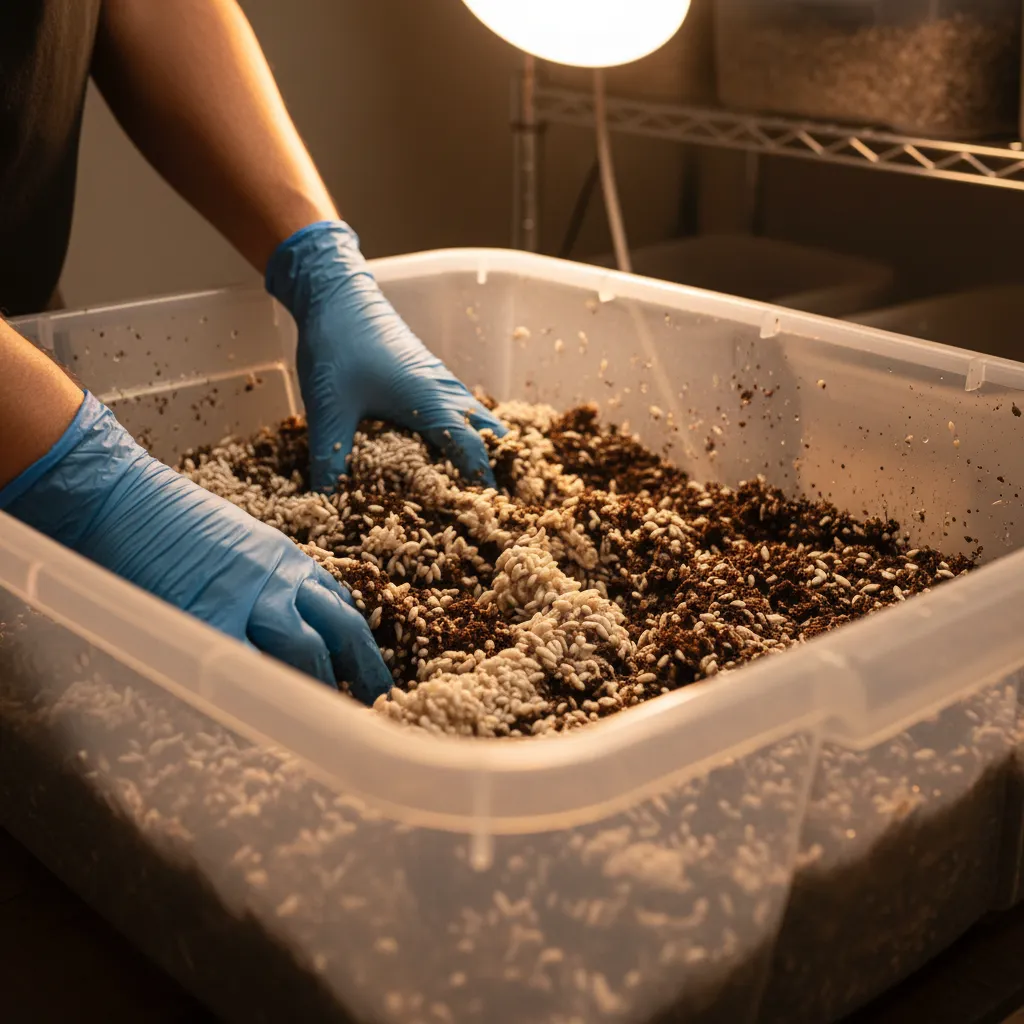
Mushroom grow bags are specially designed heat-resistant polypropylene bags with built-in filter patches that allow gas exchange while blocking contaminants. They are the standard production vessel for commercial mushroom farms worldwide and are increasingly popular with home growers.
Key features:
- Made from polypropylene (PP) rated to withstand temperatures up to 121°C (250°F) — safe for pressure cooker sterilization
- Equipped with a filter patch — a small square of microporous material (typically 0.2-0.5 micron) welded into the bag that allows oxygen and CO2 exchange while blocking bacteria and mold spores
- Gusseted design — the folded sides expand to create a flat-bottomed, freestanding bag when filled
- Available in sizes from small (1-3 lbs) to large (5-10 lbs) capacity
Why grow bags dominate commercial production:
- Scalable: A single grower can prepare and manage hundreds of bags efficiently
- Space-efficient: Bags stack on shelves better than rigid containers
- Disposable or reusable: No washing jars or tubs between cycles
- Self-contained: The bag serves as both the sterilization vessel and the fruiting container
- Consistent results: The filter patch provides uniform gas exchange
Grow bags are ideal for supplemented hardwood substrates (sawdust + soy hull or wheat bran) used for species like lion's mane, shiitake, king oyster, and pioppino. They are less commonly used for species that prefer manure-based or straw-based substrates.
Grow bags come in several configurations. Choosing the right type affects your workflow, success rate, and cost.
By filter type:
- Filter patch bags (recommended): Have a built-in microporous filter (0.2-0.5 micron) welded into the bag. Provides consistent, reliable gas exchange. Cost: $0.30-0.60 per bag.
- No-filter bags: Plain polypropylene bags without a filter. Cheaper ($0.10-0.20 per bag) but require you to add your own GE — usually by inserting a PVC pipe collar stuffed with polyfill through the bag opening.
By size:
- Small (8x5x18 inches): Holds 2-3 lbs of substrate. Good for home growers and species that fruit from a single opening (lion's mane, pioppino).
- Medium (8x5x20 inches): Holds 3-5 lbs. The most versatile home grower size.
- Large (10x6x24 inches): Holds 5-10 lbs. Used by commercial operations for shiitake and oyster blocks.
By material thickness:
- 2.2 mil: Standard thickness. Works for most applications.
- 3.0 mil: Thicker, more puncture-resistant. Recommended if you handle bags roughly or sterilize large batches where bags press against each other.
- 4.0 mil: Heavy-duty commercial grade. Overkill for home use but maximizes durability.
Recommendation: For home growers, buy medium-size filter patch bags in 2.2 mil thickness. They cost about $0.40 each and are the best all-around option. Buy in bulk (50-100 count) to reduce cost per bag.
Proper filling and sealing ensures bags survive pressure cooking without bursting and maintain sterility afterward.
Filling the bag:
- Prepare your substrate — mix hardwood pellets, soy hull pellets, water, and gypsum to field capacity (squeeze test: 2-3 drops).
- Open the bag fully — expand the gussets so the bag stands upright on its own.
- Fill to the correct level — leave at least 4-6 inches of empty space above the substrate. The bag needs room for the fold-over seal and expansion during sterilization.
- Target weight: 3-5 lbs of hydrated substrate per medium bag.
- Compact lightly — press down gently to remove large air pockets but do not pack tightly. Some air space is needed.
Sealing the bag:
- Gather the top of the bag and squeeze out excess air while leaving some air space above the substrate.
- Fold the top over twice to create a tight seal.
- Secure with an impulse sealer (preferred) or fold and tape tightly.
- If using an impulse sealer, seal 2-3 inches above the substrate line and again at the very top for a double seal.
Pre-sterilization checks:
- Ensure the filter patch is not blocked by substrate — if substrate is pressed against the filter, reposition it
- Check for punctures or holes in the bag
- Make sure the seal is airtight — squeeze the bag gently and listen for air leaking
An impulse sealer is the best tool for sealing grow bags, but there are alternatives if you do not want to invest in one.
What is an impulse sealer?
An impulse sealer uses a heated wire to fuse polypropylene bag material together, creating an airtight, watertight seal. Unlike a continuous-heat sealer, it only heats when you press the handle, making it safer and more precise.
Recommended specifications:
- Width: 12-16 inches — must be wider than your bag when flattened
- Wattage: 300-600W — enough to seal 2.2-3.0 mil polypropylene
- Cost: $30-80 for a quality unit
- Brands: Metronic, Fuxury, and Impulse brand sealers all work well
How to use:
- Flatten the top of the bag, squeezing out excess air.
- Position the flattened bag opening between the sealer jaws.
- Press the handle firmly for 3-5 seconds (adjust based on your sealer's instructions).
- Wait for the indicator light to turn off before releasing.
- Check the seal — it should be a solid, continuous line with no gaps or wrinkles.
- Create a second seal 1 inch above the first for insurance.
Alternatives to an impulse sealer:
- Fold-and-tape method: Fold the bag top over 3 times and secure tightly with packing tape. Less reliable but works for small batches.
- Zip ties or cable ties: Gather the bag neck tightly and cinch with a zip tie. Functional but harder to get airtight.
- Clothespin and tape: Fold and clip, then wrap with tape. Least reliable method.
If you plan to do more than 10-20 bags, the impulse sealer pays for itself in saved time and improved success rate.
Sterilizing grow bags requires a pressure cooker large enough to hold your bags and careful handling to prevent punctures.
Pressure cooker requirements:
- Minimum 23-quart capacity for medium bags (fits 2-4 bags depending on size)
- All American brand pressure cookers (23, 30, or 41 quart) are the gold standard for mushroom cultivation because they have no gasket to replace and maintain consistent pressure
- Presto 23-quart works well as a budget option
Sterilization process:
- Load bags into the pressure cooker standing upright. Do not stack bags horizontally — the weight can cause blowouts.
- Add 2-3 inches of water to the bottom of the cooker.
- Place a trivet or rack on the bottom to keep bags above the water line.
- If loading multiple bags, ensure the filter patches face inward (toward the center) and are not pressed against the cooker wall.
- Close the cooker and bring to 15 PSI.
- Sterilize for 150 minutes (2.5 hours) — bags require longer than jars because of the larger substrate mass and insulating effect of the bag material.
- Turn off heat and let the cooker depressurize naturally — never force-cool.
- Leave bags inside the sealed cooker for 8-12 hours to cool completely.
Critical warnings:
- Never exceed 15 PSI — higher pressure can melt bag seams
- Do not let bags touch the heating element or bare metal bottom
- If a bag burst during sterilization, clean the cooker thoroughly before the next batch
- Bags are extremely hot after sterilization — let them cool fully before handling
Non-filter bags are significantly cheaper than filter patch bags and can be made functional with a simple DIY filter using PVC pipe and polyfill.
The PVC polyfill collar method:
Materials needed: - Non-filter polypropylene grow bags - 3/4-inch PVC pipe cut into 3-inch lengths - Polyfill (polyester stuffing) — small wads - Impulse sealer or tape
Assembly:
- Fill the bag with substrate as normal.
- Insert a 3-inch piece of 3/4-inch PVC pipe into the bag opening, centering it in the neck.
- Gather the bag tightly around the PVC pipe.
- Use an impulse sealer, tape, or zip tie to seal the bag snugly around the pipe. The pipe should protrude about 1 inch above the seal.
- Stuff a small wad of polyfill into the open end of the PVC pipe — this is your filter.
- Cover the polyfill-stuffed pipe end with a small square of aluminum foil during sterilization to prevent water entry.
- After sterilization and cooling, remove the foil. The polyfill filter provides gas exchange.
Inoculation through the collar:
Inject liquid culture or grain spawn directly through the polyfill into the bag. The polyfill acts as both the filter and the injection port.
Trade-offs: - Pro: Bags cost $0.10-0.15 each versus $0.40-0.60 for filter patch bags - Con: More labor-intensive, less consistent gas exchange, higher risk of contamination at the PVC seal point
This method is best for growers doing large volumes where the savings on bag cost justify the extra preparation time.
Inoculating grow bags must be done with sterile technique to protect the investment of time and materials in substrate preparation.
Method 1 — Injection through a self-healing port:
Many grow bags come with (or can be fitted with) a self-healing injection port — a silicone disc that a needle can penetrate and reseal automatically.
- Wipe the injection port with an alcohol swab.
- Flame-sterilize your syringe needle.
- Push the needle through the silicone port.
- Inject 2-5cc of liquid culture directly into the center of the substrate.
- Withdraw the needle — the port reseals.
Method 2 — Injection through the bag wall:
- Choose an injection spot on the bag, away from the filter patch.
- Wipe the area with alcohol.
- Flame-sterilize the needle.
- Push the needle through the bag wall and into the substrate.
- Inject 2-5cc of liquid culture.
- Withdraw and immediately cover the puncture with micropore tape.
Method 3 — Open-top inoculation with grain spawn:
- Work in front of a laminar flow hood (this method is not SAB-friendly due to the large bag opening).
- Open the top of the bag.
- Pour or spoon colonized grain spawn onto the top of the substrate.
- Reseal the bag with an impulse sealer.
- Shake or knead the bag to distribute the grain through the substrate.
Spawn rates for bags: - Liquid culture: 5-10cc per 5-lb bag - Grain spawn: 10-15% of substrate weight (approximately 0.5-0.75 lbs per 5-lb bag)
Grow bag colonization requires patience and minimal intervention. The process takes 14-30 days depending on substrate type, spawn rate, and temperature.
Colonization conditions:
- Temperature: 21-27°C (70-80°F)
- Light: none needed during colonization
- Position: bags can stand upright or lay on their sides
- Location: clean shelf away from direct sunlight and airflow
Mixing during colonization:
If you inoculated with grain spawn distributed throughout the substrate, no mixing is needed — the spawn points are already distributed.
If you inoculated with liquid culture injected at one point, the mycelium will grow outward from that single location. You can speed colonization by mixing (shake and break) at 30-40% colonization:
- When approximately one-third of the bag appears white with mycelium, gently massage and knead the bag to break up the colonized chunk.
- Redistribute the colonized pieces throughout the uncolonized substrate.
- This creates dozens of new colonization starting points.
Timeline with and without mixing:
- No mixing: 21-30 days to full colonization from LC injection
- One mix at 30%: 14-21 days total
- Two mixes (at 20% and 50%): Can reduce to 10-18 days but increases contamination risk
Signs of healthy colonization: - Thick, white, ropey mycelium spreading visibly through the substrate - Fresh mushroom smell when you sniff near the filter patch - Substrate pulling slightly away from bag walls as mycelium contracts it
Signs of problems: - Green, black, or orange patches — contamination, discard the bag - Sour or fermented smell — bacterial infection - No growth after 14 days — failed inoculation or dead culture
Once a grow bag is fully colonized, you need to create an opening for mushrooms to emerge. The method you choose depends on the species you are growing.
Top cut method (best for lion's mane and clusters):
- Using a clean blade wiped with alcohol, cut the bag open across the top, removing the upper portion entirely.
- Leave the substrate block exposed from the top.
- Mushrooms will fruit upward from the top surface.
- Best for: lion's mane, pioppino, chestnut mushrooms
X cut method (best for oysters and shiitake):
- Using a clean razor blade, cut an X shape (about 2-3 inches across) on the side of the bag where you want mushrooms to emerge.
- Make 2-4 X cuts on different sides of the bag.
- Mushrooms emerge through the X openings in tight, directed clusters.
- Best for: oyster mushrooms, shiitake, maitake
Slit method (minimalist):
- Make a single 3-4 inch horizontal slit on one side of the bag.
- The mushrooms push through the slit opening.
- This provides the least surface area exposure, which can be beneficial in contamination-prone environments.
Fruiting conditions after cutting:
- Humidity: 85-95% — place bags in a fruiting chamber, greenhouse, or Martha tent
- Temperature: varies by species, typically 16-24°C (60-75°F)
- Light: 12 hours indirect light per day
- FAE: gentle air movement, avoid direct fan on the cuts
Misting: Mist the area around the cuts 2-3 times daily. Avoid pooling water directly on the cut surface, which invites bacterial contamination.
Spawn rate affects colonization speed, contamination resistance, and cost efficiency. The optimal rate varies by substrate type and nutritional density.
Spawn rates by substrate:
- Hardwood sawdust (unsupplemented): 10-15% spawn by weight. Lower contamination risk allows lower spawn rates.
- Masters Mix (50/50 hardwood + soy hull): 10-20% spawn by weight. The higher nutrition demands faster colonization to outpace mold — use the higher end for safety.
- Supplemented sawdust (sawdust + 10% bran): 15-20% spawn. Bran is a contamination magnet, so aggressive spawn rates are important.
- Straw in bags: 10-15% spawn. Similar to Bucket Tek rates.
- Manure-based substrates: 15-20% spawn. These are highly nutritious and contamination-prone.
Calculation example:
For a 5-lb (2.27 kg) supplemented sawdust bag at 15% spawn rate: - 5 lbs × 0.15 = 0.75 lbs of grain spawn (approximately 340g)
Liquid culture rates:
When using liquid culture instead of grain spawn, the rates are much lower: - 5-10cc per 5-lb bag is standard - LC colonizes more slowly initially but catches up once established - Always supplement LC inoculation with a shake at 30% colonization to redistribute growth points
General rule of thumb: If you are unsure, err on the side of more spawn rather than less. The extra cost is minimal compared to the cost of losing a bag to contamination because colonization was too slow.
Masters Mix is a 50/50 blend of hardwood fuel pellets and soy hull pellets that produces the highest yields for wood-loving gourmet mushroom species. It is the substrate of choice for commercial lion's mane, king oyster, pioppino, and chestnut mushroom production.
Recipe for one 5-lb grow bag:
- Hardwood fuel pellets: 625g (1.38 lbs)
- Soy hull pellets: 625g (1.38 lbs)
- Water: 1.5 liters (approximately 1.5 quarts)
- Gypsum (optional): 25g (about 1 tablespoon)
Preparation steps:
- Weigh out pellets and combine in a large mixing container.
- Add water and mix thoroughly. The pellets will absorb water and break apart into loose sawdust and soy hull within 15-30 minutes.
- Add gypsum and mix again.
- Check moisture with the squeeze test — 2-3 drops when squeezed hard.
- Fill grow bags to the appropriate level (leave 4-6 inches at the top).
- Seal bags with an impulse sealer.
- Sterilize at 15 PSI for 150 minutes (2.5 hours).
- Cool for 12+ hours before inoculating.
Why Masters Mix works so well:
The soy hull pellets provide a high-nitrogen supplement (approximately 7% protein) that dramatically boosts yields — typically 200-300% more than unsupplemented hardwood alone. The 50/50 ratio has been optimized through extensive testing by commercial farms.
Important warning: Masters Mix must be sterilized, never pasteurized. The high soy hull content makes it extremely contamination-prone if not fully sterilized.
Grow bag failures usually fall into a few predictable categories. Here is how to diagnose and prevent each one.
Problem 1 — Green mold (Trichoderma): - Appears as bright green patches, usually starting near the filter patch or injection site - Cause: Incomplete sterilization, contaminated spawn, or breach in the bag - Prevention: Sterilize for the full 150 minutes. Use clean spawn. Check bags for punctures before inoculating. - Action: Discard the entire bag. Do not open it indoors — Trichoderma spores spread aggressively.
Problem 2 — Bacterial contamination (wet spot): - Symptoms: Slimy, wet areas that do not colonize. Sour smell near filter patch. - Cause: Substrate too wet (over field capacity) or insufficient sterilization time. - Prevention: Nail the squeeze test. Do not rush sterilization.
Problem 3 — Bag burst during sterilization: - Cause: Over-filled bag, trapped air expanding, or defective seal - Prevention: Leave 4-6 inches of empty space. Squeeze out excess air before sealing. Do not exceed 15 PSI.
Problem 4 — Slow or stalled colonization: - Cause: Temperature too low, insufficient spawn rate, or weak genetics - Fix: Maintain 24°C (75°F). Use 15-20% spawn rate. Shake bag at 30% colonization.
Problem 5 — Filter patch melting or deforming: - Cause: Filter pressed against hot cooker wall during sterilization - Prevention: Position filter patches facing inward, away from cooker walls.
Record-keeping tip: Label each bag with the date, substrate recipe, spawn type, and sterilization time. Track success and failure rates across batches to identify patterns and improve your process systematically.
A fruiting bag (also called a mushroom grow bag or filter patch bag) is a heat-resistant polypropylene bag with a built-in filter patch that allows gas exchange while blocking contaminants. With an estimated 4,400 monthly searches worldwide, this is one of the most fundamental pieces of mushroom cultivation equipment.
Types of fruiting bags:
- Filter patch bags — the standard. A 0.2-0.5 micron filter welded into the bag allows oxygen in and CO2 out while blocking bacteria and mold spores
- Gusseted bags — have folded sides that expand to hold more substrate. Most common for 5 lb blocks
- Autoclavable bags — rated for pressure cooker temperatures (121°C / 250°F). Not all bags survive autoclaving
How to use a fruiting bag:
- Fill with hydrated, supplemented substrate (Masters Mix, hardwood + bran, etc.)
- Seal with an impulse sealer, leaving the filter patch unblocked
- Sterilise at 15 PSI for 2-2.5 hours
- Cool completely (12+ hours) before handling
- Inoculate through an injection port or by opening briefly in front of a flow hood
- Colonise at 21-24°C for 2-4 weeks
- Fruit by cutting an X or removing the top — mist the opening and maintain 85-95% humidity
Fruiting bags are the industry standard for gourmet mushroom production — from small hobby operations to large commercial farms.
Growing mushrooms on logs is the oldest cultivation method and remains one of the most rewarding — producing superior flavour and texture compared to indoor-grown mushrooms. With 4,400 monthly searches worldwide, log cultivation is a major interest area.
The process in brief:
- Cut fresh hardwood logs — oak, maple, beech, or birch. Logs should be 10-15cm diameter and 1 metre long. Cut in late winter when sap is down but bark is tight
- Wait 2-4 weeks — let the tree's natural antifungal compounds dissipate
- Drill holes — 12mm diameter, 25mm deep, spaced every 15cm along the log in a diamond pattern
- Insert plug spawn — tap colonised wooden dowels into each hole with a hammer
- Seal with wax — melt cheese wax or beeswax and paint over each plug to retain moisture and block competitors
- Stack and wait — lean logs against a fence or stack in a shaded, humid spot. The mycelium colonises the sapwood over 6-18 months
- Force fruit — soak the fully colonised log in cold water for 24 hours to trigger pinning
Best species for logs:
- Shiitake — the classic log mushroom, produces for 3-7 years per log
- Oyster — faster colonisation but shorter log lifespan (2-3 years)
- Lion's mane — spectacular on beech and maple logs
- Maitake — slow but produces large clusters at the log base
Need more help? Dr. Myco can answer follow-up questions about grow bag tek based on thousands of real growing experiences.
Ask Dr. Myco