Bucket Tek
12 tips in Teks & Methods
By Andrew Langevin · Founder, Nature Lion Inc · Contributing author, Mushroomology (Brill, 2026)
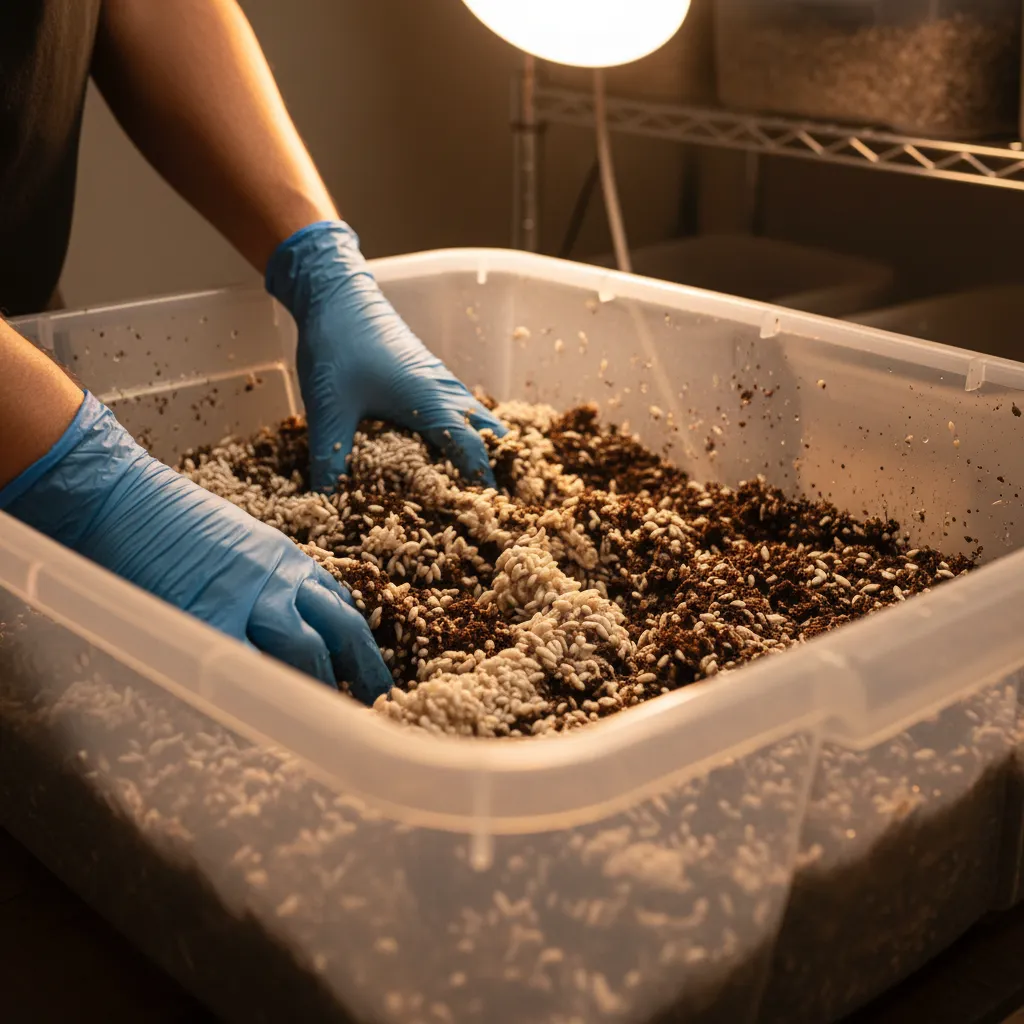
Bucket Tek is a low-tech mushroom cultivation method that uses 5-gallon buckets filled with pasteurized straw and grain spawn. Mushrooms fruit directly through holes drilled in the sides of the bucket. It is widely considered the easiest and most beginner-friendly method because it requires no pressure cooker, no sterile technique, and minimal equipment.
The method works by layering pasteurized straw and grain spawn inside a bucket with pre-drilled holes. Mycelium colonizes the straw over 2-3 weeks, then mushrooms emerge through the holes when fruiting conditions are met.
Why Bucket Tek is so accessible:
- No pressure cooker needed — straw is pasteurized with hot water, not sterilized
- No still air box or laminar flow hood — the simplicity of the process tolerates less-than-perfect conditions
- Cheap materials — a bucket, straw, and spawn cost under $20 total
- Compact — a single bucket fits on a balcony, countertop, or closet shelf
- Visually engaging — mushrooms emerging from holes in a bucket is impressive and fun
Bucket Tek is primarily used for oyster mushrooms (Pleurotus species) because oysters are aggressive colonizers that thrive on straw. Other species generally do not perform well in this format.
Bucket Tek requires the fewest and cheapest materials of any mushroom growing method:
Essential materials:
- 5-gallon bucket with lid — food-grade HDPE plastic. Available at hardware stores, bakeries, or restaurant supply shops. Cost: $3-5 or often free from bakeries and delis.
- Drill with 12mm (1/2-inch) drill bit — for making fruiting holes
- Straw — wheat straw, barley straw, or oat straw. One small bale is enough for 5-10 buckets. Cost: $5-10 per bale.
- Grain spawn — colonized grain of your chosen oyster mushroom species. You need approximately 1-2 pounds per bucket. Cost: $10-20 if purchased.
- Large pot or second bucket for pasteurizing the straw
- Thermometer (optional but helpful for pasteurization)
- Spray bottle for maintaining humidity during fruiting
Optional but helpful:
- Pillowcase or mesh laundry bag for holding straw during pasteurization
- Rubber bands or bungee cord to secure the lid
- Humidity tent (clear plastic bag) for fruiting in dry climates
Total startup cost: Under $30 if you buy everything new, or under $15 if you scavenge the bucket and use homemade spawn. This makes Bucket Tek the cheapest entry point into mushroom cultivation.
Proper hole placement determines where your mushrooms will fruit and how evenly air circulation reaches the colonizing mycelium.
Recommended pattern:
- Drill 12-16 holes evenly spaced around the bucket in 4 rows
- Each row should have 3-4 holes evenly distributed around the circumference
- Space rows approximately 4-5 inches apart vertically
- Start the bottom row about 3-4 inches from the base of the bucket
- Hole diameter: 10-12mm (approximately 1/2 inch) — this is large enough for mushroom clusters to emerge but small enough to retain substrate
Drilling tips:
- Use a standard drill bit, not a spade bit or hole saw — you want clean, small holes
- Drill from the outside in to avoid cracking the plastic
- Remove any plastic burrs from the inside of the holes — rough edges can trap moisture and harbor bacteria
- Stagger the rows so holes in one row are offset from holes in the row above — this creates more even airflow through the substrate
Do you need holes in the bottom? No — bottom holes cause water to drain out and create a mess. Some growers drill 2-3 small drainage holes in the bottom as insurance against waterlogging, but this is optional.
Do you need holes in the lid? A few small holes in the lid provide top air exchange. Drill 4-6 small holes (6mm) in the lid and cover with micropore tape.
Straw preparation involves chopping to the right length and pasteurizing to kill competing organisms.
Chopping the straw:
Cut or chop straw into pieces 2-4 inches long. Shorter pieces pack more densely and give mycelium shorter distances to bridge between colonized areas. Methods for chopping:
- Run a lawnmower over it on a tarp
- Use garden shears or a machete in a trash can
- Leaf shredder or wood chipper
- Some growers skip chopping entirely and use full-length straw — this works but colonization is slower
Pasteurization (hot water method):
- Stuff chopped straw into a pillowcase or mesh laundry bag.
- Place the bag in a large pot or clean trash can.
- Fill with water heated to 71-82°C (160-180°F).
- Maintain temperature for 60-90 minutes. If using a pot on the stove, monitor with a thermometer and adjust the burner.
- Remove the straw bag and hang it to drain for 2-4 hours until it stops dripping and reaches field capacity.
Cold water lime pasteurization (alternative):
Soak straw in cold water with hydrated lime (calcium hydroxide) at a rate of 1-2 tablespoons per gallon for 18-24 hours. This raises the pH high enough to kill most contaminants without heat. Drain thoroughly before use. This method is popular because it requires no heating.
Proper layering ensures even colonization throughout the entire bucket.
Step-by-step layering process:
- Make sure your pasteurized straw has cooled to below 27°C (80°F) and is at field capacity — squeezed in your fist, only 1-2 drops of water should come out.
- Add a 2-3 inch layer of straw to the bottom of the bucket. Press it down gently but do not compact it tightly.
- Sprinkle a thin, even layer of grain spawn over the straw. Focus spawn near the edges where it can access the drilled holes.
- Add another 2-3 inch layer of straw on top.
- Add another layer of spawn.
- Repeat until the bucket is full — you should have 4-5 layers of straw with spawn between each layer.
- Finish with a final layer of straw on top (no spawn on the very top surface).
- Press the top layer down gently and snap the lid on.
Spawn distribution tip: Concentrate slightly more spawn near the edges of the bucket where the holes are. This ensures mycelium reaches the fruiting holes quickly and begins colonizing the outer surface first.
How much spawn total? Use approximately 10-15% spawn by weight relative to wet straw weight. For a 5-gallon bucket, this works out to roughly 1-2 pounds of grain spawn. More spawn means faster colonization and better contamination resistance.
The ideal spawn rate for Bucket Tek is 10-15% of the wet substrate weight. For a standard 5-gallon bucket filled with pasteurized straw (approximately 5-7 pounds wet), this means 1-2 pounds of grain spawn.
Spawn rate breakdown:
- 5% spawn rate: Very slow colonization (4-6 weeks). High contamination risk. Not recommended.
- 10% spawn rate: Standard rate. Colonizes in 14-21 days. Good balance of cost and speed.
- 15% spawn rate: Fast colonization (10-14 days). Excellent contamination resistance. Recommended for beginners.
- 20%+ spawn rate: Diminishing returns. Colonizes slightly faster but wastes spawn. The extra grain can also attract pests.
Does more spawn always help? Yes, up to a point. Higher spawn rates mean the mycelium has more starting points and shorter distances to colonize between grain kernels, which translates to faster full colonization. Faster colonization means less opportunity for contaminants to establish.
However, beyond 15-20%, the improvement is marginal and you are better off using that extra spawn for a second bucket. Two buckets at 10% will always out-produce one bucket at 20%.
If buying spawn: One bag of grain spawn (typically 3-5 pounds) should fill 2-4 buckets depending on spawn rate. This makes Bucket Tek an economical method for producing large quantities of oyster mushrooms.
Bucket Tek colonization takes 14-21 days under ideal conditions, with mushrooms appearing 3-7 days after colonization completes.
Full timeline:
- Days 1-7: Mycelium spreads from grain spawn into surrounding straw. You cannot see this happening through the opaque bucket walls, so resist the urge to open the lid.
- Days 7-14: White mycelium becomes visible at the drilled holes as it reaches the outer surface of the straw. This is your first visual confirmation that colonization is progressing.
- Days 14-21: Mycelium fills all holes and the straw is fully colonized. When you see thick white growth at every hole, colonization is complete.
- Days 21-28: Primordia (baby mushroom pins) form at the holes. They look like tiny clusters of white bumps.
- Days 25-35: Pins develop into full mushroom clusters ready for harvest.
Ideal conditions during colonization:
- Temperature: 20-24°C (68-75°F)
- Location: dark or dimly lit area
- Lid: sealed tight
- Do not open the lid to check progress
What if colonization is slow? Common causes include low spawn rate, cold temperatures, or poor straw pasteurization. If no mycelium is visible at any hole after 3 weeks, the spawn may have been dead or the straw may have been contaminated before inoculation.
Humidity management is simpler with Bucket Tek than with most other methods because the bucket itself acts as a humidity reservoir. However, the exposed holes where mushrooms fruit still need attention.
Humidity methods:
Method 1 — Humidity tent (best for dry climates):
- Place a clear plastic bag loosely over the bucket, leaving the bottom open for air exchange
- Mist inside the bag 2-3 times daily
- This creates a humid microclimate around the fruiting holes
- Remove the bag for 10 minutes during each misting to provide fresh air
Method 2 — Misting only (works in humid climates):
- Mist the bucket holes directly 3-4 times daily with a fine mist sprayer
- Aim for tiny droplets visible on the mushroom pins and surrounding plastic
- Do not drench — soggy conditions promote bacterial blotch
Method 3 — Martha tent or greenhouse:
- Place multiple buckets inside a small greenhouse shelf unit with an ultrasonic humidifier
- Set humidifier on a timer: 15 minutes on, 45 minutes off
- This is the most hands-off approach and works well for multiple buckets
Target humidity: 85-95% during fruiting. Oyster mushrooms are the most forgiving species for humidity — they will tolerate brief dry periods better than most other mushrooms. If caps are cracking or edges are curling inward, humidity is too low. If caps are slimy or developing yellow spots, humidity is too high or air circulation is insufficient.
Harvesting from bucket holes is straightforward but requires a gentle touch to avoid damaging the mycelium and reducing future flushes.
When to harvest:
Oyster mushrooms should be harvested when the caps are fully expanded but the edges are still slightly curled downward. If the edges flatten completely or begin to turn upward, the mushrooms are past peak — still edible but they will drop spores everywhere and have a shorter shelf life.
Harvesting technique:
- Grasp the entire cluster at the base where it meets the bucket hole.
- Twist and pull gently — the cluster should break cleanly from the straw inside.
- Do not cut individual mushrooms — harvest the entire cluster as one unit.
- If any straw comes out with the cluster, push it back into the hole.
- Trim the base of the cluster to remove any straw or substrate material.
Timing across the bucket:
Not all holes will fruit simultaneously. Harvest clusters as they mature rather than waiting for every hole to produce. Mature clusters left on the bucket will drop spores, which coat surfaces in a fine white powder — not harmful but messy.
Post-harvest handling:
- Store fresh oyster mushrooms in a paper bag in the refrigerator — they keep for 5-7 days
- Do not use plastic bags — trapped moisture causes rapid spoilage
- For longer storage, dehydrate at 57°C (135°F) until cracker-dry
A well-managed Bucket Tek bucket typically produces 3-5 flushes over a period of 6-10 weeks.
Flush-by-flush breakdown:
- Flush 1 (weeks 3-4): Usually the largest, producing clusters from 60-80% of the holes. Expect 0.5-1.5 pounds fresh weight depending on species and spawn rate.
- Flush 2 (weeks 5-6): Second largest. Some holes that did not fruit on the first flush will produce now. Expect 60-80% of first flush yield.
- Flush 3 (weeks 7-8): Noticeably smaller clusters. Expect 40-60% of first flush yield.
- Flush 4-5 (weeks 8-10): Small clusters from fewer holes. Each flush diminishes further.
Between flushes:
- After harvesting all mature clusters, re-seal the lid tightly.
- Rehydrate by pouring 1-2 quarts of water directly into the top of the bucket through the lid opening. Let it soak in for 2-4 hours, then drain any excess from the bottom holes.
- Re-seal and wait 7-10 days for the next flush.
Maximizing flushes: - Rehydrate between every flush — this is the single most important factor - Keep the bucket out of direct sunlight and wind - Maintain temperatures in the 15-24°C (60-75°F) range
When to retire the bucket: When fewer than 3 holes produce mushrooms or when green mold appears, the substrate is exhausted. Empty the spent straw into your compost or garden — it makes excellent mulch.
Bucket Tek is the most budget-friendly cultivation method because it eliminates the two most expensive requirements: a pressure cooker and sterile technique equipment.
Cost comparison per grow:
- Bucket Tek: $15-25 total (bucket $3-5, straw $2-3, spawn $10-15)
- PF Tek: $50-80 (jars, BRF, vermiculite, perlite, pressure cooker $40-80 if not owned)
- Monotub: $40-60 (grain, CVG, tub, pressure cooker required for grain spawn)
Why no pressure cooker is needed:
Straw is a low-nutrient substrate that only requires pasteurization (not sterilization) to prepare. Pasteurization is achieved with nothing more than a large pot of hot water on a stove or even a large bucket with boiling water poured in. The surviving beneficial bacteria in pasteurized straw actually help protect against mold — a natural defense you lose with full sterilization.
Why sterile technique is less critical:
Oyster mushrooms are extremely aggressive colonizers that outcompete most contaminants in a race for the straw nutrients. Combined with the high spawn rate (10-15%) and the pasteurization method, the result is a process that tolerates imperfect technique.
Free or near-free materials: - Buckets: free from bakeries, delis, or restaurants - Straw: often free or very cheap from farms, feed stores, or landscapers - The only real cost is the spawn, and even that can be eliminated once you learn to make your own
Bucket Tek works best with oyster mushrooms (Pleurotus species) because they are aggressive primary decomposers that thrive on straw substrates. Here are the best species ranked by ease of success:
Top tier (excellent for Bucket Tek):
- Blue oyster (Pleurotus ostreatus var. columbinus): The most popular choice. Fruits reliably at 10-21°C (50-70°F), produces large dense clusters, tolerant of imperfect conditions. The best species for beginners.
- Pearl oyster (Pleurotus ostreatus): Very similar to blue oyster but prefers slightly warmer temperatures 15-24°C (60-75°F). Milder flavor.
- Italian oyster (Pleurotus pulmonarius): Excels in warmer climates 18-30°C (65-85°F). Great choice for summer grows.
Good (works well with extra attention):
- Pink oyster (Pleurotus djamor): Beautiful coral-pink color. Requires warm temperatures 24-30°C (75-85°F) and higher humidity. Not cold-tolerant.
- Golden oyster (Pleurotus citrinopileatus): Stunning yellow clusters. Needs warmth and high humidity. More finicky than blue or pearl.
Not recommended for Bucket Tek:
- King oyster — requires supplemented sawdust, not straw
- Lion's mane — requires supplemented hardwood
- Shiitake — requires hardwood logs or supplemented sawdust blocks
- Reishi — requires hardwood substrate
Stick with blue or pearl oyster for your first Bucket Tek grow. They are the most forgiving and produce the most consistently.
Need more help? Dr. Myco can answer follow-up questions about bucket tek based on thousands of real growing experiences.
Ask Dr. Myco