Advanced & Specialty Teks
10 tips in Teks & Methods
By Andrew Langevin · Founder, Nature Lion Inc · Contributing author, Mushroomology (Brill, 2026)
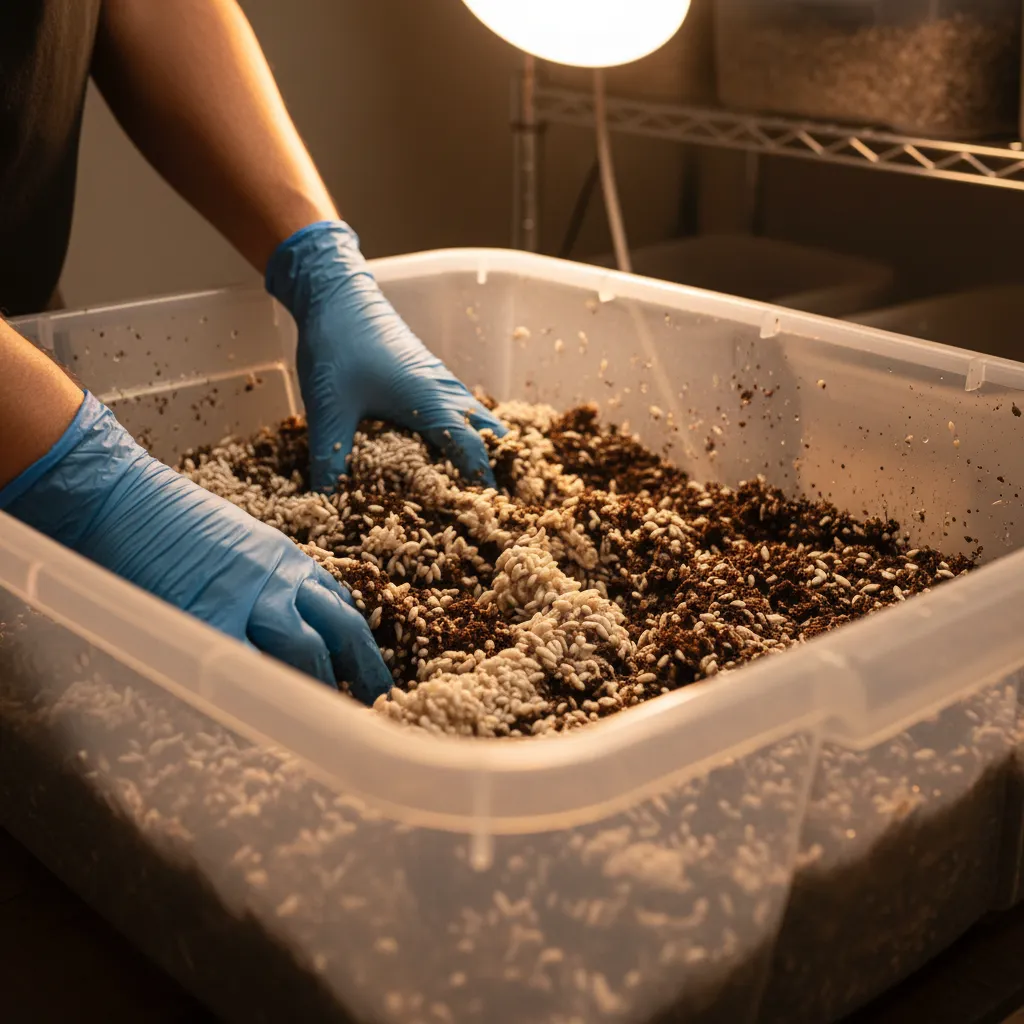
Easy Felt Tek is a creative low-tech method that uses felt fabric as a substrate carrier for oyster mushroom cultivation. The method was developed by community experimenters looking for the simplest possible way to grow mushrooms without traditional substrates.
How it works:
- Obtain plain felt fabric — use undyed, untreated polyester or wool felt sheets. Avoid felt with adhesive backing or synthetic treatments.
- Cut felt into sheets approximately 12x12 inches.
- Soak the felt in a mixture of water and coffee grounds or wheat bran slurry for 30 minutes. This adds nutrients to the otherwise inert felt fibers.
- Pasteurize by soaking in hot water at 71-82°C (160-180°F) for 60 minutes.
- Cool to room temperature.
- Layer felt sheets with grain spawn crumbled between layers — typically 4-6 layers per stack.
- Place the stack in a container or plastic bag with gas exchange holes.
- Allow to colonize for 10-14 days.
- Once colonized, expose to fruiting conditions.
Why it is interesting:
- Extremely simple setup with grocery-store materials
- The felt fibers provide physical structure for the mycelium to grip
- Easy to observe colonization through the semi-transparent felt
- Works well as a teaching or demonstration method
Limitations:
- Low yields compared to straw or sawdust methods
- Only works reliably with oyster mushrooms
- Not practical for production-scale growing
- Best treated as an experiment or educational tool
Greenhouse Tek combines a small plastic greenhouse shelf unit with an ultrasonic humidifier to create a dedicated mushroom fruiting environment. This setup is popular because it is affordable, compact, and highly effective.
Equipment needed:
- Plastic greenhouse shelf unit — 4-5 tier wire shelf with clear plastic cover. Available at garden centers for $25-50. Dimensions typically 27×19×63 inches.
- Ultrasonic cool mist humidifier — disc or pond fogger type. Reptile foggers work well. Cost: $15-30.
- Humidity controller (optional but recommended) — Inkbird or similar controller that turns the humidifier on/off to maintain a target humidity. Cost: $30-40.
- Small fan (optional) — a USB-powered computer fan for gentle air circulation inside the greenhouse.
- Timer — if not using a humidity controller, use a basic outlet timer.
Setup:
- Assemble the greenhouse unit on a waterproof surface (tray, tarp, or tile floor).
- Place the humidifier on the bottom shelf or floor of the greenhouse.
- Connect the humidifier to the humidity controller, set target to 85-95%.
- Place mushroom blocks, bags, or tubs on the upper shelves.
- Zip the plastic cover mostly closed, leaving a 2-3 inch gap at the bottom for fresh air intake.
- Optionally mount a small fan on a middle shelf pointing upward to circulate humid air.
Maintenance:
- Refill the humidifier reservoir daily or as needed
- Clean the humidifier weekly to prevent mineral buildup and bacterial slime
- Use distilled water if your tap water is hard — mineral deposits from hard water coat mushrooms with white residue
- Wipe down the inside of the greenhouse weekly to prevent mold on surfaces
Wine cap mushrooms (Stropharia rugosoannulata, also called King Stropharia or Garden Giant) are one of the easiest species to grow outdoors. They thrive in wood chip and straw beds with almost no maintenance once established.
Setting up a wine cap bed:
- Choose a location — partial shade (under trees or on the north side of a building). Wine caps tolerate more sun than most mushrooms but produce better in 50-80% shade.
- Prepare the bed area — clear a space 3-4 feet wide by 6-8 feet long (or any size you prefer). No raised bed frame is needed.
- Lay cardboard on the ground to suppress weeds and retain moisture.
- Add a base layer of 3-4 inches of hardwood chips (not bark mulch — actual wood chips from a chipper). Fresh chips are preferred.
- Spread grain or sawdust spawn evenly over the chips — use approximately 5-10 lbs per 25 square feet of bed.
- Cover with another 2-3 inches of wood chips or straw.
- Water thoroughly — soak the entire bed until water runs out the bottom.
- Mulch the top with straw for moisture retention.
Maintenance:
- Water the bed during dry periods — wine caps need consistent moisture, similar to a garden
- Add fresh wood chips annually (1-2 inches) to feed the mycelium
- Expect first mushrooms in 3-6 months (spring planting yields fall harvest)
Yields: A well-maintained bed produces 5-20 lbs of mushrooms per year and can produce for 3-5 years with annual wood chip additions. Wine caps are large mushrooms — individual caps can reach 6-12 inches across and weigh over a pound each.
Shoebox Tek is a scaled-down version of the monotub method that uses small 6-quart plastic shoebox containers instead of large 54-66 quart tubs. SFF stands for Small Form Factor, referring to the compact size of the growing vessel.
Why use Shoebox Tek:
- Lower risk: Each shoebox uses only 1-2 quarts of spawn. If one tub contaminates, you lose much less than with a full monotub.
- More experiments: You can run 4-6 shoeboxes for the same amount of spawn as one monotub, allowing you to test different substrates, ratios, or genetics simultaneously.
- Fits anywhere: Shoeboxes fit on closet shelves, under beds, or on desks.
- Great for testing new genetics before committing to a full monotub.
How to set up a shoebox:
- Use a clear or translucent 6-quart plastic shoebox with a matching lid.
- Optionally line with a small black trash bag.
- Mix 1-2 quarts of grain spawn with 2-4 quarts of CVG substrate (1:2 ratio).
- Spread evenly to a depth of 2-3 inches.
- Add a thin casing layer of plain CVG (1/4 inch).
- Snap the lid on for colonization (7-10 days).
- For fruiting, flip the lid upside down or crack it slightly for FAE.
No modifications needed: Unlike monotubs, shoeboxes are always run unmodified — no holes drilled, no polyfill, no tape. The small volume and flipped-lid design provide adequate air exchange naturally.
Expected yields: Each shoebox produces approximately 0.5-2 ounces dry per flush, with 3-4 flushes. Not as efficient per-unit as a monotub but excellent for learning, testing, and managing risk.
Broke Boi Tek is a grain preparation method that uses steam sterilization (boiling water bath) instead of a pressure cooker to sterilize grain spawn jars. Developed by the community cultivator PhillyGoldenTeacher, it has become the most reliable no-pressure-cooker grain method available.
How it works:
The key insight is that while steam at atmospheric pressure only reaches 100°C (212°F) — below the 121°C (250°F) achieved by a pressure cooker at 15 PSI — extending the sterilization time and reducing grain moisture compensates for the lower temperature.
Step-by-step process:
- Soak whole oats or brown rice in water for 12-24 hours.
- Simmer the soaked grain for 15-20 minutes until the grains are hydrated but not burst. They should squish slightly when pressed but not split open.
- Drain and dry the grain by spreading it on a clean towel or baking sheet for 30-60 minutes. The surface should be dry to the touch — no visible moisture.
- Load into mason jars (quart size), filling to the shoulder of the jar. Apply modified lids with micropore tape GE.
- Cover lids with aluminum foil.
- Place jars in a large pot on a trivet or rack with 3-4 inches of water.
- Bring to a rolling boil and maintain for 90-120 minutes with the pot lid on.
- Let jars cool in the covered pot overnight (minimum 8 hours).
Success rate: Approximately 75-85% when done correctly — lower than pressure cooker sterilization (95%+) but much better than Uncle Ben's Tek (60-70%). The key to success is thoroughly drying the grain surface before jarring — wet grain clumps together and does not sterilize evenly.
Oven Tek uses a conventional kitchen oven to sterilize or pasteurize small quantities of substrate. It is one of the most debated methods in mushroom cultivation — some growers swear by it, while others consider it unreliable.
How Oven Tek works:
1. Prepare substrate (BRF, grain, or supplemented sawdust) at field capacity moisture. 2. Load into oven-safe containers — mason jars, oven bags, or covered casserole dishes. 3. Bake at 120-180°C (250-350°F) depending on the substrate type and desired result: - Pasteurization: 80°C (176°F) internal temperature for 60-90 minutes - Sterilization attempt: 121°C (250°F) internal temperature for 2-3 hours 4. Cool completely before inoculating.
Does it work?
For pasteurization of low-nutrient substrates (coco coir, straw): Yes, it works reasonably well. Achieving 80°C throughout the substrate is straightforward in an oven.
For sterilization of nutrient-rich substrates (grain, supplemented sawdust): Unreliable. The problem is that an oven heats through dry air convection, which does not penetrate substrate as effectively as pressurized steam. The outer layers may reach sterilization temperature while the center remains below. Additionally, dry heat denatures substrate nutrients differently than moist heat.
When to use Oven Tek:
- Pasteurizing small amounts of coco coir or straw (it works fine for this)
- Emergency substitute when no other option is available
- Experimental grows where you accept a higher failure rate
When NOT to use Oven Tek:
- Grain spawn preparation (too unreliable — use Broke Boi Tek instead)
- Supplemented substrates (mold almost guaranteed)
- Any grow where you need consistent results
Cardboard Tek uses corrugated cardboard as a substrate for growing oyster mushrooms. It is one of the simplest possible cultivation methods and is often recommended as a first experiment for complete beginners.
Why cardboard works:
Corrugated cardboard is made from cellulose (wood pulp) — the same compound found in hardwood substrates. Oyster mushrooms are efficient cellulose decomposers and can colonize cardboard readily. The corrugated fluting creates air channels that provide gas exchange within the substrate.
Step-by-step process:
- Collect plain corrugated cardboard — no glossy coatings, no colored printing, no tape or labels. Brown shipping boxes are ideal.
- Tear cardboard into pieces approximately 3-4 inches square.
- Soak in boiling water for 30 minutes. This pasteurizes the material and saturates it with moisture.
- Drain and squeeze until at field capacity.
- Layer cardboard and spawn in a clean container (bucket, tub, or bag): cardboard layer, thin sprinkle of grain spawn, cardboard layer, spawn, and so on.
- Cover loosely and store in a dark area at 21-24°C (70-75°F).
- Colonization takes 14-21 days.
- Once colonized, expose to fruiting conditions (humidity, light, FAE).
Realistic expectations:
- Yields are very low — expect a few small clusters, not a full harvest
- Only oyster mushrooms work reliably on plain cardboard
- This is a learning method, not a production method
- The value is in observing the full lifecycle and building confidence before investing in more advanced methods
Cardboard Tek is perfect for children, classroom demonstrations, and absolute beginners who want to see mycelium grow and produce mushrooms with zero investment.
Straw Log Tek involves packing pasteurized straw into a cylindrical form (usually a tube of plastic or chicken wire) to create a vertical log-shaped growing vessel. Mushrooms fruit from the surface of the straw log, similar to how they emerge from natural wood logs.
How to make a straw log:
- Prepare straw — chop to 2-4 inch lengths and pasteurize in hot water at 71-82°C (160-180°F) for 60-90 minutes. Drain to field capacity.
- Create the form — use a clear plastic tube (4-6 inch diameter), a mesh produce bag, or a cylinder of chicken wire lined with a thin plastic sheet. The form should be 18-24 inches long.
- Pack and layer — stuff a 3-inch layer of straw into the bottom, add a ring of grain spawn around the edges, add more straw, more spawn, and repeat until full. Use 10-15% spawn by weight.
- Poke holes — if using solid plastic, poke 8-12 holes (1/2 inch each) evenly around the tube for fruiting sites. If using mesh or chicken wire, holes are already present.
- Seal the ends — tie off or tape the top and bottom.
- Hang or stand upright in a shaded area with good humidity.
Colonization: 14-21 days at 21-24°C (70-75°F).
Fruiting: Mushrooms emerge from the holes or mesh openings. Mist 2-3 times daily. Expect first pins 5-10 days after colonization completes.
Advantages over bucket tek: - Better air circulation (vertical hanging) - More even fruiting surface - Visually impressive hanging displays
Best species: Blue oyster, pearl oyster, Italian oyster, pink oyster (in warm climates).
Understanding the difference between indoor and outdoor growing environments is critical for choosing the right tek and managing contamination effectively.
Indoor growing environment:
- Higher contamination control — you control temperature, humidity, and airflow
- Lower microbial diversity — fewer competing organisms in the air
- Requires sterile or semi-sterile technique — still air boxes, flow hoods, sealed containers
- Best for: PF Tek, monotubs, grow bags, Uncle Ben's, grain spawn production
- Risk: Mold spores that do enter can dominate because there are no beneficial outdoor microbes to compete with them
Outdoor growing environment:
- Higher microbial diversity — beneficial bacteria, competing fungi, and other organisms are everywhere
- Natural microbial balance — the diverse ecosystem actually helps prevent any single contaminant from dominating
- Less sterile technique needed — outdoor methods rely on speed of colonization and microbial competition rather than sterility
- Best for: Log cultivation, Bucket Tek, wine cap beds, straw logs, totem method
- Risk: Pests (slugs, flies, beetles), weather extremes, animal damage
The balance principle:
Indoor and outdoor methods are not interchangeable — they rely on fundamentally different strategies:
- Indoor methods eliminate all organisms and give your mushroom a head start in a clean environment. These methods fail outdoors because the sterile substrate is immediately overwhelmed by outdoor organisms.
- Outdoor methods rely on aggressive colonization speed and the natural microbial community to keep contaminants in check. They use hardy species (oysters, wine caps) that can outcompete wild organisms.
Practical advice: Keep indoor and outdoor grows physically separated. Do not bring outdoor logs or substrates into your indoor grow space — they carry millions of spores and organisms that will contaminate your sterile work.
Choosing the right tek depends on your experience level, available equipment, target species, budget, and growing space. Here is a decision guide:
Based on experience level:
- Complete beginner: Cardboard Tek (learning) → Uncle Ben's Tek or Bucket Tek (first real grow)
- Beginner with some research: PF Tek or Shoebox Tek
- Intermediate: Monotub Tek with grain spawn or Grow Bag Tek
- Advanced: Masters Mix in grow bags, log cultivation, commercial-scale monotubs
Based on equipment:
- No pressure cooker: Uncle Ben's Tek, Broke Boi Tek, Bucket Tek, Cardboard Tek, Log Cultivation
- Pressure cooker available: PF Tek, Monotub, Grow Bags, any method requiring grain spawn
- Laminar flow hood available: Grow Bags (open-top inoculation), agar work, grain-to-grain transfers
Based on target species:
- Oyster mushrooms: Bucket Tek, Straw Logs, Grow Bags, Monotub, Log Cultivation
- Shiitake: Log Cultivation, Grow Bags (supplemented sawdust)
- Lion's mane: Grow Bags (Masters Mix), Log Cultivation
- King oyster: Grow Bags (Masters Mix) — this species requires supplemented hardwood
- Wine caps: Outdoor wood chip beds (the only reliable method)
Based on budget:
- Under $20: Bucket Tek, Cardboard Tek, Uncle Ben's Tek
- $20-50: PF Tek, Shoebox Tek
- $50-100: Monotub Tek with purchased spawn
- $100-300: Full grain spawn production setup + Monotubs or Grow Bags
Based on space:
- Apartment/small space: Shoebox Tek, Uncle Ben's to shoebox, small grow bag setup
- House with spare room: Monotub Tek, Greenhouse Tek
- Outdoor space: Log Cultivation, Bucket Tek, Wine Cap Beds, Straw Logs
Universal recommendation: Start with one method, master it, then expand. Trying multiple teks simultaneously as a beginner leads to diluted attention and higher failure rates.
Need more help? Dr. Myco can answer follow-up questions about advanced & specialty teks based on thousands of real growing experiences.
Ask Dr. Myco