Morel Cultivation
10 tips in Teks & Methods
By Andrew Langevin · Founder, Nature Lion Inc · Contributing author, Mushroomology (Brill, 2026)
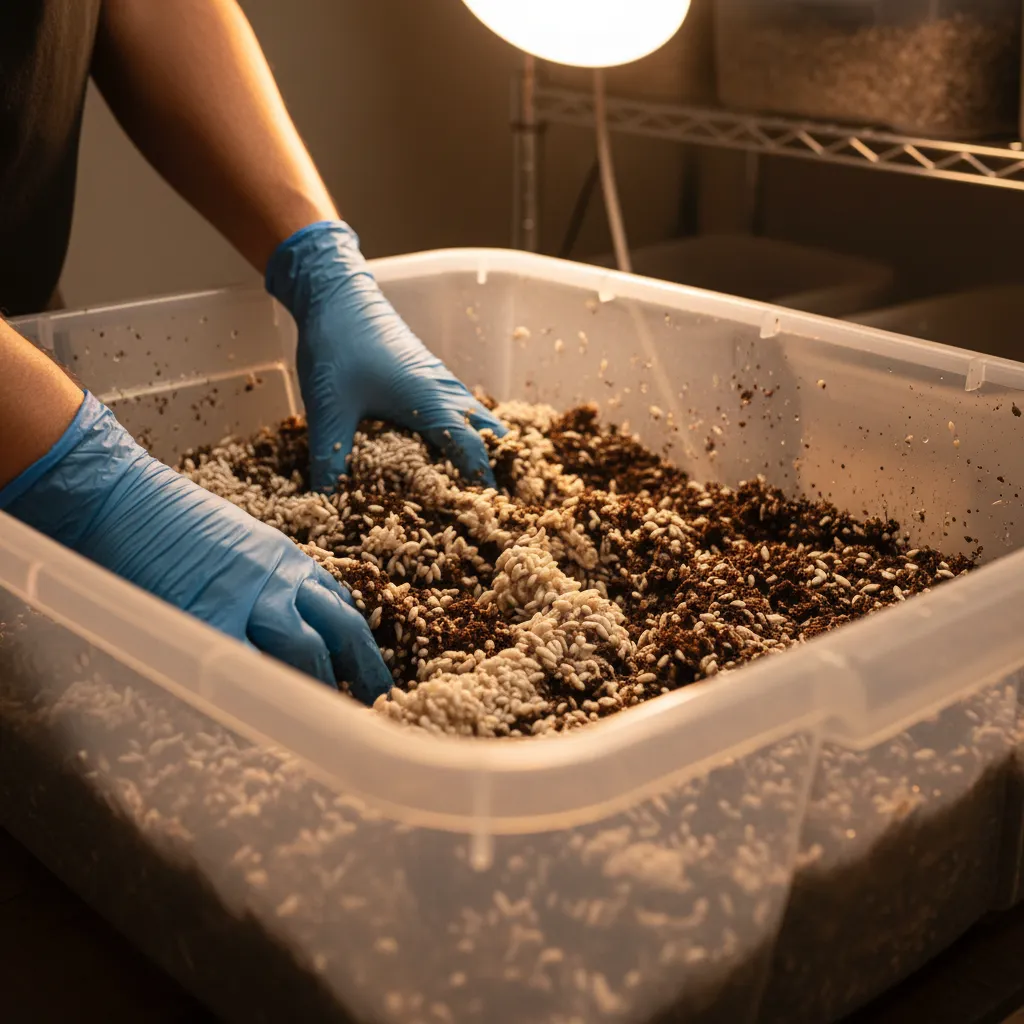
The honest answer is that growing morel mushrooms at home is extremely difficult and unreliable compared to virtually every other cultivated mushroom species. Morels have a complex life cycle that science still does not fully understand, and no home method produces consistent, repeatable harvests.
Why morels are so hard to cultivate:
- Morels require a sclerotia stage — a hardened mass of mycelium that must form before fruiting can occur. Triggering sclerotia formation reliably in artificial conditions remains unsolved for home growers.
- The environmental triggers for fruiting appear to involve a precise sequence of temperature shifts, soil chemistry changes, and microbial interactions that are nearly impossible to replicate indoors.
- Morel mycelium grows readily on grain or agar, giving many growers false hope. Colonizing substrate is easy — fruiting is the bottleneck.
What you can realistically try:
- Outdoor morel beds using spent spawn, wood chips, and soil offer the best chance for home growers, though success rates remain below 30%.
- Indoor attempts using controlled environments have produced occasional fruits in research settings but are not reproducible at home scale.
If you want reliable home-grown mushrooms, start with oyster, shiitake, or lion's mane. Morel cultivation is a long-term experiment, not a guaranteed harvest.
Morel mushrooms have unique substrate requirements that differ dramatically from typical cultivated species. In nature, morels are saprotrophic and possibly mycorrhizal, meaning they may form relationships with living tree roots in addition to decomposing organic matter.
Substrates used in morel cultivation attempts:
- Hardwood chips mixed with soil — the most common outdoor bed substrate. Use a 50/50 blend of aged hardwood chips (ash, elm, tulip poplar, or apple) and garden soil.
- Grain spawn on rye or wheat berries — used to produce mycelium for transfer to outdoor beds. Morel mycelium colonizes grain readily but this alone will not fruit.
- Sandy loam soil — morels in the wild prefer well-drained, slightly alkaline soils with a pH of 7.0-7.9.
- Wood ash amendments — adding small amounts of wood ash to the substrate mimics post-fire soil conditions that trigger wild morel fruitings.
Key substrate principles:
- Morels need a nutrient transition — rich nutrients during the sclerotia-building phase, followed by nutrient depletion to trigger fruiting.
- Calcium content in the soil appears important. Many successful outdoor patches occur in limestone-rich areas.
- The substrate must support a diverse microbial community — completely sterile substrates do not produce morel fruits.
Supplementing with gypsum (calcium sulfate) and maintaining a slightly alkaline pH gives outdoor beds the best chance of success.
Creating an outdoor morel bed is the most accessible method for home growers attempting morel cultivation. Success is never guaranteed, but proper site selection and bed preparation maximize your odds.
Site selection:
- Choose a shaded or semi-shaded area near deciduous trees, especially ash, elm, tulip poplar, or old apple trees.
- Ensure the soil is well-drained — morels will not fruit in waterlogged areas.
- A north-facing slope or the shaded side of a building works well.
Building the bed step by step:
- Clear a 4x8 foot area down to bare soil.
- Loosen the top 4-6 inches of soil with a garden fork.
- Mix in aged hardwood chips (2-3 inches deep), a handful of wood ash, and optionally a cup of gypsum to raise calcium levels.
- Spread morel spawn or slurry evenly across the bed. You can make a spore slurry by soaking fresh morel caps in non-chlorinated water with a tablespoon of molasses for 24-48 hours.
- Cover with a 1-inch layer of hardwood mulch and water thoroughly.
- Maintain moisture through the growing season — the bed should stay consistently damp but never soggy.
Timeline: If successful, fruiting may occur the following spring (12-18 months later), typically when soil temperatures reach 10-15°C (50-60°F). Many beds take 2-3 years to produce, and some never do.
Refresh the bed annually with fresh wood chips and ash to sustain the nutrient cycle.
Distinguishing true morels from false morels is a critical safety skill for anyone foraging or growing morels. False morels contain gyromitrin, a toxin that converts to monomethylhydrazine (rocket fuel compound) in the body and can cause serious illness or death.
True morels (Morchella species):
- Hollow inside — cut a true morel lengthwise and the interior is completely hollow from cap to stem, forming one continuous cavity
- Pitted cap surface — the cap has a honeycomb pattern of ridges and pits
- Cap attached directly to the stem at the base of the cap
- Symmetrical shape — generally uniform and upright
False morels (Gyromitra and Verpa species):
- Not hollow — the interior contains chambered, cottony, or solid tissue
- Brain-like or wrinkled cap — the surface is wavy, lobed, or folded rather than pitted
- Cap hangs free from the stem — attached only at the very top like an umbrella (especially Verpa species)
- Irregular, lumpy shape — often asymmetrical
The definitive test: Slice the mushroom in half vertically. A true morel is one continuous hollow chamber. A false morel has internal structure, chambers, or solid material.
When in doubt, do not eat it. False morel poisoning can cause vomiting, diarrhea, dizziness, and in severe cases liver failure and death.
Yes, false morels are genuinely poisonous and should never be eaten raw. The primary toxin is gyromitrin, which hydrolyzes in the body to produce monomethylhydrazine (MMH) — the same compound used as rocket fuel.
Toxicity facts:
- Gyromitra esculenta is the most commonly encountered false morel and the most studied for toxicity. Despite the species name "esculenta" (meaning edible), it has caused numerous fatalities.
- Symptoms appear 6-12 hours after ingestion and include severe headache, vomiting, diarrhea, abdominal cramps, and dizziness.
- In severe cases, liver and kidney failure can develop 2-4 days after consumption, potentially leading to death.
- Toxicity varies by individual specimen, geographic region, and preparation method — this unpredictability makes false morels especially dangerous.
The parboiling controversy:
- In Finland and parts of Scandinavia, Gyromitra esculenta is sold in markets after double-boiling (parboiling twice with water changes), which reduces gyromitrin content.
- However, this does not guarantee safety. MMH is volatile, and inhaling steam from boiling false morels has caused poisoning in cooks.
- No amount of cooking reliably eliminates all toxin from every specimen.
The safe approach is simple: learn to identify false morels and avoid eating them entirely. Stick to verified true morels (Morchella species) that pass the hollow-interior test.
Fire morels are true morels (typically Morchella sextelata or Morchella exuberans) that fruit prolifically in forests the spring after a wildfire. They are among the most sought-after morels due to their large size and abundance in burn zones.
Appearance:
- Color: dark grey to black when young, lightening to grey-brown as they mature. Often called "black morels" or "burn morels."
- Size: frequently larger than non-fire morels — caps of 8-15cm (3-6 inches) are common, with some reaching 20cm or more.
- Cap shape: conical (elongated and pointed), with deep pits and prominent ridges arranged in a vertical pattern.
- Stem: thick, white to cream colored, and hollow.
- Hollow interior: like all true morels, fire morels are completely hollow when sliced lengthwise.
Where and when to find them:
- Fruit in burned conifer forests (pine, fir, spruce) the spring following a fire — typically April through June depending on elevation and latitude.
- Most productive in areas with moderate burn severity — not fully incinerated but significantly charred.
- Often appear in massive quantities — experienced foragers can harvest 10-50+ pounds per day in a productive burn.
Fire morels are safe to eat and highly prized for their robust, smoky flavor. They dry exceptionally well and are a major target for commercial wild harvesters across the western United States and Canada.
Black morels and yellow morels are both true morels in the Morchella genus, but they differ in appearance, timing, habitat, and flavor. Learning to distinguish them helps with identification and knowing when and where to look.
Black morels (*Morchella elata* group):
- Cap color: dark brown to black ridges with lighter grey-brown pits
- Cap shape: narrowly conical, elongated, and pointed
- Ridge pattern: ridges run predominantly vertically with shorter horizontal cross-ridges, creating a ladder-like pattern
- Timing: appear first in the season, typically 1-3 weeks before yellow morels
- Habitat: mixed hardwood-conifer forests, burn areas, wood chip mulch beds, disturbed ground
- Size: generally smaller, 5-12cm (2-5 inches) tall
Yellow morels (*Morchella esculenta* group):
- Cap color: pale yellow to tan ridges with cream to buff pits, darkening with age
- Cap shape: rounder, more egg-shaped or bulbous
- Ridge pattern: more random and maze-like, without the strong vertical orientation
- Timing: appear later in the season, when tulip poplars bloom and lily-of-the-valley emerges
- Habitat: strongly associated with dying or dead elm, ash, tulip poplar, and old apple orchards
- Size: often larger, 8-20cm (3-8 inches) tall, with some specimens exceeding 25cm
Both are excellent edibles. Yellow morels are generally considered to have a milder, nuttier flavor, while black morels offer a more intense, earthy taste.
Understanding wild morel fruiting triggers is essential for both foragers and cultivation researchers. Morels require a specific sequence of environmental conditions rather than a single trigger.
The key triggers:
- Soil temperature: The primary trigger is soil temperature reaching 10-15°C (50-60°F) at a depth of 4 inches. Morels rarely appear when soil is below 10°C or above 18°C.
- Temperature fluctuation: A pattern of warm days (15-21°C) followed by cool nights (4-10°C) for 7-14 days seems critical. This mimics spring weather transitions.
- Moisture: Significant rainfall (25-50mm) followed by 2-3 days of warming appears to initiate pinning. Soil must be consistently moist but not saturated.
- Tree disturbance or death: Morels frequently fruit near dying, damaged, or recently dead trees — particularly elm, ash, and apple. The dying root system may release nutrients or chemical signals that trigger fruiting.
- Fire: Forest fires create ideal conditions through nutrient release, pH changes (ash raises soil pH), canopy opening, and elimination of competing fungi.
Seasonal timing indicators:
- Dandelions blooming — a folk indicator that soil temperatures are entering morel range
- Lilac and apple tree bloom — traditionally marks the peak of yellow morel season
- Oak leaves reaching squirrel-ear size — another traditional timing indicator
For cultivation attempts, mimicking these triggers means providing a cold period followed by gradual warming, maintaining consistent moisture, and ensuring slightly alkaline soil chemistry.
Growing morel mushrooms indoors is theoretically possible but practically unreliable with current knowledge and home-scale equipment. A few research groups and one commercial operation in China have achieved indoor fruiting, but the methods are complex, expensive, and not consistently reproducible.
What has been achieved:
- Chinese commercial cultivation — since approximately 2012, farms in Sichuan and Yunnan provinces have produced morels in controlled greenhouse environments using proprietary soil-based methods. Production remains inconsistent and yields vary dramatically between seasons.
- Research lab fruitings — several university labs have produced small quantities of morel fruiting bodies in controlled chambers, but the protocols involve precise manipulation of temperature, nutrients, light, and microbial communities.
Why indoor growing fails for most people:
- Morel mycelium colonizes substrate easily, giving the illusion of progress, but colonization and fruiting are completely separate challenges.
- The sclerotia formation stage requires a nutrient-rich phase followed by nutrient starvation — difficult to manage in small containers.
- Temperature cycling must be precise: a warm growth phase at 20-25°C, then cold shocking to 4-8°C for several weeks, then gradual rewarming.
- The microbial community in the substrate appears to play a role that is not yet fully characterized.
If you want to try indoor morels, set your expectations extremely low. Budget for multiple failed attempts and treat it as a long-term experiment rather than a food production method. Most experienced growers recommend focusing on outdoor beds as the more realistic approach.
Commercial morel cultivation is in a transitional phase — no longer purely theoretical, but far from the reliability of oyster or shiitake production. As of 2025, China dominates the field with an emerging but still inconsistent industry.
China's morel industry:
- Sichuan and Yunnan provinces are the epicenters of commercial morel farming, with an estimated 10,000+ hectares under cultivation.
- Growers use outdoor raised beds in greenhouse tunnels, with soil-based substrates enriched with grain bags (called "nutrition bags") placed on the bed surface.
- Yields average 150-300kg per mu (roughly 1,000-2,000 kg per hectare) in good years, but crop failures of 30-50% are common.
- The primary species cultivated is Morchella sextelata (a black morel), which has proven most amenable to controlled production.
Outside China:
- No country has established reliable commercial morel cultivation at scale.
- Several U.S. and European companies have attempted indoor morel farms, but none have achieved consistent, commercially viable production.
- Patents exist for various morel cultivation methods, but none have translated to repeatable large-scale success.
Key challenges remaining:
- Yield unpredictability — identical beds with identical inputs produce wildly different results between seasons
- Disease and contamination — morel beds are susceptible to mold, bacterial infections, and nematodes
- High labor costs — harvest is still entirely manual
- Short shelf life — fresh morels last only 3-5 days, requiring rapid processing or drying
The consensus among mycologists is that morel cultivation will become more reliable over the next decade as Chinese research advances, but it will likely never be as straightforward as oyster or shiitake production.
Need more help? Dr. Myco can answer follow-up questions about morel cultivation based on thousands of real growing experiences.
Ask Dr. Myco