Mushroom Contamination or Normal Mycelium?
10 tips in Contamination & Troubleshooting
By Andrew Langevin · Founder, Nature Lion Inc · Contributing author, Mushroomology (Brill, 2026)
Quick answer
Healthy mycelium is usually white and organized; contamination often introduces a separate color, texture, boundary or abnormal speed
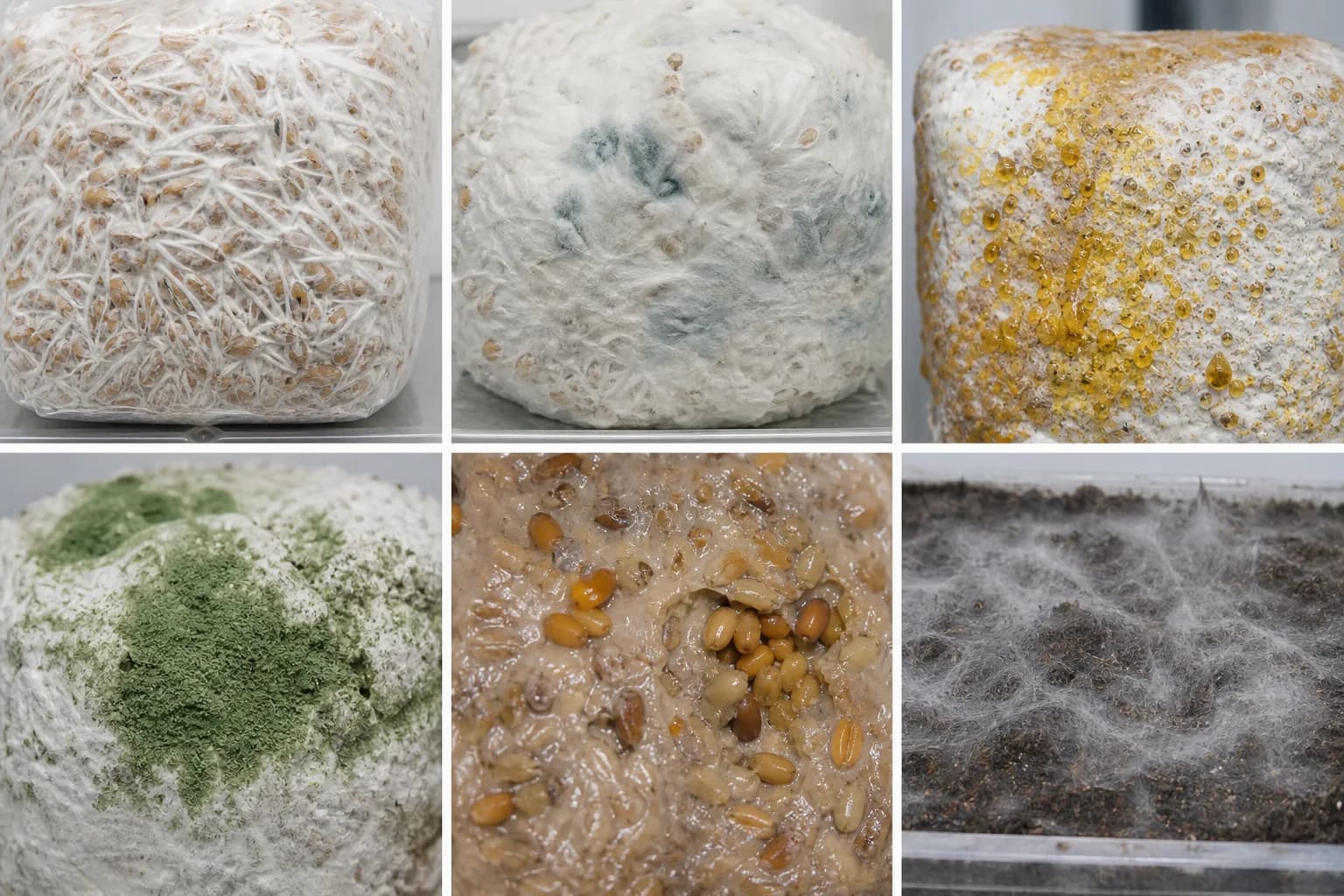
Blue bruising, amber metabolites, fluffy aerial growth and tiny white primordia can all be normal. Powdery green growth, slime, spreading gray webbing, strong off odors or unexpected black, pink and orange colors require isolation.
Normal mycelium vs contamination: immediate actions
When uncertain, isolate the container and photograph the same area under the same light. Change over 24–48 hours is often more informative than a single glance.
| Appearance | Status | Possible explanation | Next action |
|---|---|---|---|
| Bright white ropes or even cottony growth | Usually normal | Healthy rhizomorphic or tomentose mycelium | Continue observing growth rate and odor |
| Blue discoloration after handling or drying | Often normal | Bruising or oxidation | Photograph and recheck; isolate if it spreads independently or becomes powdery |
| Amber or yellow droplets | Monitor | Mycelial metabolites, often associated with stress | Check temperature, moisture and airflow; watch for odor or color change |
| Small firm white bumps | Usually normal | Hyphal knots, primordia or early pins | Maintain stable fruiting conditions and watch for organized development |
| Green, blue-green or powdery colony | Discard / isolate | Sporulating mold such as Trichoderma or Penicillium | Keep sealed, remove from the grow area and avoid disturbing spores |
| Wet, greasy or slimy uncolonized grain | Discard / isolate | Likely bacterial contamination | Do not transfer or spawn; review grain hydration and sterilization |
| Wispy gray growth spreading very rapidly | Isolate | Possible cobweb-like mold; aerial mycelium can look similar | Compare color, density and 24-hour spread; do not rely on peroxide alone |
| Black, pink or orange growth | Discard / isolate | Unexpected mold, yeast or bacteria | Keep sealed and remove cautiously; do not attempt a smell test |
Do not disturb a visibly sporulating culture
Keep green, black or powdery contamination sealed. Do not open it for a smell test, scrape it, swab it or carry it uncovered through a clean growing area. Home peroxide or swab tests can add evidence but are not definitive identification methods.
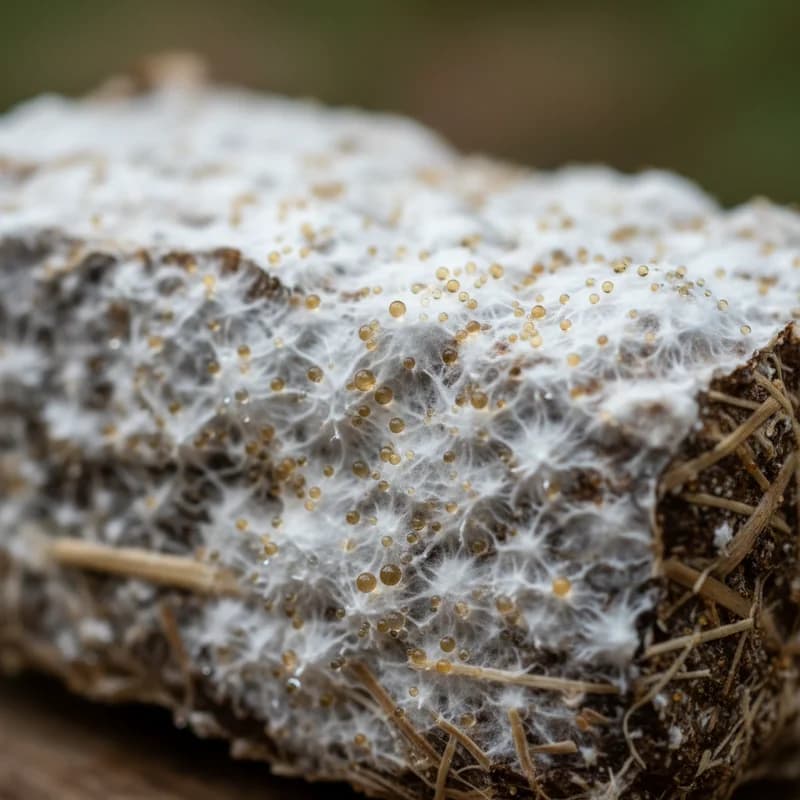
Yellow or amber droplets on your mycelium are almost always metabolites, and they are completely normal. Metabolites are liquid waste products that mycelium exudes as it digests substrate and defends its territory. They look like tiny drops of honey or amber liquid sitting on top of the white mycelial surface — sometimes called mycelium pee in online forums.
Metabolites often appear when mycelium is stressed — fighting off a competitor, running low on fresh air, or encountering a less-than-ideal substrate composition — but their presence alone does not mean contamination. In fact, metabolite production can be a sign that your mycelium is healthy and actively defending itself against microorganisms that you cannot even see yet. The color ranges from pale yellow to deep amber or even slightly orange.
Where you should pay attention is if those yellow areas are accompanied by:
- An off smell, which would suggest actual contamination
- Yellow transitioning to green within a day or two, which is classic Trichoderma behavior
Trichoderma can trigger heavy metabolite production right before it overwhelms the mushroom mycelium, so monitor the area closely for color changes over the next 48 hours.
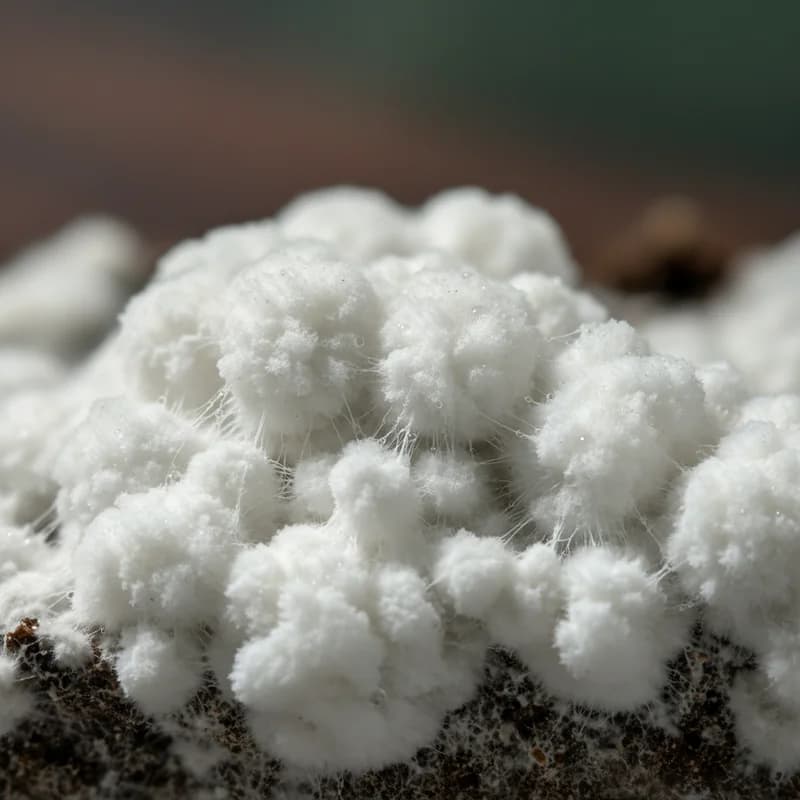
No, and confusing the two is one of the most common mistakes new growers make. Aerial mycelium — sometimes called tomentose growth — is fluffy, cotton-like mushroom mycelium that grows upward from the substrate surface. It is bright white, relatively dense, and while it looks fluffy it has substance to it. Cobweb mold is wispy, gray-tinted, and almost translucent — it looks like actual cobwebs stretched across the surface and has virtually no density.
The easiest ways to distinguish them:
- Color — Aerial mycelium is bright white; cobweb mold has a grayish tint
- Speed — Aerial mycelium expands an inch or two per day at most; cobweb mold can cover an entire tub surface overnight
- Hydrogen peroxide test — Mist with 3% hydrogen peroxide; cobweb mold visibly collapses and dissolves within seconds while healthy aerial mycelium is unharmed
Aerial mycelium is very common with certain species like oyster mushrooms and is simply a sign of high humidity and slightly low fresh air exchange. Increase FAE slightly and it will flatten out.
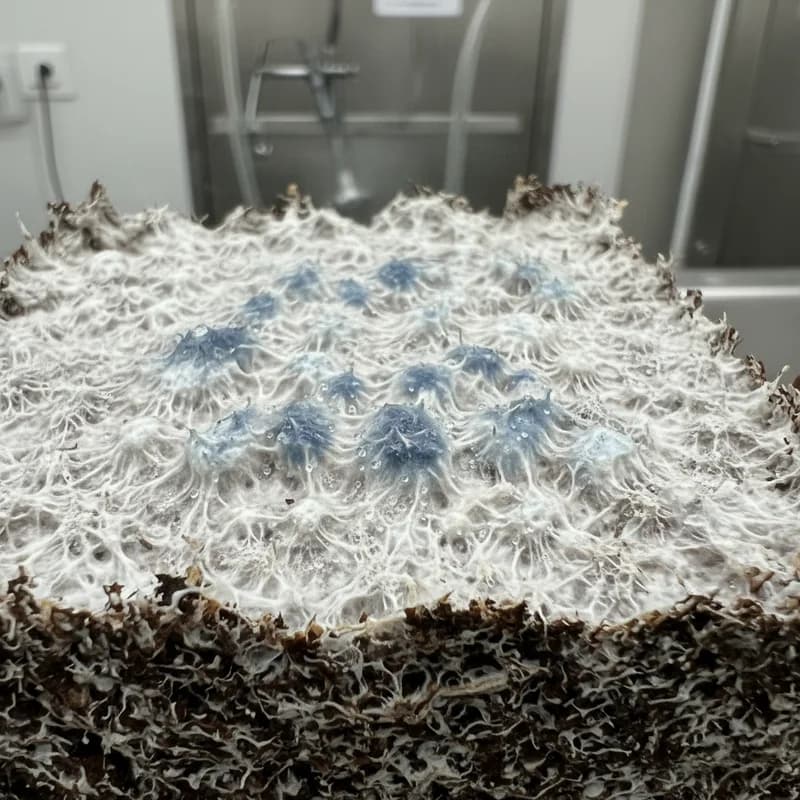
Blue bruising on mycelium or fruiting bodies is almost always physical bruising, not contamination. Many mushroom species bruise blue when their cell walls are damaged — this is an oxidation reaction involving compounds in the mushroom tissue. It is extremely common with certain species and also occurs with oyster mushrooms, some boletes, and others.
The Q-tip test is definitive here: rub a cotton swab on the blue area. If nothing transfers to the swab, it is bruising. If blue-green pigment comes off on the cotton, you are looking at Trichoderma or Penicillium spores.
Key differences between bruising and mold:
- Bruising follows the pattern of physical contact — where your hand touched, where misting water dripped, or where fruiting bodies press against each other
- Mold grows in expanding circular colonies from a central point
- Bruising tends to be blue to dark blue
- Mold (Trichoderma) has a distinctly green character, often with a yellowish component
If you are seeing blue patches and you recently handled the substrate or fanned aggressively, bruising is the most likely explanation.
Those tiny white bumps are most likely primordia — baby mushroom pins — and they are exactly what you want to see. Primordia form as small hyphal knots that look like white dots, bumps, or tiny blisters on the mycelium surface. They are the earliest visible stage of mushroom fruiting body formation.
With oyster mushrooms, primordia appear as clusters of tiny nubs, often at the edges of holes cut in bags or along the surface of a tub. With other species they may form individually across the casing layer. New growers frequently mistake primordia for contamination because they appear suddenly and look different from the smooth mycelial mat that was there before.
Key distinctions from contamination:
- Primordia are the same color as your mycelium — white
- They are raised bumps rather than flat patches
- They tend to appear in clusters, especially near areas of good fresh air exchange
- Contamination typically appears as a different color or texture from surrounding mycelium
If you have been in fruiting conditions for several days and see white bumps forming, congratulations — your mushrooms are starting. Maintain humidity above 85% and keep fresh air exchange consistent. Those bumps should develop into recognizable pins within a few days.
Thick, ropy, strand-like mycelium growth is called rhizomorphic growth and it is not only normal but actually a very good sign. Rhizomorphic mycelium forms visible cord-like strands that reach out aggressively through the substrate, looking like tiny white roots or veins. This is the opposite of tomentose (fluffy, cotton-like) growth, and it generally indicates a healthy, vigorous culture.
Many experienced growers specifically select for rhizomorphic growth when working on agar because it tends to correlate with better fruiting performance and faster colonization. The strands you see are bundles of hyphae working together as transport highways, moving water and nutrients efficiently across the substrate.
How rhizomorphic growth appears in different contexts:
- On agar plates — Looks like a starburst or lightning pattern radiating outward from the inoculation point
- In grain jars — Ropy strands reach between kernels and pull colonization forward quickly
There is nothing to worry about here. If anything, strong rhizomorphic growth means your genetics are good and your substrate conditions are on point. Different species have different tendencies, but within a given species, ropy growth generally outperforms fluffy growth.
Yellowing substrate has several possible causes, and most of them are not contamination. The most common reason is metabolite production — your mycelium is exuding yellow liquid waste as it colonizes, and this liquid soaks into the substrate and stains it yellow or amber. This is normal and especially common with aggressive colonizers like oyster mushrooms.
Other non-contamination causes include:
- Straw-based substrates turning yellow-brown as mycelium breaks down lignin and cellulose, which is simply decomposition doing its job
- Coco coir substrates yellowing from tannins leaching out as mycelium processes the fiber
Where yellowing becomes concerning:
- Yellowing accompanied by a sour or off smell suggests bacterial contamination rather than healthy metabolic activity
- Yellowing that transitions to green within a day is classic Trichoderma, which triggers metabolite production from the mushroom mycelium just before the green mold takes over
A uniformly yellowing substrate that still smells earthy and fresh is almost certainly fine. If the yellow areas are isolated and everything else looks healthy, mark them and check back in 24 hours before making any decisions.
Healthy mushroom mycelium is white, consistent in texture, and grows at a steady, predictable rate. It has a clean, uniform appearance — whether it is fluffy tomentose growth or ropy rhizomorphic strands, it looks organized. Contamination by contrast tends to look chaotic, patchy, or out of place.
Here is a mental checklist for visual assessment:
- Color — Healthy mycelium is white; any green, black, pink, orange, or gray patches are suspect; yellow droplets are usually fine
- Texture — Healthy mycelium has consistent texture across the colonized area; powdery or dusty patches suggest mold sporulation; slimy wet areas suggest bacteria
- Growth pattern — Mushroom mycelium expands relatively evenly from the inoculation point; contamination often appears as a separate colony with a distinct boundary
- Speed — A section that visibly outpaces the rest in a single day is suspicious
- Boundary lines — Clear areas between your mycelium and another organism where neither is growing indicate two organisms are battling
Look for zones of inhibition — if you see a clear demarcation line on your agar plate or in your jar, something other than your target species is growing. Your mycelium recognizes the other organism as foreign.
The decision to discard or wait comes down to a few practical rules. Worry immediately if you see green, black, or bright colors that are clearly not your mushroom species — these are confirmed contaminants and waiting only lets them sporulate and spread. Also worry if you detect a strong sour, sweet, or chemical smell — smell is often more reliable than sight for early detection.
Wait and monitor if you see:
- Yellow droplets on white mycelium
- Fluffy aerial growth
- Blue bruising
- Patches that are simply colonizing slower than the rest
These are almost always normal. The key question is: is the suspicious area getting worse over time? Take a photo, mark the spot, and check again in 24 hours. Contamination gets worse fast — a green spot today will be a bigger green spot tomorrow. Normal mycelium variations stay stable or improve.
Another useful rule: if your substrate is more than 50% colonized with healthy mycelium and you see a small suspicious spot, the mycelium may fight it off on its own, especially with aggressive species like oyster mushrooms. Below 50% colonization, the odds shift in favor of the contaminant. When genuinely uncertain, isolate the container from your other grows but do not discard it yet. Give it 48 hours and the answer will usually become obvious.
Some cloudiness in liquid culture is normal, but there is a specific kind of cloudy that means contamination. Healthy liquid culture starts clear and develops wispy white mycelial clumps over days to weeks. When you swirl the jar, you should see distinct white strands or snowflake-like formations swirling through relatively clear broth. The broth might be slightly hazy from dissolved nutrients, which is fine.
Bacterial contamination makes the broth uniformly cloudy or murky, like dirty water, with no distinct mycelial formations visible. Signs of bacterial contamination include:
- Broth looks turbid rather than clear-with-stuff-floating-in-it
- Swirling produces a uniform milky swirl rather than distinct white clumps moving through clear liquid
- A biofilm — a slimy layer at the surface or on the bottom of the jar
- A sudden increase in cloudiness (if your LC was clear yesterday and opaque today, bacteria are multiplying exponentially)
Smell is again your friend: crack the lid and a healthy LC smells like mushrooms or has a neutral yeasty smell, while bacterial LC smells sour, like fermenting fruit.
One useful practice is to keep an uninoculated control jar of the same broth. Compare the clarity — your inoculated jar should not be dramatically cloudier than the control except where you can see actual mycelium.
The cobweb-versus-mycelium question comes up constantly, and there are four reliable ways to tell them apart. Hold your tub near a good light source and compare the suspicious growth to areas you know are healthy mycelium.
The four diagnostic tests:
- Color — Cobweb mold has a grayish tint, while mushroom mycelium is bright white; the gray is subtle but visible
- Density — Cobweb mold is extremely wispy and thin, almost see-through; even fluffy tomentose mycelium has more substance and opacity
- Speed — Cobweb mold grows absurdly fast, often covering several inches or an entire tub surface overnight; even fast-growing oyster mushrooms do not expand that quickly during fruiting
- Hydrogen peroxide test — Directly spray 3% hydrogen peroxide on the suspicious growth; cobweb mold dissolves on contact with visible fizzing and collapse within seconds, while mushroom mycelium does not react
The hydrogen peroxide test is the definitive test and costs nothing. Most of the cobweb mold panic in online forums is actually just aerial mycelium from high humidity and low FAE. Real cobweb is less common than people think.
Put these tips into context
Use a safety-first grow-kit checklist before changing or opening the block.
Compare mold, bruising, and myceliumNeed more help? Dr. Myco can answer follow-up questions about mushroom contamination or normal mycelium? based on thousands of real growing experiences.
Ask Dr. Myco