Spawn Types
10 tips in Spawn Production
By Andrew Langevin · Founder, Nature Lion Inc · Contributing author, Mushroomology (Brill, 2026)
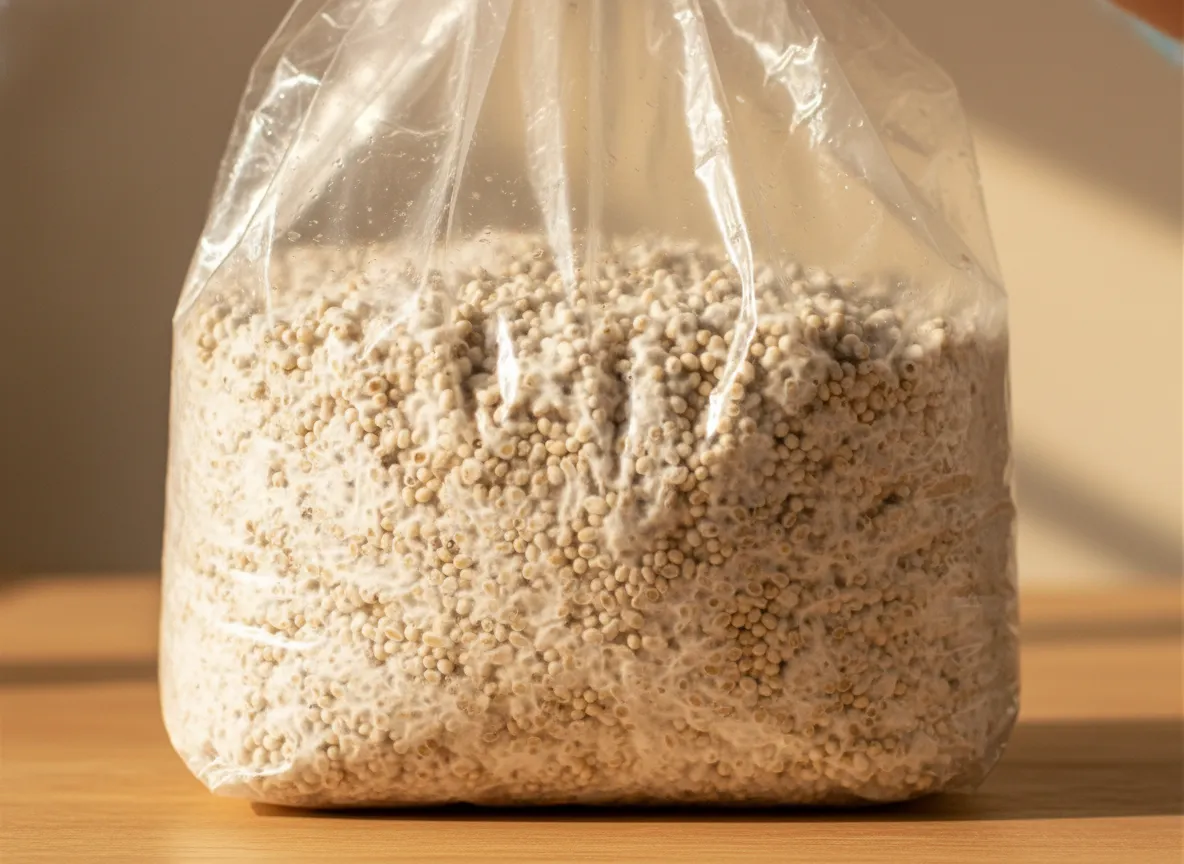
Mushroom spawn is a carrier material (usually grain) that has been fully colonized by mushroom mycelium. It serves as the 'seed' for your grow — you mix it into your bulk substrate to inoculate it. Spawn is not the mushroom itself, but rather the living mycelial network that will colonize your substrate and eventually produce mushrooms.
The quality of your spawn determines the success of your entire grow: clean, vigorous spawn colonizes fast and resists contamination, while weak or contaminated spawn leads to failed grows.
You can buy spawn from suppliers or produce your own from agar cultures or liquid culture.
Grain spawn is the most common and versatile spawn type. Cereal grains (rye, wheat, oats, millet, wild bird seed) are hydrated, sterilized in jars or bags, then inoculated with mycelium from agar or liquid culture. Grain provides an ideal nutrient-rich substrate for rapid mycelial colonization, with individual kernels acting as discrete colonization points when mixed into bulk substrate.
Use grain spawn for:
- Monotub grows
- Grow bag cultivation
- Bulk substrate inoculation
- Any indoor cultivation method
Grain spawn colonizes faster than other spawn types because the high surface-area-to-volume ratio of individual kernels provides many growth points throughout your substrate.
Sawdust spawn is sterilized hardwood sawdust (often supplemented with bran or soy hull) colonized by mushroom mycelium. Sawdust spawn colonizes more slowly than grain spawn but is cheaper to produce in bulk and blends more naturally with wood-based substrates.
It's the preferred spawn type for:
- Log inoculation (packed into drilled holes)
- Outdoor bed cultivation
- Commercial bag production of wood-loving species like shiitake and lion's mane
For most home cultivators, grain spawn is more practical. Sawdust spawn becomes cost-effective when you're scaling up or specifically doing log cultivation, where grain spawn isn't appropriate.
Plug spawn consists of small hardwood dowels (about 6mm diameter x 25mm long) that have been colonized by mushroom mycelium. Plugs are designed specifically for log cultivation — you drill holes in freshly cut hardwood logs, tap in the colonized plugs, and seal with wax.
Plug spawn is the simplest method for outdoor log cultivation because it requires no special equipment beyond a drill, a hammer, and some wax. It's also the most accessible entry point for complete beginners who want to grow mushrooms outdoors.
Available species typically include shiitake, oyster, lion's mane, and maitake. One bag of plug spawn (usually 100-1000 plugs) can inoculate several logs.
Liquid culture (LC) is not spawn itself — it's a method of inoculating spawn. You inject LC into sterilized grain to produce grain spawn, or inject it into substrate bags to bypass the grain spawn step entirely. Using LC to directly inoculate bulk substrate (like squirting it into a monotub) is not recommended because the liquid doesn't provide enough colonization points and introduces excess moisture.
The proper chain is:
- Agar → liquid culture → grain spawn → bulk substrate
Some growers successfully inject LC directly into supplemented sawdust bags, which works because the sealed bag environment and sterilized substrate compensate for the less aggressive inoculation method.
Both serve different purposes in the cultivation chain. Liquid culture is used to inoculate grain — it's a step before spawn, not a replacement for it. The decision is really: should you buy grain spawn (ready to use) or make your own (using LC to inoculate grain)?
Buy grain spawn if:
- You're a beginner
- You want convenience
- You don't have a pressure cooker
Make your own if:
- You want to save money long-term
- You need large quantities
- You want control over genetics and quality
A single liquid culture syringe ($10-15) can produce 10+ jars of grain spawn, while buying equivalent grain spawn costs $50-100+. Making your own spawn requires a pressure cooker and sterile technique.
Spawn rate (or spawn ratio) is the percentage of spawn relative to your bulk substrate by weight. A 10% spawn rate means 100g of spawn per 1000g of substrate. The sweet spot for most home cultivators is 10-20%.
How spawn rate affects your grow:
- Higher spawn rates (15-25%) — colonize faster, resist contamination better, and often produce higher yields, but cost more in spawn
- Lower spawn rates (5-10%) — more economical but colonize slowly, leaving a longer window for contamination
For beginners, err on the high side (15-20%) — the faster colonization dramatically reduces your contamination risk. As you gain confidence in your sterile technique, you can reduce spawn rates to stretch your spawn further.
Recommended spawn-to-substrate ratios by weight:
- CVG (coir/vermiculite/gypsum) — 1:2 to 1:4 (20-33% spawn rate)
- Masters Mix — 15-20% spawn rate
- Straw — 10-15% spawn rate
- Hardwood pellets — 15-20% spawn rate
- PF Tek (BRF cakes) — spawn is added via syringe, typically 1-2cc per half-pint jar
- Logs (plug spawn) — 1 plug per 6 inches of log length, rows 2-3 inches apart
General rule: supplemented substrates (Masters Mix, enriched sawdust) need higher spawn rates because they're more susceptible to contamination. Unsupplemented substrates (plain straw, coir) can use lower rates because they're less nutritious to contaminants.
For a standard 5 lb (2.27 kg) supplemented sawdust grow bag: 0.75-1 lb (340-450g) of grain spawn, which is a 15-20% spawn rate.
Other common quantities:
- For a 2.5 lb bag: 375-500g grain spawn
- For a monotub with 5-6 quarts of bulk substrate: 2-3 quarts of grain spawn (a 1:2 to 1:3 ratio)
Most grain spawn suppliers sell in quart jars (roughly 1.5 lbs dry weight) or pound bags. One quart of grain spawn is enough for one 5 lb grow bag or a small monotub.
Plan your spawn needs before you start — running out mid-inoculation means exposed substrate and contamination risk.
Technically yes, but in practice it's rarely a problem for home cultivators. Using more than 25-30% spawn rate is wasteful — the excess grain doesn't significantly speed colonization and can actually cause problems:
- Excess moisture from the grain
- Uneven substrate composition
- An overly nitrogen-rich environment that attracts Trichoderma
- Wasted spawn that could have been used for additional grows
That said, for beginners, slightly too much spawn (20-25%) is far better than too little (under 10%). Fast colonization is your best defense against contamination, and using extra spawn achieves that.
Need more help? Dr. Myco can answer follow-up questions about spawn types based on thousands of real growing experiences.
Ask Dr. Myco