Advanced Spawn Techniques
16 tips in Spawn Production
By Andrew Langevin · Founder, Nature Lion Inc · Contributing author, Mushroomology (Brill, 2026)
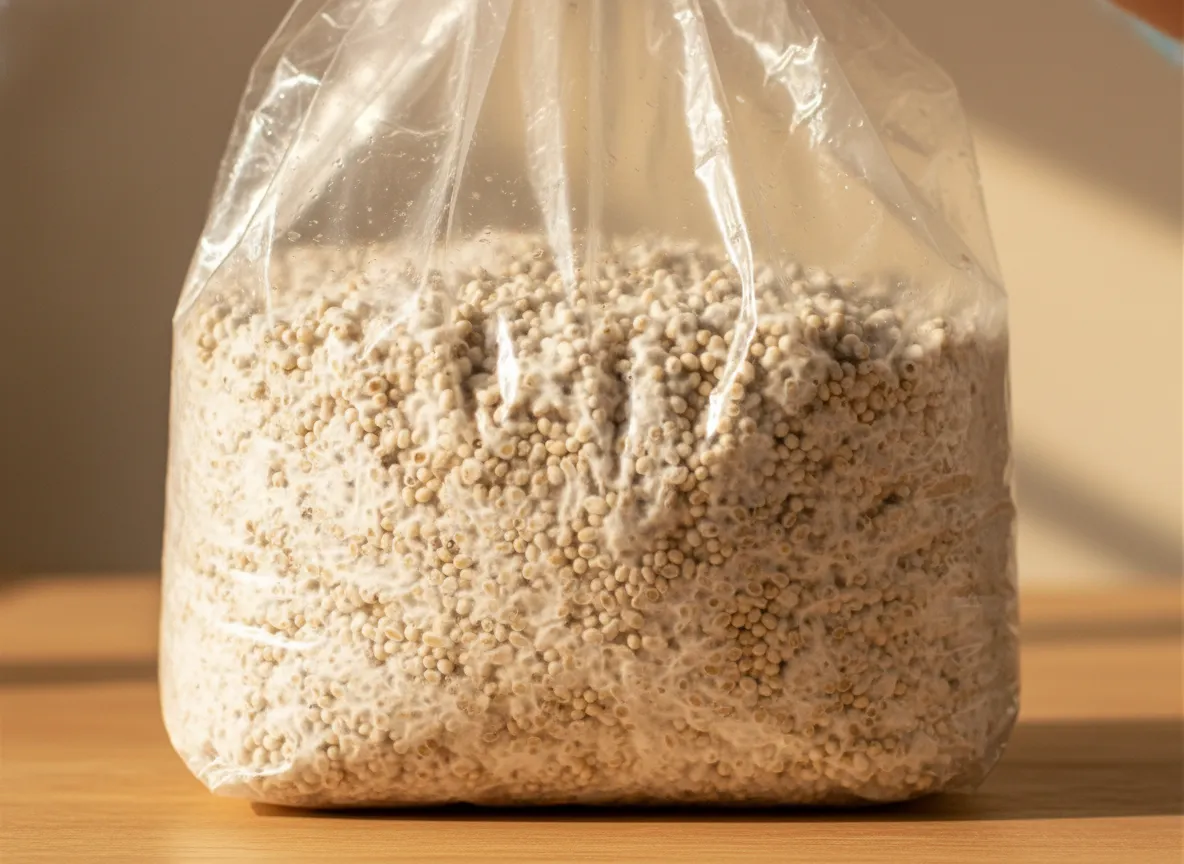
Agar-to-grain transfer is the gold standard method for producing clean, genetically consistent grain spawn. You cut small wedges from a colonized agar plate and drop them into sterilized grain, where the mycelium spreads from each wedge to colonize the entire jar.
Step-by-step process:
- Prepare and sterilize grain jars at 15 PSI for 90 minutes, then cool completely
- Work inside a still air box or in front of a laminar flow hood
- Flame-sterilize your scalpel until the blade glows red, then let it cool for 10 seconds
- Open your colonized agar plate and cut 3-5 small wedges (approximately 1 cm square) from the leading edge of healthy rhizomorphic growth
- Open the grain jar, quickly drop the wedges inside, and close immediately
- Shake gently to distribute the wedges throughout the grain
Why agar-to-grain is preferred over liquid culture inoculation:
- You can visually inspect the agar plate for contamination before committing it to grain
- You select the strongest growth sectors from the plate, improving genetics
- Multiple wedges create several inoculation points, speeding colonization
- The agar itself provides a small nutrient reserve that helps mycelium establish on the grain
Expect visible colonization around each wedge within 3-5 days and full jar colonization in 10-21 days at 75°F.
A master grain spawn jar is a fully colonized jar reserved exclusively for grain-to-grain transfers rather than spawning to bulk substrate. It serves as a living bank that can produce dozens of working spawn jars over several weeks.
Creating a master jar:
- Start from a clean agar culture with known, isolated genetics — never from a multi-spore syringe
- Inoculate a single quart jar of sterilized grain using agar wedges from the strongest sector of your plate
- Let it colonize fully at optimal temperature (75°F for most species)
- Once 100% colonized, label it clearly as MASTER with the species, strain, date, and generation number (G1)
Using the master jar:
- Shake the master jar vigorously to break up the grain
- Transfer 10-15% of the colonized grain into each fresh sterilized jar
- One master jar can inoculate 5-10 working jars
- Retire the master after 3-4 transfers (generations) to avoid senescence
Storage: Master jars can be refrigerated at 35-40°F to slow metabolism and extend useful life by several weeks. Remove from the fridge 24-48 hours before transferring to let the mycelium reactivate. Always maintain backup cultures on agar slants or plates in case your master jar contaminates.
While most grains work for most species, certain grain-species pairings optimize colonization speed and spawn quality. The differences are subtle but meaningful for growers seeking peak performance.
Optimal grain pairings:
- Oyster mushrooms (all varieties): Wheat straw pellets or rye berries — oysters are aggressive colonizers that do well on any grain, but rye's rough texture gives excellent grip
- Shiitake: Rye berries or wheat berries — shiitake benefits from the dense nutrition and moderate moisture of these grains
- Lion's mane: Millet or rye berries — millet's small kernel size creates more inoculation points, which helps this slower colonizer
- King oyster: Rye berries — king oyster prefers the consistent moisture retention of rye
- Reishi: Whole oats or rye berries — reishi is aggressive and does well on cheaper grains like oats
- Maitake: Rye berries — maitake colonizes slowly and benefits from rye's consistent hydration
- Wine cap: Rye berries or WBS — either works well for this vigorous outdoor species
Universal recommendations:
- Rye berries are the safest all-purpose choice for any species
- Millet is best when you need maximum inoculation points (slow colonizers, low spawn rates)
- Whole oats are the budget choice when cost matters more than optimization
- WBS (wild bird seed) is the cheapest option that still performs respectably across all species
Popcorn kernels make excellent mushroom spawn due to their large size, wide availability, and high starch content that supports vigorous mycelial growth. They are readily available at any grocery store, making them one of the most accessible spawn grains.
Preparation steps:
- Rinse 1.5 kg of plain yellow popcorn kernels (no butter or flavoring) under cold water
- Soak in a large pot covered with 3-4 inches of water for 12-24 hours
- After soaking, bring to a simmer for 15-20 minutes — popcorn kernels are dense and need slightly longer than rye
- The kernels should be swollen and soft enough to dent with a fingernail but NOT splitting open
- Drain in a colander and spread on a clean towel for 20-30 minutes to dry surface moisture
- Add 1 gram of gypsum per 500g of grain and mix
- Load into quart jars at three-quarters full
- Pressure cook at 15 PSI for 90 minutes
Popcorn advantages:
- Large kernel size makes contamination easy to spot visually
- Available everywhere, often cheaper than rye berries
- High starch content supports fast colonization
Popcorn drawbacks:
- Fewer inoculation points per jar compared to smaller grains like millet
- Slightly more prone to bursting during simmering if overcooked
- Dense kernels can retain excess interior moisture if not soaked long enough
Sorghum (milo) is a popular spawn grain in commercial mushroom operations due to its low cost, consistent quality, and excellent colonization characteristics. It is commonly found in wild bird seed mixes and can be purchased in bulk from feed stores for $10-$15 per 50-pound bag.
Preparation steps:
- Rinse 1.5 kg of whole sorghum under cold water to remove dust
- Soak in water for 12-16 hours — sorghum absorbs water at a moderate rate
- Drain and bring fresh water to a boil
- Simmer for 10-12 minutes — sorghum kernels should be plump and slightly soft but intact
- Drain immediately and spread on a towel to dry surface moisture for 20-30 minutes
- Add gypsum at 1 gram per 500g grain
- Load into jars or bags and sterilize at 15 PSI for 90 minutes
Why commercial farms choose sorghum:
- Extremely consistent kernel size for uniform hydration
- Harder hull than oats, so it resists splitting during cooking
- Lower cost per pound than rye berries in bulk quantities
- Moderate kernel size provides a good balance between inoculation points and nutrition per kernel
Sorghum works well for all commonly cultivated gourmet species. It is especially popular for oyster mushroom spawn production where high volumes demand an economical grain. The main drawback is limited retail availability — you may need to visit a feed store or order online.
The Broke Boi method is a budget grain spawn technique that uses extended steam sterilization at atmospheric pressure instead of a pressure cooker. Popularized on mushroom growing forums, it is the most accessible way to make grain spawn without investing in a pressure cooker.
The method:
- Prepare grain normally — soak, simmer, and dry whole oats or brown rice
- Load into pint-sized mason jars (not quart — smaller volume is critical for heat penetration)
- Place a folded towel or rack in the bottom of a large stock pot
- Add 2-3 inches of water and arrange jars on the rack
- Bring water to a boil, cover with a tight lid, and steam for 90 minutes
- Turn off heat and let jars cool inside the covered pot for 8-12 hours
Why it works (sometimes):
- Pint jars have less thermal mass, so the center reaches near-boiling temperature throughout
- The extended steam time kills most active organisms
- The sealed cooling period prevents recontamination
Important limitations:
- Atmospheric steam (212°F) does not kill all bacterial endospores — expect a 15-25% contamination rate
- Only works reliably with pint jars or smaller — quart jars do not heat through sufficiently
- Prepare extra jars to compensate for losses
- Not suitable for supplemented substrates
This method is a stepping stone. Use it to prove the hobby works for you, then invest $80-$100 in a Presto 23-quart pressure cooker for reliable results.
Liquid culture (LC) to grain transfer is the fastest way to inoculate large numbers of spawn jars from a single culture. One quart jar of LC can inoculate 20-40 jars of grain, making it the most efficient multiplication method available.
Transfer process:
- Ensure your LC is fully colonized — the liquid should contain visible mycelial clumps suspended in clear to slightly cloudy broth
- Shake or swirl the LC jar vigorously to break up mycelial clumps into small fragments
- Draw 2-3 cc of LC into a sterile syringe through the injection port
- Flame-sterilize the needle tip until red-hot, let cool 2-3 seconds
- Wipe the grain jar's injection port with an alcohol swab
- Insert the needle and inject 1-2 cc per quart jar, depositing the liquid in multiple spots inside the jar by moving the needle tip
- Shake the jar gently to distribute the LC throughout the grain
Critical success factors:
- Test your LC on agar first — draw a small amount onto an agar plate and incubate for 5-7 days to confirm it is contaminant-free before committing it to grain
- Use LC within 30 days of full colonization for best vigor
- Store LC jars on a magnetic stir plate to keep mycelium in suspension and promote even growth
- Always flame the syringe needle between jars to prevent cross-contamination
Millet is the fastest colonizing grain because its small kernel size creates the most inoculation points per unit volume. When you mix colonized millet into fresh grain or bulk substrate, each tiny kernel acts as a separate growth origin, dramatically reducing total colonization time.
Grain colonization speed ranking (fastest to slowest):
- Millet — Smallest kernels, most growth points per jar. Full colonization in 7-14 days
- Wild bird seed (WBS) — Mix of small grains provides varied kernel sizes and dense packing. 10-14 days
- Rye berries — Medium-sized, excellent moisture retention. 12-18 days
- Wheat berries — Similar to rye in size and speed. 12-18 days
- Whole oats — Larger kernels, slightly slower. 14-21 days
- Popcorn — Largest common spawn grain, fewest growth points per jar. 14-21 days
Why smaller grains colonize faster:
A quart jar of millet contains roughly 3-4 times more individual kernels than a quart jar of popcorn. Each colonized kernel, when redistributed during a break-and-shake, becomes its own colonization front. More fronts means the total volume is divided among more growth origins, each covering less territory.
The tradeoff: Millet compacts more than larger grains, potentially reducing gas exchange in tightly packed jars. Leave extra headroom (fill jars only 60-65% full) and shake vigorously after sterilization to loosen the grain before inoculating.
Scaling from quart jars to 5-pound spawn bags is the natural progression for growers who need more spawn volume without running multiple small batches. The process is straightforward but requires adjustments to your preparation and sterilization routine.
Equipment needed:
- Autoclavable spawn bags with filter patches (Unicorn 14A or similar)
- Impulse sealer (12-inch minimum) for sealing bags
- Larger pressure cooker or multiple runs in your existing cooker
Preparation adjustments:
- Prepare grain the same way — soak, simmer, dry surface moisture
- Fill each bag with approximately 5 lbs (2.3 kg) of hydrated grain
- Leave 4-6 inches of empty space above the grain for expansion
- Fold the bag top over and seal with your impulse sealer, leaving the filter patch exposed
- Sterilize at 15 PSI for 120-150 minutes (longer than quart jars due to greater thermal mass)
Inoculation:
- Use 1 fully colonized quart jar per 5-pound bag (approximately 15-20% spawn rate)
- Open the bag in front of clean air, pour in the colonized grain, and reseal
- Knead and shake the bag to distribute the spawn evenly
Key differences from jar work:
- Bags cannot be shaken as easily as jars — knead gently at 30% colonization instead
- Bags take 14-28 days to fully colonize due to larger volume
- Monitor bags through the clear plastic for signs of contamination
- Store bags on shelves with the filter patch facing up for optimal gas exchange
Grain spawn stalling at approximately 50% colonization is a common and frustrating problem with several possible causes. The mycelium grows vigorously at first, then slows or stops entirely, leaving half the jar uncolonized.
Most likely causes:
- Insufficient moisture in the grain — The uncolonized grain may have dried out internally. Mycelium needs moisture to extend its hyphae, and if the grain on the far side of the jar is too dry, growth halts.
- Temperature fluctuation — If ambient temperature drops below 65°F at night, colonization slows dramatically. Consistent warmth (72-77°F) is essential throughout the entire colonization period.
- Bacterial competition — Hidden bacterial contamination can create an invisible barrier. The mycelium grows until it reaches the bacterial zone and cannot advance further. Smell the jar — any sourness confirms this.
- Skipped break-and-shake — Without shaking at 20-30%, the mycelium must grow from one side to the other. The growing front slows as it encounters decreasing moisture and increasing metabolic waste products.
- Weak genetics or senescence — Cultures past generation 4-5 of grain-to-grain transfers may lack the vigor to complete colonization.
What to do:
- If the jar smells clean, try a gentle shake to redistribute mycelium and check temperature
- If the jar smells sour, discard it — bacterial contamination will not resolve
- If multiple jars from the same batch stall, the issue is likely grain preparation (moisture) or temperature
Fully colonized grain spawn can be refrigerated at 35-40°F (2-4°C) to extend its viable life by 2-6 months, depending on the species. Cold temperatures slow the mycelium's metabolism to a near-dormant state without killing it.
Storage protocol:
- Wait until the jar or bag is 100% colonized — do not refrigerate partially colonized spawn
- Ensure the container is properly sealed with gas exchange (micropore tape or filter patch intact)
- Place in a refrigerator at 35-40°F — the vegetable crisper drawer is ideal
- Label with species, strain, date colonized, and date refrigerated
- Do not freeze — ice crystal formation destroys mycelial cells
Shelf life by species (refrigerated):
- Oyster mushrooms: 2-4 months
- Shiitake: 3-6 months
- Lion's mane: 2-3 months
- King oyster: 3-4 months
- Reishi: 4-6 months
Reactivating stored spawn:
- Remove from the fridge 24-48 hours before use
- Let it come to room temperature gradually
- Shake vigorously to break up the grain — cold spawn tends to clump
- The mycelium should begin active growth within 2-3 days of warming
Spawn quality declines over time even in the fridge. Older spawn colonizes slower and produces lower yields. For best results, use refrigerated spawn within 2 months and always maintain backup cultures on agar for fresh starts.
Grain spawn drying out during colonization is caused by excessive gas exchange, low ambient humidity, or insufficient initial hydration. Dried grain stops colonizing because mycelium cannot extend hyphae without moisture at the growing tips.
Common causes:
- Too much gas exchange — Large holes in jar lids or loose filter patches allow excessive moisture loss through evaporation. Use only a single 1/4-inch hole covered with 2 layers of micropore tape.
- Low ambient humidity — Heated rooms in winter can drop below 20% RH, rapidly wicking moisture from jars through the gas exchange port. Store jars in a closet or cabinet where humidity stays more stable.
- Under-hydrated grain — If the grain was not soaked or simmered long enough, it starts with insufficient moisture. No amount of incubation care can fix this.
- High incubation temperature — Temperatures above 80°F increase evaporation rate and metabolic water consumption.
Prevention strategies:
- Verify grain hydration before loading jars — cut a kernel in half, and it should be uniformly moist throughout with no dry white center
- Use tight-fitting modified lids with minimal but adequate gas exchange
- Store colonizing jars inside a loose plastic bag or covered tote to maintain a humid microenvironment around the jars
- Keep incubation temperature at 72-77°F, not higher
If you catch drying early, you can add 5-10 ml of sterile water through the injection port using a syringe. This is a last resort — it introduces contamination risk.
Sawdust spawn is made by inoculating sterilized hardwood sawdust with colonized grain spawn. It is the preferred spawn type for log inoculation, outdoor bed cultivation, and commercial production of wood-loving species.
Preparation:
- Mix hardwood sawdust (oak, maple, or beech are ideal) with 5-10% wheat bran by dry weight for added nutrition
- Hydrate to field capacity — squeeze test should yield 2-3 drops
- Load into autoclavable bags and sterilize at 15 PSI for 120-150 minutes
- Cool completely (8-12 hours)
Inoculation:
- Work in front of a flow hood or inside a SAB
- Open the sterilized sawdust bag and add fully colonized grain spawn at a 10-15% rate by weight
- Seal the bag and knead thoroughly to distribute grain kernels evenly throughout the sawdust
- Incubate at 70-77°F for 3-6 weeks until fully colonized
Why use sawdust spawn instead of grain:
- Sawdust spawn blends naturally with wood-based substrates and logs
- Lower cost per unit when producing at scale (sawdust is cheaper than grain)
- Better colonization of hardwood logs — the mycelium is already adapted to digesting wood
- Longer shelf life than grain spawn when refrigerated
Sawdust spawn colonizes more slowly than grain because sawdust is less nutritious. Expect 3-6 weeks for full colonization compared to 2-3 weeks for grain. The tradeoff is worth it for log and outdoor bed applications.
Mixing two or more grain types in a single spawn jar can combine the strengths of each grain while minimizing their individual weaknesses. This is an advanced technique used by experienced growers to optimize colonization and spawning performance.
Popular grain combinations:
- Rye berries + millet (70/30): Rye provides excellent moisture retention and nutrition while millet adds many small inoculation points. The mix colonizes faster than pure rye and holds moisture better than pure millet.
- Oats + millet (60/40): Budget-friendly combination where cheap oats provide bulk nutrition and millet boosts colonization speed.
- WBS + rye (50/50): The varied kernel sizes in WBS pack efficiently with rye berries, reducing air gaps and improving overall colonization density.
Why mixed grains work well:
- Different kernel sizes create varied packing density, improving both air circulation and moisture distribution
- Small grains fill gaps between large grains, increasing the total number of inoculation points per jar
- Each grain type contributes different nutrients, providing a more complete nutritional profile
Practical considerations:
- Different grains have different soak and simmer times — prepare them separately and mix after draining
- The grain with the longest prep time dictates your workflow
- Use the squeeze test to verify overall moisture is correct after mixing
For most growers, a single grain type is perfectly adequate. Mixed grains are a refinement for those seeking marginal improvements in colonization speed and spawn distribution.
Evaluating purchased spawn quality before using it can save you from wasting substrate, time, and effort on a doomed grow. Not all spawn suppliers are equal, and even good suppliers occasionally ship subpar product.
Quality indicators to check upon arrival:
- Color: Healthy spawn is bright white throughout. Any green, blue, black, pink, or orange discoloration indicates contamination — do not use it.
- Smell: Open the container in a clean area and smell it immediately. Healthy spawn smells clean and earthy, like fresh mushrooms or forest floor. Sour, sweet, vinegary, or chemical smells indicate bacterial or mold contamination.
- Moisture level: Grain should be individually separated, not clumped in a wet mass. Standing liquid at the bottom of the bag is a red flag for bacterial contamination.
- Mycelium vitality: The mycelial coating should be thick, vigorous, and firmly attached to the grain. Thin, wispy, barely visible mycelium suggests old or weak spawn.
- Contamination spots: Inspect the entire bag or jar carefully for any patches of non-white growth.
Red flags when ordering:
- No reviews or very new suppliers with no track record
- Unusually cheap spawn (quality cultures and sterile technique cost money)
- No species or strain information on the label
- Spawn shipped without cold packs in hot weather
Always test purchased spawn on agar before committing it to a large batch of substrate. Place a few grains on an agar plate and incubate for 5-7 days — this reveals hidden contamination that visual inspection misses.
Scaling spawn production from hobby to semi-commercial volumes requires shifting from ad hoc jar work to a systematic pipeline approach that minimizes contamination risk while maximizing throughput per session.
Key efficiency strategies:
- Batch processing — Prepare all grain in a single session rather than small batches. Soak 10-20 kg of grain overnight, simmer and dry in assembly-line fashion, load all jars or bags at once, and run one large pressure cooker cycle. This produces 20-40 quart jars in the time it takes most beginners to make 4-6
- Assembly line approach — Dedicate specific days to specific tasks: grain prep on Monday, sterilization Tuesday, inoculation Wednesday. This rhythm prevents bottlenecks and ensures consistent output
- Dedicated clean room — Even a small closet with a laminar flow hood dramatically reduces contamination rates at scale. A proper HEPA-filtered flow hood pays for itself within months by reducing losses from the typical 5-15% contamination rate to under 1%
- Liquid culture to grain pipeline — Maintain 2-3 active LC jars on magnetic stir plates, each capable of inoculating 20-40 grain jars. This eliminates the agar-to-grain bottleneck for routine production
- Grain-to-grain multiplication chart — Map your expansion mathematically: 1 LC jar produces 10 G1 jars, each G1 produces 8 G2 jars (80 total), each G2 produces 6 G3 jars (480 total). Three generations from a single culture produces enough spawn for hundreds of fruiting blocks
Track your contamination rate per batch — if it exceeds 5%, audit your technique, grain preparation, and equipment before scaling further. Contamination losses multiply at scale and can quickly erase the economic advantage of self-produced spawn.
Need more help? Dr. Myco can answer follow-up questions about advanced spawn techniques based on thousands of real growing experiences.
Ask Dr. Myco