Colonization
12 tips in Spawn Production
By Andrew Langevin · Founder, Nature Lion Inc · Contributing author, Mushroomology (Brill, 2026)
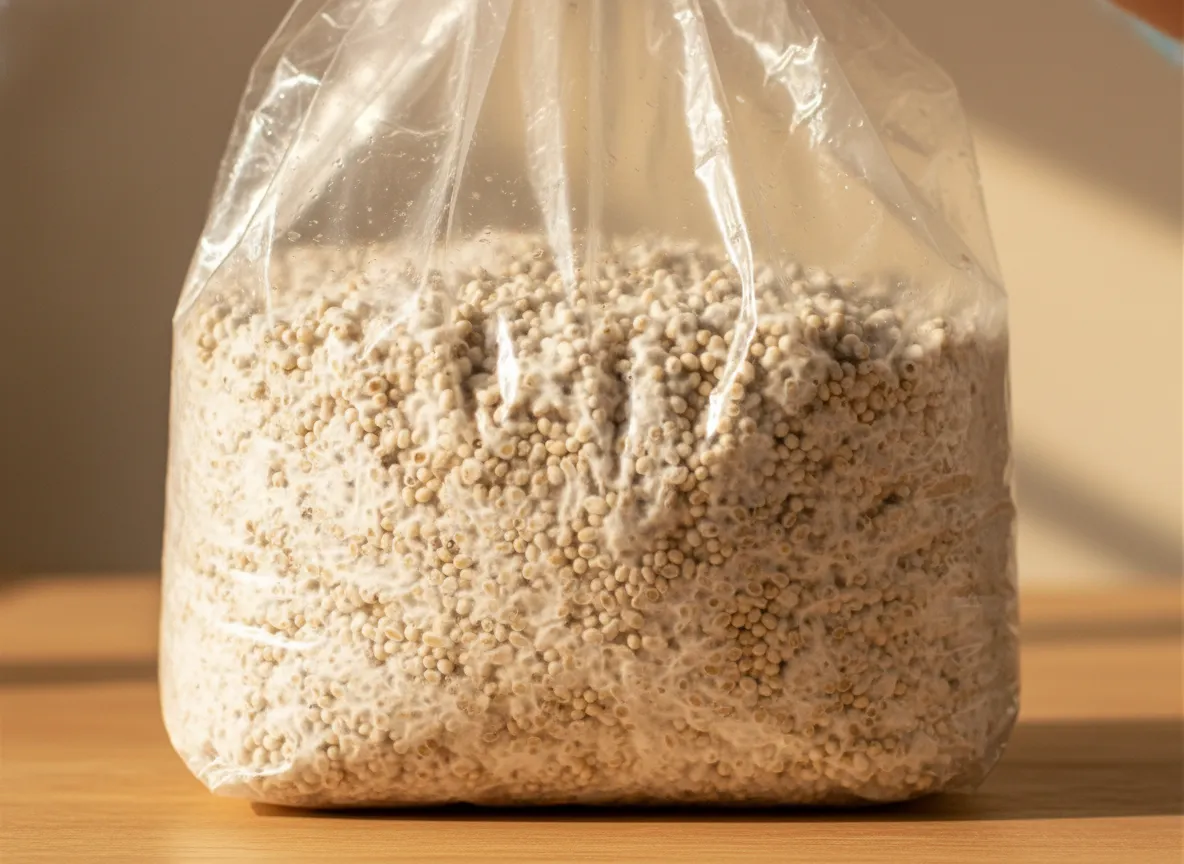
Colonization is the phase where mushroom mycelium grows through and takes over a substrate, establishing a dominant mycelial network before fruiting can begin. It is the most critical stage of any grow — if colonization fails or stalls, everything downstream fails too.
During colonization, the mycelium is:
- Secreting enzymes to break down and digest the substrate
- Absorbing nutrients and building its cellular network
- Expanding outward from inoculation points
- Competing with any other organisms present for territory and resources
Colonization is essentially a race against contamination. Your mushroom mycelium needs to claim all available territory and resources before competing organisms can establish themselves. This is why fast-colonizing spawn, adequate spawn rates, and proper substrate preparation are so important.
The colonization phase requires warm temperatures, minimal air exchange (some CO2 buildup is fine), darkness (not strictly required but traditional), and no disturbance. Most home cultivators store colonizing containers in a closet or on a shelf at 21-24°C.
Each species has an optimal temperature range for colonization. Growing at the correct temperature maximizes colonization speed and reduces contamination risk. Too hot can kill the mycelium or encourage bacteria; too cold slows growth dramatically.
Optimal colonization temperatures:
- Blue oyster (P. ostreatus): 21-24°C (70-75°F)
- Pink oyster (P. djamor): 24-30°C (75-86°F) — the warmest colonizer
- King oyster (P. eryngii): 21-24°C (70-75°F)
- Shiitake (L. edodes): 21-24°C (70-75°F)
- Lion's mane (H. erinaceus): 21-24°C (70-75°F)
- Maitake (G. frondosa): 21-24°C (70-75°F)
- Reishi (G. lucidum): 24-30°C (75-86°F)
- Chestnut (P. adiposa): 21-24°C (70-75°F)
- Wine cap (S. rugosoannulata): 18-24°C (65-75°F)
Most species colonize well in the 21-24°C range, making temperature management straightforward if you're growing multiple species. The notable exceptions are pink oyster and reishi, which prefer warmer conditions, and wine cap, which prefers slightly cooler conditions.
Avoid temperature fluctuations — consistent warmth produces the fastest, most even colonization.
Colonization time varies by substrate type, spawn rate, species, and temperature. Most grain jars colonize in 10-21 days, and most bulk substrates colonize in 7-14 days when conditions are optimal.
Typical timelines at 15-20% spawn rate and optimal temperature:
- Grain jar (quart, from LC): 10-21 days
- Grain jar (quart, from spore syringe): 14-30 days
- CVG monotub (from grain spawn): 7-14 days
- Supplemented sawdust bag (5 lb): 14-30 days
- Straw bucket (from grain spawn): 10-21 days
- PF Tek BRF jar (from spore syringe): 14-28 days
- Hardwood log (from plug spawn): 6-18 months
Factors that affect colonization time:
- Spawn rate: Higher spawn rate = faster colonization (20% colonizes roughly twice as fast as 10%)
- Temperature: Within the optimal range, warmer = faster
- Spawn vigor: Fresh, healthy spawn from early G2G generations colonizes faster
- Grain type: Millet and WBS colonize faster than rye due to smaller kernel size (more inoculation points per gram)
Patience is critical. Do not open, shake, or disturb containers to check progress more than necessary — every opening is a contamination risk.
Darkness is not strictly required for colonization, but it's generally recommended and is standard practice for most cultivators. The reasoning is practical rather than biological — light doesn't harm colonizing mycelium, but it can trigger premature pinning in some species.
Why dark is recommended:
- Light can trigger primordia (pin) formation before the substrate is fully colonized, wasting energy the mycelium should be spending on colonization
- A dark storage location (closet, cabinet) also tends to provide more stable temperatures
- It's a simple precaution that costs nothing
Why it's not absolutely necessary:
- Mycelium does not photosynthesize and does not need darkness to grow
- Ambient room light during colonization won't cause problems for most species
- Some cultivators colonize and fruit in the same location with ambient light with no issues
The practical advice: store colonizing containers in a warm, dark, undisturbed location like a closet, cabinet, or shelf with a cover. This provides ideal temperature stability, prevents premature pinning, and keeps the containers out of the way. But don't stress if your containers get some incidental light — it won't ruin your grow.
Most home growers do not need a dedicated incubator. If your home stays in the 21-24°C (70-75°F) range, that's adequate for most species. An incubator is only necessary if your ambient temperature is consistently too cold or fluctuates widely.
When you DON'T need an incubator:
- Your home temperature is 20-26°C (68-78°F)
- Temperature doesn't fluctuate more than 3-4°C throughout the day
- You're growing common species (oyster, shiitake, lion's mane)
When you DO need one:
- Growing in an unheated space during winter
- Your home runs below 18°C (65°F)
- Growing warm-weather species (pink oyster, reishi) and your space is cool
- You want precise temperature control for faster, more consistent results
DIY incubator options:
- Seedling heat mat with a thermostat controller (cheapest, works great for a few jars)
- Styrofoam cooler with a reptile heat cable and thermostat
- Dedicated mini-fridge with an Inkbird temperature controller (can both heat and cool)
- A warm closet near a furnace or water heater
Never use direct, unregulated heat (like placing jars on a radiator). Uneven heating kills mycelium on the hot side while leaving the other side too cool.
Healthy colonization has distinct visual characteristics that you should learn to recognize. Bright white mycelium growing outward from inoculation points in an even, expanding front is the hallmark of a healthy colonize.
Signs of healthy colonization:
- Bright white color — the mycelium should be clean white (some species have slight off-white or cream tones, which is normal)
- Even growth pattern radiating outward from inoculation points
- Rhizomorphic strands (rope-like) or tomentose growth (fluffy) — both are normal depending on species and strain
- Clean, earthy smell when you get close (like fresh forest floor)
- Condensation on jar walls near the colonization front — this is normal metabolic moisture
- Grain kernels bound together by a web of white mycelium
What is NOT healthy:
- Any colors other than white: green, blue, black, pink, orange, or yellow patches
- Sour, sweet, or chemical smells
- Wet, slimy, or translucent grain
- Growth that appears at random spots not connected to the original inoculation point (suggests contamination entering from outside)
Check your jars daily but handle them minimally. Visual inspection through the glass is sufficient — there is no need to open jars during colonization.
Stalled colonization — where mycelial growth slows or stops before the substrate is fully colonized — is a common problem with several possible causes. The most frequent causes are incorrect temperature, insufficient moisture, and contamination.
Common causes and solutions:
- Temperature too low: Mycelium grows very slowly below 18°C. Move to a warmer location (21-24°C for most species)
- Temperature too high: Above 30°C, most species' mycelium becomes stressed or dies. Cool the environment
- Substrate too dry: Grain that wasn't adequately hydrated won't support mycelial growth. Prevention is key — check moisture before sterilizing
- Substrate too wet: Excess moisture creates anaerobic conditions that favor bacteria over mycelium. Wet spots may be visible
- Contamination: Bacteria or mold competing for resources can slow or halt mycelial growth, even if not yet visible. Smell the jar — sour or sweet odors indicate contamination
- Weak or old spawn: Mycelium that has been through too many transfers (senescence) or was stored too long may lack vigor
- Low spawn rate: Under 10% spawn rate means fewer inoculation points and much longer colonization times
If colonization has stalled for more than a week with no visible progress, the grow is likely lost to contamination. Inspect carefully, smell test if possible, and discard if contamination is confirmed.
If your grain shows no visible colonization after 7-10 days, something has gone wrong. The most likely causes are dead inoculant, improper grain preparation, or contamination killing the mycelium before it could establish.
Troubleshooting checklist:
- Was the inoculant viable? Spore syringes and LC can lose viability if stored improperly (too hot, too old, frozen). Try inoculating an agar plate with the same syringe to test viability
- Was the grain properly hydrated? Under-hydrated grain (too dry after soaking/simmering) won't support growth. Over-hydrated grain breeds bacteria that kill mycelium
- Was sterilization adequate? If you cut corners on pressure cooking time (under 90 minutes at 15 PSI for quart jars), surviving contaminants may be dominating the grain
- Is the temperature correct? Below 18°C, colonization is extremely slow and may appear stalled
- Did you inoculate enough? Very low inoculation rates (under 0.5cc of LC or spores) may not provide enough starting material
If grain smells sour or looks wet and shiny after a week, bacterial contamination has won — discard the jar outside. If the grain looks and smells normal but nothing is growing, give it another week (spore syringes can take 14+ days to show visible growth) and check your temperature.
Colonization is complete when 100% of the visible substrate surface is covered by white mycelium with no uncolonized patches remaining. This applies to grain jars, bulk substrate surfaces, and grow bags alike.
Checking for full colonization:
- Grain jars: Rotate the jar and inspect all sides through the glass. Every visible grain kernel should be covered in white mycelium. Check the bottom especially — it's often the last area to colonize
- Monotubs: The entire surface should be uniformly white. No brown or uncolonized patches of substrate should be visible
- Grow bags: Feel the bag — fully colonized substrate is firm and solid throughout. Squeeze gently to check for soft, uncolonized areas
Do not rush to fruiting conditions if colonization isn't complete. Uncolonized substrate patches are vulnerable to contamination, especially when you introduce fruiting conditions (higher humidity, more air exchange). These patches will often turn green with Trichoderma within days of opening.
For bulk substrates, many experienced growers recommend waiting an additional 3-7 days after the surface appears fully colonized — this consolidation period allows the mycelium to strengthen its hold throughout the full depth of the substrate.
Consolidation is the period after visible surface colonization is complete during which the mycelium continues to mature and strengthen its network throughout the substrate. Even when the surface looks 100% white, the interior may still have areas that need additional time.
What happens during consolidation:
- Mycelium thickens and fortifies its network throughout the full substrate depth
- Hyphal connections become denser and more resilient
- The mycelium accumulates energy reserves (glycogen) for fruiting
- Enzyme production peaks, breaking down remaining available nutrition
- The substrate becomes more firmly bound together
Typical consolidation time is 3-7 days after surface colonization appears complete. You know consolidation is adequate when:
- The colonized surface feels firm and rubbery to the touch (for monotubs)
- Metabolic moisture (condensation) on container walls diminishes
- The substrate block or cake holds its shape firmly when handled
- Mycelium may begin producing a slightly yellow metabolite (normal stress response)
Some growers skip consolidation and move directly to fruiting conditions once the surface is white. This can work, but allowing consolidation generally produces better pin sets, more even flushes, and improved contamination resistance during fruiting.
Moderate consolidation (3-7 days) generally improves yields and flush quality, but excessive consolidation (beyond 10-14 days) can actually hurt yields by causing the mycelium to exhaust substrate nutrients before fruiting.
Benefits of adequate consolidation:
- More uniform pin sets (mushrooms emerge more evenly across the surface)
- Stronger substrate that holds together through multiple flushes
- Better contamination resistance during fruiting
- Higher first-flush yields compared to immediately fruiting
Risks of over-consolidation:
- Overlay — a thick, rubbery mat of mycelium forms on the surface that can resist pinning
- Nutrient depletion — the mycelium consumes nutrition that should have gone into mushroom production
- Premature metabolite production — thick yellow liquid (mycelium pee) can accumulate, indicating stress
- Side pinning and bottom pinning increase as the mycelium seeks any surface with favorable conditions
The sweet spot for most species is 3-7 days of consolidation. If you see the surface begin to form a thick, shiny, rubbery layer (overlay), introduce fruiting conditions immediately — you may need to fork or scratch the surface to break through the overlay and allow pins to form.
The transition from colonization to fruiting is one of the most important timing decisions in mushroom cultivation. Move to fruiting conditions when the substrate surface is 100% colonized and you've allowed 3-7 days of consolidation, or when you see the very first primordia (pins) appearing.
Signs that it's time to fruit:
- Surface is fully white with no uncolonized patches visible
- Substrate feels firm and cohesive (not loose or crumbly)
- You've waited 3-7 days after surface colonization for consolidation
- Tiny primordia (bumps or knots) may be forming — this means the mycelium is ready and telling you it wants to fruit
- Aerial mycelium (fluffy growth reaching upward) may be forming — another sign the mycelium is seeking fresh air
How to transition:
- Increase FAE: Open or crack the lid, uncover air holes, or start fanning
- Increase humidity: Mist surfaces, add a humidifier, or create a humid microclimate
- Lower temperature: Drop 5-10°C from colonization temps (species-dependent)
- Introduce light: Ambient indirect light or a 12/12 timer is sufficient
When in doubt, err on the side of patience — an extra few days of consolidation rarely hurts, but fruiting too early with uncolonized patches almost always leads to contamination.
Need more help? Dr. Myco can answer follow-up questions about colonization based on thousands of real growing experiences.
Ask Dr. Myco