Pressure Cookers & Autoclaves
10 tips in Equipment & Lab Setup
By Andrew Langevin · Founder, Nature Lion Inc · Contributing author, Mushroomology (Brill, 2026)
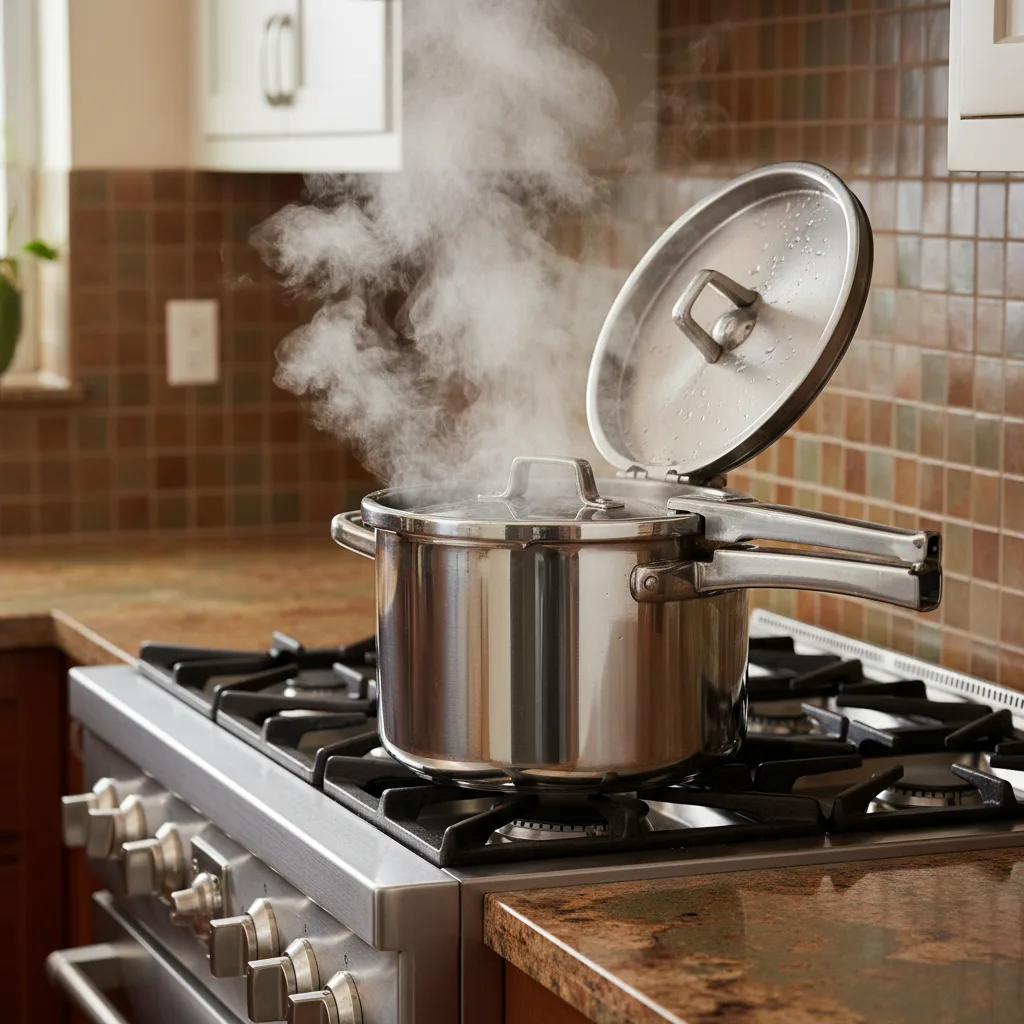
Not always, but it dramatically increases your success rate. Some beginner-friendly species like oyster mushrooms can be grown on pasteurized straw or cold-water lime-bath substrates without any pressure cooking. However, once you move to grain spawn, agar work, or supplemented hardwood substrates, a pressure cooker becomes essential.
Without a pressure cooker, you're limited to:
- Pasteurized straw or cardboard substrates
- Pre-sterilized spawn bags purchased from suppliers
- Uncle Ben's tek or similar no-pour methods
A pressure cooker reaches 15 PSI (250°F / 121°C), which is the temperature required to kill endospores — the toughest contaminant survival form. Pasteurization (160-180°F) kills most organisms but not endospores, which is why grain and agar must be pressure-sterilized.
If you're serious about cultivation, a pressure cooker is the single most important investment you'll make. It pays for itself within a few grows by letting you prepare your own spawn instead of buying it.
Both achieve the same goal — killing all microbial life through pressurized steam — but they differ in design, precision, and cost. A pressure cooker is a kitchen appliance that reaches 15 PSI, while an autoclave is a laboratory instrument with precise digital controls, timers, and safety interlocks.
Key differences:
- Temperature control — Autoclaves maintain exact temperature (121°C) with digital sensors. Pressure cookers rely on weight-jiggle regulators and manual stove adjustment.
- Drying cycle — Autoclaves can run a post-sterilization drying cycle. Pressure cookers cannot.
- Cost — A 23-quart pressure cooker costs $80-$150. A benchtop autoclave starts at $2,000-$5,000.
- Capacity — Home autoclaves are often smaller than the largest pressure cookers.
For home mycology, a pressure cooker is more than sufficient. Autoclaves are overkill unless you're running a commercial lab or doing scientific research. The sterilization result at 15 PSI for 90 minutes is identical between the two devices.
The All American is the gold standard for mycology, but the Presto is an excellent budget option. Both work perfectly well for sterilization — the choice depends on your budget and how much you plan to grow.
Presto 23-Quart ($80-$110): - Aluminum body, lightweight (~12 lbs) - Rubber gasket seal (needs replacement every 1-2 years, ~$10) - Fits 7 quart jars or 10 pint jars - Great starter cooker for hobbyists
All American 921 / 941 ($250-$400): - Cast aluminum, heavy-duty (~25 lbs) - Metal-to-metal seal — no gasket to replace, ever - 921 fits 7 quart jars; 941 fits 19 quart jars - Built to last decades with zero maintenance - Better pressure regulation
If you're on a tight budget, start with the Presto 23-quart — it handles everything a home grower needs. If you can afford it and plan to grow long-term, the All American 921 or 941 is a lifetime investment. Many experienced growers upgrade to an All American after wearing through a couple of Presto gaskets.
Get the biggest one you can afford — 23 quarts minimum. Every experienced grower says the same thing: they wish they'd bought bigger. A larger cooker means fewer sterilization runs, which saves hours of time and stove energy.
Size recommendations by use:
- 16-quart — Bare minimum. Fits 5 quart jars. Only consider if budget is extremely tight.
- 23-quart — The sweet spot for hobbyists. Fits 7 quart jars or 10 pint jars per run. Both the Presto 23-qt and All American 921 are this size.
- 30-quart (All American 930) — Fits 14 quart jars. Great for intermediate growers doing weekly runs.
- 41-quart (All American 941) — Fits 19 quart jars. The largest home model. Ideal for serious hobbyists or small-scale commercial.
Consider what you'll sterilize: Grain jars stand upright and stack. Agar bottles fit in the gaps. Substrate bags need more height clearance. If you plan to do spawn bags, measure the bag height against the cooker's interior depth before purchasing.
Pressure cookers operate at high temperature and pressure — respecting safety protocols is non-negotiable. Accidents are rare but can be severe.
Essential safety rules:
- Never fill past the 2/3 line. Leave room for steam expansion.
- Always add enough water — typically 2-3 inches in the bottom. Running dry can warp the bottom or cause a dangerous pressure spike.
- Check the gasket before every use. Look for cracks, brittleness, or deformation. Replace annually with heavy use.
- Verify the vent pipe is clear by holding it up to light. A clogged vent can cause over-pressurization.
- Let pressure drop naturally after sterilization — never force-cool under water or release steam quickly, as this can cause jars to boil over and crack.
- Wait until the pressure gauge reads zero before opening the lid.
- Place on a sturdy burner that can support the weight (30+ lbs when loaded).
Always stay home while the pressure cooker is running. Set a timer and check periodically that the rocker is maintaining steady rhythm.
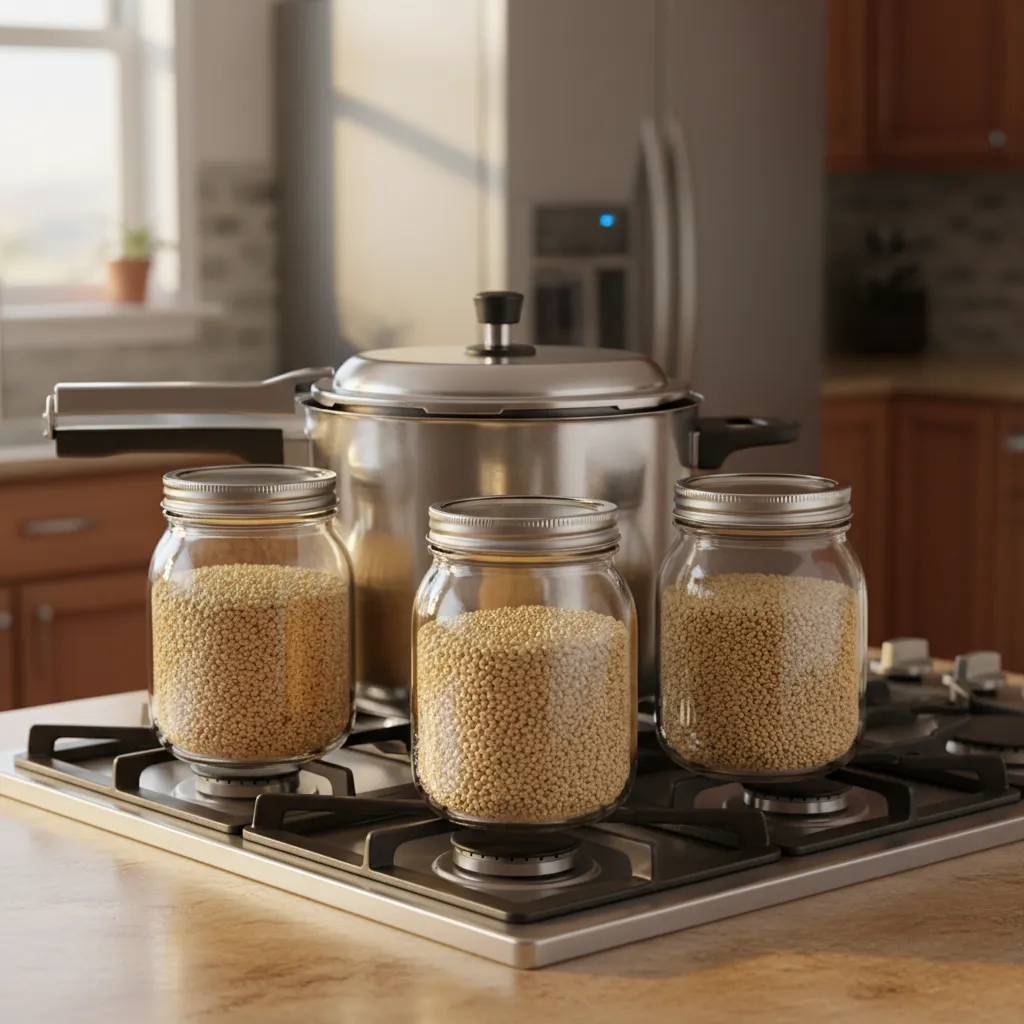
Proper loading ensures even steam penetration and prevents broken jars. The key principle is that steam must circulate freely around every jar.
Step-by-step loading:
- Place the included rack or a round cookie cooling rack in the bottom — jars must never sit directly on the metal bottom or they can crack from direct heat.
- Add 2-3 inches of water (tap water is fine).
- Place the first layer of jars upright. Lids should be finger-tight with micropore tape over the holes, then covered with foil.
- Stack the second layer directly on top of the first, offset slightly so they nest between the jar lids below.
- Ensure no jar touches the cooker wall — leave a small gap for steam flow.
Loading maximums (23-quart): - Quart jars: 7 (4 bottom, 3 top) - Pint jars: 10 (5 bottom, 5 top) - Half-pint jars: 12-14
If you're short a jar to complete a layer, fill an empty jar with water as a spacer. This prevents the top layer from tilting during the run.
Sterilizing bags in a pressure cooker requires more care than jars because bags can melt, burst, or block steam circulation if loaded incorrectly.
Loading bags properly:
- Fold the bag top over and secure with an impulse sealer or fold-and-clip. Leave the filter patch exposed if using filtered bags.
- Stand bags upright when possible. In a 23-quart cooker, a 5-lb bag won't fit upright — lay it on its side.
- Never let the bag touch the cooker wall — the direct heat can melt polypropylene.
- Place a rack on the bottom and optionally line the sides with a towel for insulation.
- Don't overfill bags. Leave enough slack for the grain or substrate to expand with steam.
Bag-specific tips:
- Use bags rated for autoclave use (Type 14A or similar polypropylene, rated to 250°F+).
- Unicorn bags (type 14A, 3T, or 10T) are the industry standard — $0.30-$0.60 each in bulk.
- Load no more than 2-3 bags per run in a 23-quart cooker to ensure steam circulation.
Run at 15 PSI for 90-120 minutes depending on bag size.
Sterilization time depends on the substrate density, moisture content, and container size. All times below are at 15 PSI (250°F) and begin timing only after the cooker reaches full pressure.
Standard sterilization times:
- Grain spawn (quart jars) — 90 minutes. This is the universal standard. Some growers do 60 minutes for pint jars.
- Grain spawn (5-lb bags) — 120 minutes. Larger thermal mass needs more time.
- Agar media (bottles/flasks) — 30-45 minutes. Agar denatures if overcooked, so don't exceed 45 minutes.
- Supplemented sawdust (Masters Mix) — 150 minutes. The added soy hull or wheat bran is nutrient-rich and contam-prone.
- Plain hardwood sawdust — 90 minutes in jars, 120 minutes in bags.
- Rye berries, wheat berries — 90 minutes.
- Wild bird seed (WBS) — 90 minutes. Pre-soak and simmer first to hydrate.
- Brown rice flour (BRF) jars — 60-90 minutes. PF Tek jars are small and less dense.
- Liquid culture — 20-30 minutes. Over-sterilizing caramelizes sugars.
When in doubt, go longer. Over-sterilization rarely causes problems (except with agar and LC), but under-sterilization invites contamination.
Most Instant Pot models only reach 11-12 PSI, which is NOT sufficient for true sterilization. The standard for sterilization is 15 PSI (250°F / 121°C) sustained for 90+ minutes. At 11 PSI, the temperature tops out around 240°F — not hot enough to reliably kill all endospores.
That said, some growers report success using an Instant Pot for:
- Agar preparation — Since agar only needs 30-45 minutes and is less contam-prone when used quickly
- Small grain jars — With extended times (120+ minutes) and immediate use
- Liquid culture — Which requires lower sterilization intensity
The Instant Pot Max was the one model that reached 15 PSI, but it has been discontinued. If you find one used, it works for small batches.
The real problems with Instant Pots for mycology:
- Small capacity (6-8 quarts vs 23 quarts)
- Auto-shutoff timers limit run duration
- Inconsistent pressure maintenance
- Not designed for the heavy thermal loads of packed jars
Bottom line: spend the $80 on a Presto 23-quart instead. It's purpose-built for this kind of work and will save you from contamination headaches.
Regular maintenance prevents dangerous failures and extends your cooker's lifespan by decades. A well-maintained pressure cooker is a safe, reliable workhorse.
After every use:
- Wipe the rim and lid seal area clean. Grain residue and starch buildup prevent proper sealing.
- Inspect the gasket for cuts, flattening, or hardening.
- Check that the vent pipe is clear — push a pipe cleaner or toothpick through it.
Monthly (with heavy use):
- Deep-clean the lid, safety valve, and pressure regulator. Soak in hot water with white vinegar.
- Inspect the safety plug — it should be soft and pliable, not brittle.
- For Presto models, lightly coat the gasket with cooking oil to prevent drying.
Annually:
- Replace the Presto gasket ($8-$12 on Amazon). Even if it looks fine, rubber degrades with heat cycling.
- Replace the safety plug if it shows any cracking ($3-$5).
- Check the pressure gauge accuracy with a known-good gauge if you have a weighted-jiggle type.
All American owners have it easier — the metal-to-metal seal needs only a thin coat of petroleum jelly on the rim threads. No gasket to replace. This is why many growers consider the higher upfront cost worthwhile.
Need more help? Dr. Myco can answer follow-up questions about pressure cookers & autoclaves based on thousands of real growing experiences.
Ask Dr. Myco