Reishi
13 tips in Species Guides
By Andrew Langevin · Founder, Nature Lion Inc · Contributing author, Mushroomology (Brill, 2026)
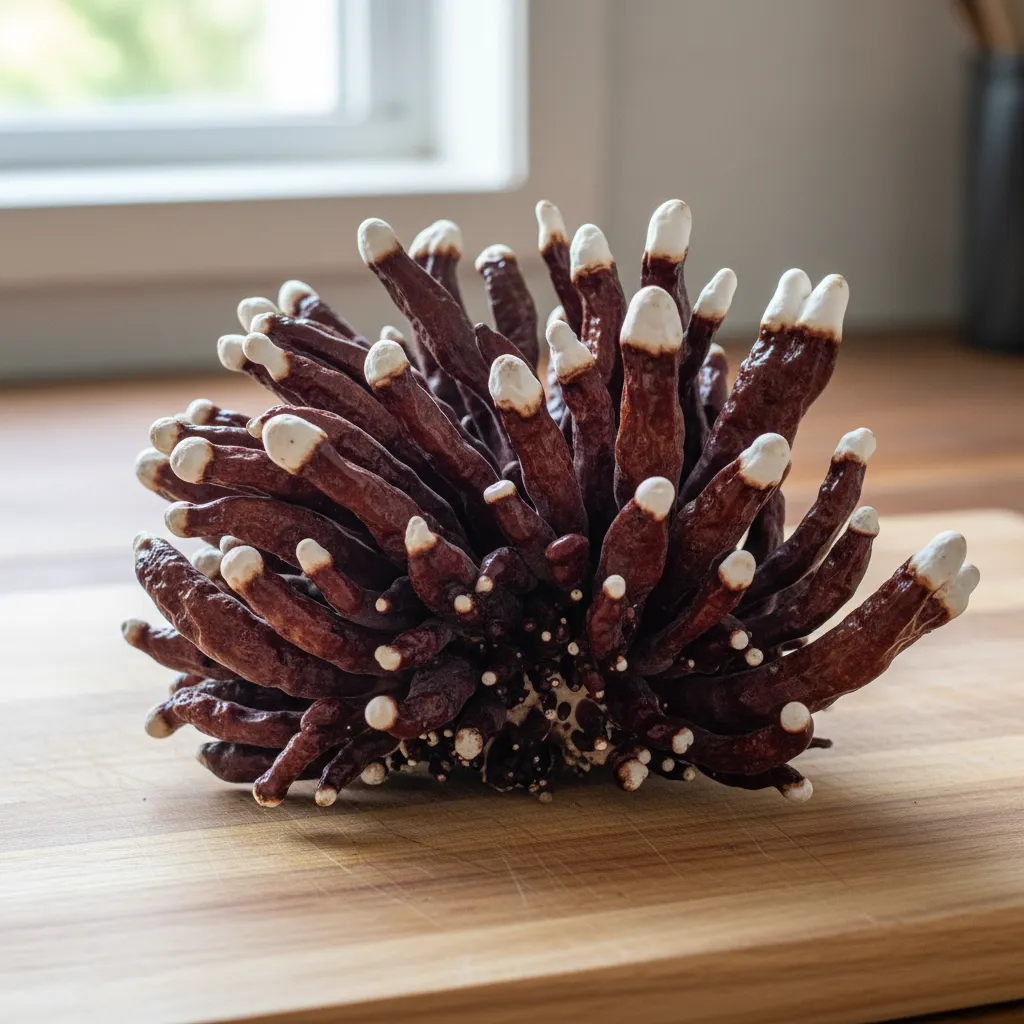
Reishi (Ganoderma lucidum) is a polypore mushroom with a 2,000+ year history in traditional Chinese and Japanese medicine, where it is called lingzhi (spirit mushroom) and mannentake (10,000-year mushroom). It earned the name "mushroom of immortality" due to its prominent role as an adaptogen believed to promote longevity, boost immunity, and reduce stress.
Modern research has identified bioactive compounds including triterpenoids (ganoderic acids), beta-glucans, and polysaccharides that demonstrate anti-inflammatory, immunomodulatory, and antioxidant properties. Reishi is not a culinary mushroom — it is woody, tough, and intensely bitter. It is consumed as tea, tincture, powdered extract, or capsules.
In cultivation, reishi is fascinating because its growth form can be controlled by environmental conditions: high CO2 produces antler-like formations, while more FAE produces the classic flat, shelf-like conks with a varnished reddish-brown surface. Reishi is one of the easiest medicinal mushrooms to grow but requires patience — conk formation takes 2-6 months.
Reishi colonization is aggressive and vigorous when provided with warm temperatures.
- Colonization temperature: 24-30°C (75-86°F) — warmer than most cultivated species
- Colonization time: 14-21 days on supplemented sawdust blocks
- Spawn rate: 10-15% (sufficient because reishi colonizes so aggressively)
- Grain spawn: rye or wheat berries
- Substrate: Masters Mix or hardwood sawdust with 10-20% wheat bran, pressure sterilized at 15 PSI for 2.5 hours
Reishi mycelium is bright white, fast-growing, and notably thick and aggressive. It produces a strong, distinctly earthy and slightly bitter aroma during active colonization. Within the first few days, you will see vigorous white growth radiating from spawn points. By day 7-10, the block should be 50-70% colonized.
Reishi mycelium generates noticeable heat during rapid colonization, so ensure blocks are not stacked tightly or in an enclosed space where heat can build up above 35°C, which can kill the mycelium.
Reishi grows in two dramatically different morphologies depending on CO2 levels, and understanding this is the key to controlling what you produce.
Antler form: In high CO2 environments (above 2000-3000 ppm), reishi produces elongated, finger-like or antler-shaped growths that reach upward. These antlers are white at the growing tips, developing a reddish-brown varnished exterior as they mature. Antlers can grow 15-30cm tall and branch like coral or deer antlers. They are visually stunning and dry into beautiful display pieces. Antler reishi is also potent medicinally.
Conk form: With more fresh air exchange (CO2 below 1000 ppm), reishi develops the classic flat, shelf-like or kidney-shaped conk with a glossy, varnished reddish-brown top surface and white growing edge. Conks are the traditional medicinal form, typically 10-20cm across. They take significantly longer to develop than antlers — 2-6 months versus 4-8 weeks for antlers.
Most home growers start with antler form because it requires less environmental control (just keep the grow bag mostly sealed) and develops faster.
Growing reishi antlers is the simplest approach and requires minimal equipment.
Once the block is fully colonized, cut a small opening (2-3cm) in the top of the grow bag. Do NOT open the bag wide or provide significant ventilation. The restricted opening allows just enough oxygen for growth while maintaining elevated CO2 inside the bag, which triggers antler formation.
Within 1-2 weeks, white finger-like growths will emerge from the opening and begin reaching upward. As they grow, the base develops a reddish-brown, lacquered exterior while the tips remain white. The antlers grow 1-3cm per week under good conditions.
- Temperature: 21-27°C
- Humidity: 60-80% is sufficient since the bag maintains internal humidity
- Timeline: antlers typically reach full size in 4-8 weeks
- Multiple antlers: cut several small openings to train multiple growths
Some growers remove the bag entirely and place the block in a sealed terrarium or container with minimal airflow for the same effect. Antler reishi is complete when growth stops and the entire surface develops the characteristic varnished appearance.
Producing the classic shelf-like reishi conk requires more FAE and patience than antler form.
Remove the bag from the fully colonized block or cut it wide open and place the block in a fruiting chamber with regular air exchange — similar to what you would provide for oyster mushrooms. The lower CO2 concentration signals the mycelium to produce a flat, shelf-like structure instead of antlers.
- Humidity: 80-90%
- Temperature: 21-27°C
- Light: indirect, on a 12/12 cycle
A white, knobby mass will emerge from the block surface and gradually expand outward into a fan or kidney shape. The upper surface develops the characteristic glossy, reddish-brown lacquer (from which the name "varnish shelf" derives) while the underside shows a white pore surface.
Conk development is SLOW — expect 2-6 months from initial formation to full maturity. The white growing edge gradually advances outward, adding 0.5-1cm per week. The conk is mature when the white growing edge disappears and the entire surface is varnished.
During this long development period, maintain stable conditions and resist the urge to disturb the block.
Reishi fruiting is among the slowest in cultivated mushroom species because of its woody, dense growth structure. Unlike the soft, fleshy tissue of oyster or lion's mane that develops in days, reishi produces extremely dense, fibrous tissue impregnated with bitter triterpenoid compounds and covered in a hard, lacquered surface layer.
Timeline comparison:
- Antler form: 4-8 weeks from first emergence to maturity. Antlers grow vertically at 1-3cm per week, and multiple antlers may emerge simultaneously.
- Conk form: 2-6 months from first emergence to a fully developed shelf. The conk grows outward at only 0.5-1cm per week and gradually thickens as it matures. A fully developed reishi conk may be only 10-20cm across after months of growth.
This is why many medicinal growers prefer antler form — the same block produces harvestable reishi in a fraction of the time.
For conk growers, the key is maintaining consistent conditions throughout the entire development period. Any interruption in humidity, temperature, or FAE can cause the growing edge to stall or abort.
Reishi grows best on supplemented hardwood substrate, similar to lion's mane and king oyster.
- Standard recipe: Masters Mix (50% hardwood fuel pellets, 50% soy hull pellets) hydrated to 60-65% moisture, pressure sterilized at 15 PSI for 2.5 hours
- Alternative: hardwood sawdust (oak, maple, or beech preferred) supplemented with 15-20% wheat bran by dry weight
- Block size: 3-5 kg is common (larger than most species) because the extended fruiting period draws heavily on substrate nutrition
- Whole grain bags (rye or wheat) work for antler reishi — high nutrition density produces aggressive antler growth, though contamination risk is higher
The supplementation provides nitrogen and protein that reishi needs for its slow, sustained fruiting period — unsupplemented hardwood produces significantly smaller and fewer fruiting bodies. Larger blocks support longer growth and produce bigger conks or more substantial antler formations.
For log cultivation (outdoor), reishi does well on oak, maple, and sweetgum logs inoculated with plug or sawdust spawn. Log-grown reishi produces conks naturally and can fruit for several years.
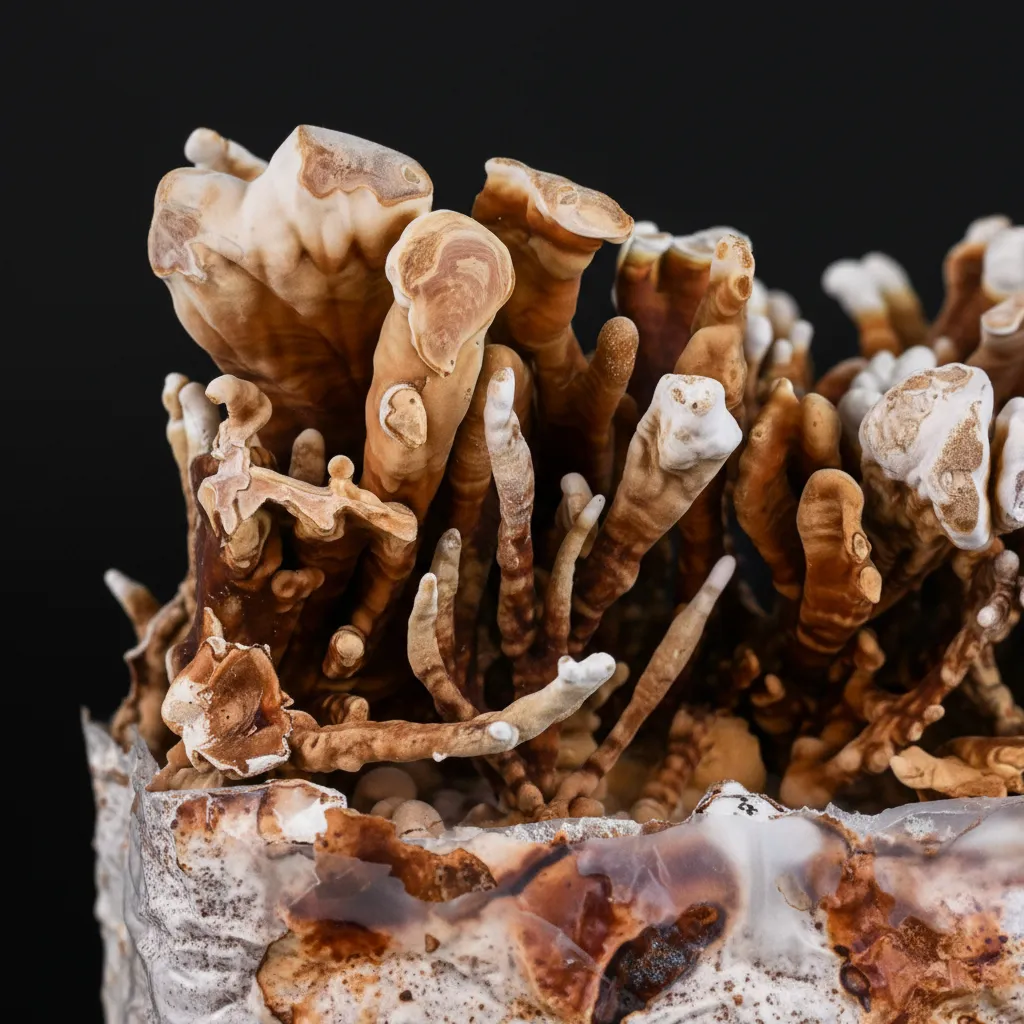
Antler Reishi (Ganoderma multipileum) is a distinct tropical Ganoderma species that naturally produces branching, antler-like formations regardless of CO2 levels — unlike G. lucidum, which only produces antlers under high CO2.
- Colonization temperature: 25-32°C (warmer than standard reishi)
- Fruiting temperature: 24-30°C
- Minimum temperature: will not fruit below 20°C
- Humidity: 80-90%
G. multipileum is native to tropical and subtropical regions of Asia and produces striking coral-like growths with glossy reddish-brown to dark brown surfaces. The antlers emerge rapidly and branch profusely, creating dramatic sculptural formations.
Medicinally, G. multipileum contains similar triterpenoid and beta-glucan compounds to G. lucidum, though the specific chemical profile differs slightly.
Antler Reishi is an excellent choice for growers in warm climates who struggle with the cooler temperatures other species require, and for anyone who wants the most visually spectacular reishi variant without needing to manage CO2 levels.
Hemlock Varnish Shelf (Ganoderma tsugae) is a North American species closely related to true reishi (G. lucidum) that grows naturally on hemlock and other conifer trees. It produces similar glossy, reddish-brown conks and has been used as a medicinal substitute for Asian reishi for centuries by North American herbalists.
G. tsugae is widely considered to have comparable medicinal properties to G. lucidum, containing similar triterpenoids and polysaccharides, though some differences in chemical profiles exist.
- Colonization: 20-26°C
- Fruiting: 18-25°C (tolerates cooler temperatures than G. lucidum)
- Substrate: supplemented hardwood or conifer sawdust — one of the few cultivated species that grows well on softwood
- Outdoor logs: hemlock, spruce, or pine logs work well
For North American medicinal growers interested in using a native species rather than an imported Asian variety, G. tsugae is an excellent choice with the added benefit of being well-adapted to local conditions.
Reishi is harvested and dried differently from culinary mushrooms because it is consumed as medicine, not food.
Harvesting:
- Antler reishi: harvest when growth has stopped and the entire surface is covered in the glossy, lacquered coating — no more white growing tips visible. Cut at the base with a clean knife.
- Conks: harvest when the white growing edge has completely disappeared and the underside pore surface has turned from white to brown, indicating spore maturity. Cut the conk from the block.
Drying: Reishi is already dense and low-moisture, making drying straightforward. Slice antlers or conks into 3-5mm slices and dehydrate at 40-50°C for 8-12 hours until completely bone-dry and brittle. Thin antlers can be dried whole. Store in airtight containers in a cool, dark place — properly dried reishi lasts 2-3 years without significant potency loss.
For spore collection (reishi spores are highly valued medicinally), place a mature conk with brown pore surface face-down on aluminum foil in a clean area for 1-3 days. Reishi drops billions of brown spores that accumulate as a fine powder. Collect and store the spore powder separately.
Reishi's medicinal compounds require extraction because the mushroom's tough, woody cell walls (chitin) lock the beneficial compounds inside. Two extraction methods target different compound groups:
Hot water extraction pulls out beta-glucans and polysaccharides. Simmer dried reishi slices (15-30g per liter of water) at 80-90°C for 2-4 hours. Do not boil vigorously — gentle simmering preserves heat-sensitive compounds. The resulting dark, bitter tea can be consumed directly (honey helps with the bitterness) or reduced further for concentration.
Alcohol extraction (tincture) pulls out triterpenoids and ganoderic acids that are not water-soluble. Soak dried reishi pieces in high-proof alcohol (40-60% ethanol, like vodka or Everclear) for 4-6 weeks, shaking daily. Strain and bottle.
Dual extraction combines both methods: first do the alcohol extraction, then simmer the same reishi pieces in water, and finally combine the two liquids. This captures the full spectrum of medicinal compounds.
Dosage varies by preparation — 1-3 cups of tea daily or 2-4ml of tincture twice daily are common recommendations. Home-grown reishi produces potent extracts comparable to commercial products at a fraction of the cost.
Reishi holds a unique position in medicinal mushroom cultivation for several reasons.
- Most extensively researched medicinal mushroom, with hundreds of published studies on immunomodulatory, anti-inflammatory, adaptogenic, and potentially anti-cancer properties
- Relatively easy to cultivate — colonization is aggressive, contamination resistance is good, and the woody fruiting body is far less sensitive to humidity fluctuations than delicate species like lion's mane
- Stores for years without losing potency, unlike fresh gourmet mushrooms that must be used within days
- Commands high prices: dried reishi sells for $20-40/oz, tinctures for $25-50/bottle, and spore powder for $40-80/oz
- Long-term production: a single block can produce reishi over 2-6 months
For anyone interested in medicinal mushrooms — whether for personal health use, herbalism, or small-scale sales — reishi is the foundational species to master.
Reishi (*Ganoderma lucidum*) is one of the most beginner-friendly medicinal mushrooms to cultivate, thanks to aggressive colonization, strong contamination resistance, and tolerance for imperfect humidity. The process differs from gourmet species in one key way — you are growing a woody, shelf-like conk, not a soft edible mushroom.
Step-by-step method:
- Prepare substrate — use 80% hardwood sawdust with 20% wheat bran or Masters Mix. Hydrate to 60-65% moisture.
- Bag and sterilize — fill autoclavable bags, seal, and sterilize at 15 PSI for 2.5 hours.
- Inoculate — add grain spawn at 10-15% by weight. Reishi colonizes aggressively, so lower spawn rates work fine.
- Colonize — incubate at 24-27°C (75-80°F) in darkness for 10-21 days. Reishi colonizes faster than most species.
- Initiate fruiting — cut a small slit or hole in the bag. Reishi is unusual: the fruiting body emerges as antler-like fingers in high CO2, or develops a flat, kidney-shaped conk with good FAE.
- Fruiting conditions — 21-27°C, 70-90% humidity, indirect light 12 hours daily. Reishi tolerates lower humidity than gourmet species.
- Harvest — reishi takes 2-6 months to fully develop. Harvest when the white growing edge stops expanding and the surface develops its characteristic lacquered reddish-brown sheen.
Antler vs. conk form:
- High CO2 (limited FAE): produces elongated antler-shaped growths — visually striking, higher market value as display pieces
- Normal FAE: produces the traditional flat shelf conk — better for medicinal use due to higher triterpenoid content in the cap surface
Post-harvest processing:
- Reishi is too woody to eat fresh — it must be dried, then processed into tea, tincture, or powder
- Dry at 50°C for 12-24 hours until cracker-dry
- Store dried reishi for 1-3 years without potency loss
Reishi is the ideal first medicinal mushroom project — it is more forgiving than lion's mane, more rewarding than turkey tail, and the dried product stores indefinitely.
Need more help? Dr. Myco can answer follow-up questions about reishi based on thousands of real growing experiences.
Ask Dr. MycoMore in Species Guides
Oyster Mushrooms
15 tips
Lion's Mane
13 tips
Shiitake
13 tips
King Oyster
12 tips
Chestnut & Other Gourmet
15 tips
Mushroom Health & Medicinal Benefits
17 tips
Cooking & Preparation
16 tips
Enoki, Maitake & Cordyceps
14 tips
Mushroom Alternate Names & Varieties
17 tips
Mushroom Supplement Guide
18 tips
Common Mushroom Varieties
20 tips
Rare & Specialty Cultivatable Species
16 tips