Quick Reference
10 tips in Tools & Calculators
By Andrew Langevin · Founder, Nature Lion Inc · Contributing author, Mushroomology (Brill, 2026)
Getting substrate moisture right is critical. Too wet invites bacteria; too dry stalls colonization. Use the squeeze test as your quick field check, but these target percentages give you the science behind it.
Target moisture content by substrate:
- Hardwood sawdust (supplemented) — 60-65% moisture
- Straw — 68-72% moisture
- Coco coir (CVG) — 65-70% moisture
- Manure-based substrates — 65-70% moisture
- BRF (PF Tek) — 55-60% moisture
- Coffee grounds — 55-60% moisture
- Cardboard — 70-75% moisture
The squeeze test: grab a handful of prepared substrate and squeeze firmly. You want 1-2 drops of water to emerge between your fingers. A stream of water means too wet — add dry material. No drops means too dry — mist and remix.
For precision, weigh a sample before and after oven-drying at 100C for 24 hours. Moisture % = (wet weight - dry weight) / wet weight x 100.
Spawn rate directly affects colonization speed, contamination resistance, and cost. Higher rates are safer for beginners; lower rates stretch your spawn further once your technique is dialed in.
Recommended spawn-to-substrate ratios by weight:
- CVG monotub — 1:2 to 1:4 (20-33% spawn rate)
- Masters Mix bags — 1:5 to 1:7 (15-20% spawn rate)
- Straw buckets/bags — 1:7 to 1:10 (10-15% spawn rate)
- Hardwood pellet blocks — 1:5 to 1:7 (15-20% spawn rate)
- PF Tek jars — 1-2 cc spore syringe per half-pint jar
- Log inoculation (plugs) — 1 plug per 15 cm of log, rows 5-8 cm apart
- Outdoor beds — 1:5 to 1:8 (12-20% spawn rate)
Quick volume conversions:
- 1 quart grain spawn is roughly 680g (1.5 lbs)
- 1 quart spawn inoculates roughly 1 standard 5 lb grow bag
- For a 66-quart monotub, use 3-5 quarts spawn to 10-15 quarts substrate
Many recipes list dry weights, but you work with hydrated material. Use these multipliers to convert between dry weight and field weight (fully hydrated, ready-to-use substrate).
Dry-to-wet multipliers for substrates:
- Hardwood pellets — 1 lb dry = approximately 2.5 lbs hydrated (add 1.5x water by weight)
- Coco coir — 1 brick (650g dry) = approximately 2.5 kg hydrated (roughly 4x water by weight)
- Straw — 1 lb dry = approximately 3 lbs soaked and drained
- Soy hull pellets — 1 lb dry = approximately 2.5 lbs hydrated
- Vermiculite — absorbs 3-4x its weight in water
- Grain (rye/wheat) — 1 lb dry = approximately 1.6-1.8 lbs after soak and simmer
Fresh-to-dry multipliers for harvested mushrooms:
- Oyster mushrooms — 10:1 to 12:1 (very high water content)
- Shiitake — 8:1 to 10:1
- Lion's mane — 10:1 to 12:1
- King oyster — 9:1 to 10:1
- Maitake — 9:1 to 11:1
Practical example — 5 lb Masters Mix bag: Start with 1.25 lbs hardwood pellets + 1.25 lbs soy hull pellets (2.5 lbs dry). Add 2.5 lbs water (equal weight). Final hydrated weight is approximately 5 lbs at 50:50 ratio.
All times are at 15 PSI (103 kPa / 121C / 250F). Start timing only after the cooker reaches full pressure. Altitude above 300m (1000 ft) requires adding 5 minutes per 300m of elevation.
Grain spawn:
- Half-pint jars — 90 minutes
- Quart jars — 90 minutes
- Spawn bags (2.5-5 lbs) — 2-2.5 hours
Substrate:
- Masters Mix bags (5 lbs) — 2.5 hours
- Supplemented sawdust bags — 2-2.5 hours
- Hardwood + bran bags — 2-2.5 hours
Agar and liquid culture:
- Agar plates (stack of 10-20) — 45 minutes
- Liquid culture jars (pint/quart) — 20-30 minutes (longer degrades sugars)
PF Tek:
- BRF jars (half-pint) — 90 minutes
Important notes:
- Never rush cooling — let the PC depressurize naturally (1-4 hours)
- Don't stack grain jars too tightly — steam must circulate
- Use a rack or trivet to keep jars off the bottom
- Water level: halfway up the bottom row of jars
- Let jars cool to room temperature before inoculation — opening hot jars creates a vacuum that sucks in contaminants
Each species has distinct requirements for colonization and fruiting. Use this reference to dial in your grow room or fruiting chamber.
Oyster mushrooms (Pleurotus ostreatus):
- Colonization: 21-24C (70-75F), no light needed
- Fruiting: 10-21C (50-70F), 85-95% RH, FAE 4-8x/day, indirect light 12h
Pink oyster (Pleurotus djamor):
- Colonization: 24-30C (75-86F), no light
- Fruiting: 18-30C (65-86F), 85-95% RH, high FAE, warm-weather species
Shiitake (Lentinula edodes):
- Colonization: 21-27C (70-80F), no light
- Fruiting: 10-21C (50-70F), 80-90% RH, cold shock triggers pinning
Lion's mane (Hericium erinaceus):
- Colonization: 21-24C (70-75F), no light
- Fruiting: 18-24C (65-75F), 90-95% RH, heavy FAE, indirect light
King oyster (Pleurotus eryngii):
- Colonization: 21-24C (70-75F), no light
- Fruiting: 12-18C (54-64F), 85-90% RH, moderate FAE, high CO2 for longer stems
Reishi (Ganoderma lucidum):
- Colonization: 24-30C (75-86F), no light
- Fruiting (antler): 24-30C (75-86F), 80-90% RH, low FAE for antler form
Maitake (Grifola frondosa):
- Colonization: 21-24C (70-75F), no light
- Fruiting: 15-21C (59-70F), 85-95% RH, moderate FAE
Chestnut (Pholiota adiposa):
- Colonization: 21-24C (70-75F), no light
- Fruiting: 15-21C (59-70F), 85-95% RH, moderate FAE
Colonization time depends on spawn rate, temperature, species, and container size. These estimates assume optimal temperatures and clean spawn.
Grain jars (quart) from liquid culture:
- Fast colonizers (oyster, reishi) — 7-10 days
- Medium colonizers (lion's mane, shiitake) — 10-14 days
- Slow colonizers (maitake, chicken of the woods) — 14-21 days
Grain jars from grain-to-grain transfer:
- Most species — 5-10 days (faster due to multiple inoculation points)
Bulk substrate (monotub, 1:2 spawn ratio):
- Fast colonizers — 7-10 days
- Medium colonizers — 10-14 days
Grow bags (5 lb supplemented sawdust, 15% spawn rate):
- Oyster — 14-21 days
- Lion's mane — 18-28 days
- Shiitake — 30-60 days (includes browning phase)
Factors that slow colonization:
- Low spawn rate — double the time for half the spawn
- Low temperature — each 3C below optimum adds approximately 25% more time
- Wet grain — bacterial competition slows mycelium
- Compacted substrate — poor gas exchange stalls growth
CVG (coco coir, vermiculite, gypsum) is the most popular bulk substrate for species that fruit on compost-like substrates. Scale these recipes to your container size.
Small monotub (32-quart / 30L):
- Coco coir — 325g (half brick)
- Vermiculite — 2 quarts (2.2L)
- Gypsum — 1 cup (120g)
- Boiling water — 2.5 quarts (2.4L)
- Grain spawn — 2-3 quarts
Standard monotub (66-quart / 62L):
- Coco coir — 650g (1 brick)
- Vermiculite — 4 quarts (4.4L)
- Gypsum — 2 cups (240g)
- Boiling water — 5 quarts (4.7L)
- Grain spawn — 4-6 quarts
Large monotub (106-quart / 100L):
- Coco coir — 975g (1.5 bricks)
- Vermiculite — 6 quarts (6.6L)
- Gypsum — 3 cups (360g)
- Boiling water — 7.5 quarts (7.1L)
- Grain spawn — 6-9 quarts
Preparation: Place coir, vermiculite, and gypsum in a clean bucket. Pour boiling water over the mix. Seal with a lid and let sit 2-4 hours. Mix thoroughly, check moisture with the squeeze test (1-2 drops when squeezed firmly), and cool to under 27C before spawning.
Masters Mix is a 50:50 blend of hardwood fuel pellets and soy hull pellets by dry weight, hydrated to approximately 60% moisture. It is the gold standard substrate for gourmet species like lion's mane, oyster, and king oyster.
2.5 lb bag (1.1 kg):
- Hardwood pellets — 625g dry
- Soy hull pellets — 625g dry
- Water — 1.1-1.25 kg
- Spawn — 170-225g (15-20%)
5 lb bag (2.3 kg) — the standard:
- Hardwood pellets — 1.25 kg dry
- Soy hull pellets — 1.25 kg dry
- Water — 2.3-2.5 kg
- Spawn — 340-450g (15-20%)
10 lb bag (4.5 kg):
- Hardwood pellets — 2.5 kg dry
- Soy hull pellets — 2.5 kg dry
- Water — 4.5-5 kg
- Spawn — 680-900g (15-20%)
Steps: Mix pellets dry. Add water gradually, mixing until pellets break down into sawdust and hull consistency. Load into autoclavable bags with filter patches. Sterilize at 15 PSI for 2.5 hours. Cool completely before inoculation. Masters Mix must be sterilized, not pasteurized, because the soy hull supplementation fuels aggressive contaminant growth if any survive.
Proper grain preparation prevents burst kernels (too much moisture) and dry spots (not enough). The goal is hydrated but surface-dry grain with no burst kernels.
Rye berries (most popular):
- Soak: 12-24 hours in cool water
- Simmer: 10-15 minutes (until grain is plump but not splitting)
- Dry: Spread on towels, fan for 30-60 minutes until surface is matte
Whole oats:
- Soak: 12-24 hours
- Simmer: 10-12 minutes (oats burst easily — watch closely)
- Dry: 30-45 minutes
Wheat berries:
- Soak: 12-24 hours
- Simmer: 10-15 minutes
- Dry: 30-60 minutes
Millet:
- No soak needed — simmer 15-20 minutes, stirring frequently
- Dry: 20-30 minutes (drains fast due to small size)
Wild bird seed (WBS):
- Soak: 12-24 hours
- Simmer: 10-12 minutes
- Dry: 30-45 minutes
Popcorn kernels:
- Soak: 24 hours (hard shells need more time)
- Simmer: not typically required
- Dry: 30-45 minutes
Pro tip: Add 1 tablespoon of gypsum per quart of grain before loading jars. It prevents grains from clumping and provides calcium and sulfur for the mycelium.
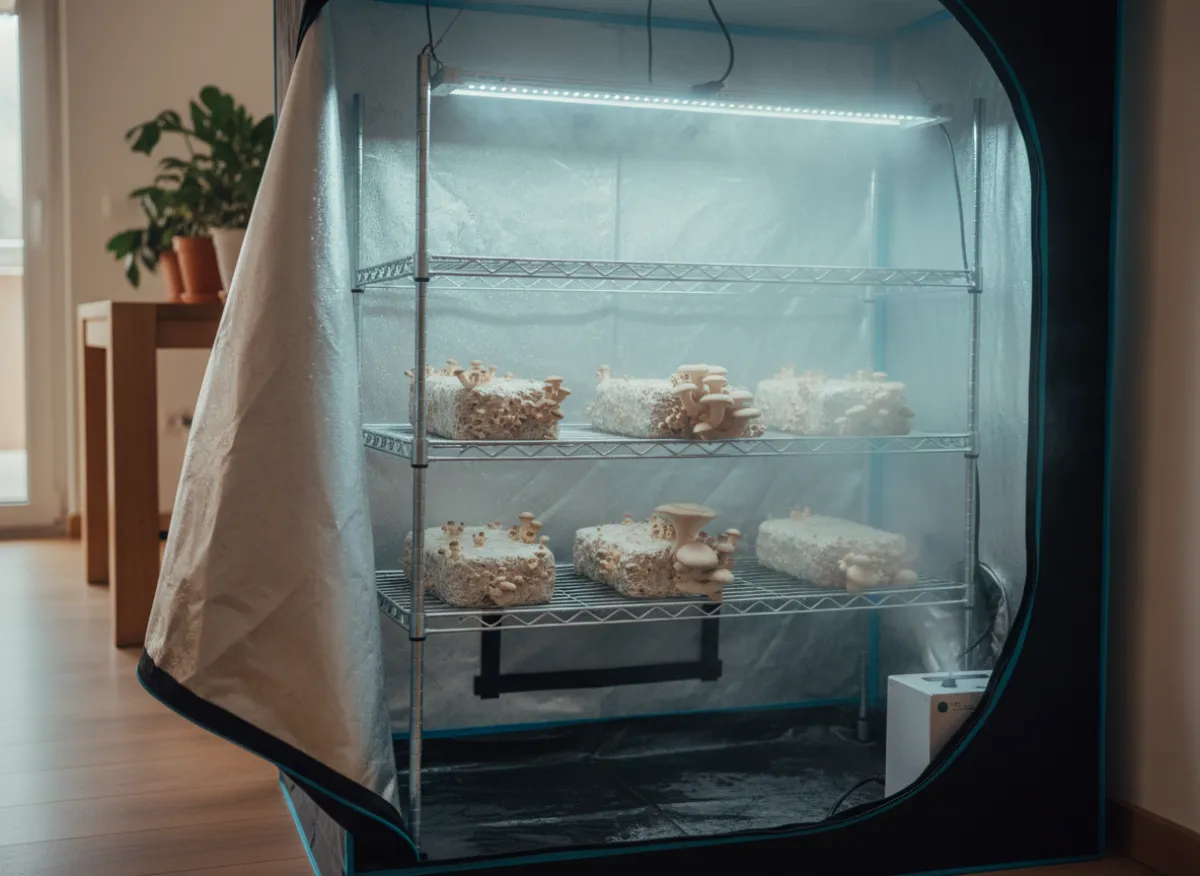
Whether you are using a closet, a spare room, or a dedicated grow space, size your room based on how many blocks or tubs you want to fruit simultaneously.
Small / hobby (1-10 blocks at a time):
- Space: Closet or Martha tent (2x2x5 ft / 60x60x150 cm)
- Shelving: 3-4 wire shelves
- Humidifier: Small ultrasonic (1-2L capacity)
- FAE: Passive holes + small PC fan (80mm) on timer, 4-6x/day for 5 min
- Lighting: 6500K LED strip, 12h on/off
Medium (10-50 blocks):
- Space: Spare room or walk-in closet (6x6x8 ft / 1.8x1.8x2.4 m)
- Shelving: Metro-style racks, 4-6 shelves each
- Humidifier: 5-8L ultrasonic or cool-mist
- FAE: Inline duct fan (4 inch) with HEPA filter on intake, timer-controlled
- Lighting: Fluorescent or LED shop lights
Large / commercial (50+ blocks):
- Space: Dedicated room 10x10 ft+ (3x3 m+)
- HVAC: Mini split for temp control
- Humidifier: Industrial humidifier or misting nozzle system
- FAE: Positive pressure with HEPA-filtered fresh air intake
- Monitoring: Humidity/temp/CO2 sensors with data logging
Key numbers to remember:
- Each 5 lb block needs roughly 30x30 cm (1 sq ft) of shelf space
- Target air exchange: 4-8 complete room volumes per hour during fruiting
- CO2 under 800 ppm for most gourmet species
- Humidity 85-95% during fruiting
Need more help? Dr. Myco can answer follow-up questions about quick reference based on thousands of real growing experiences.
Ask Dr. Myco